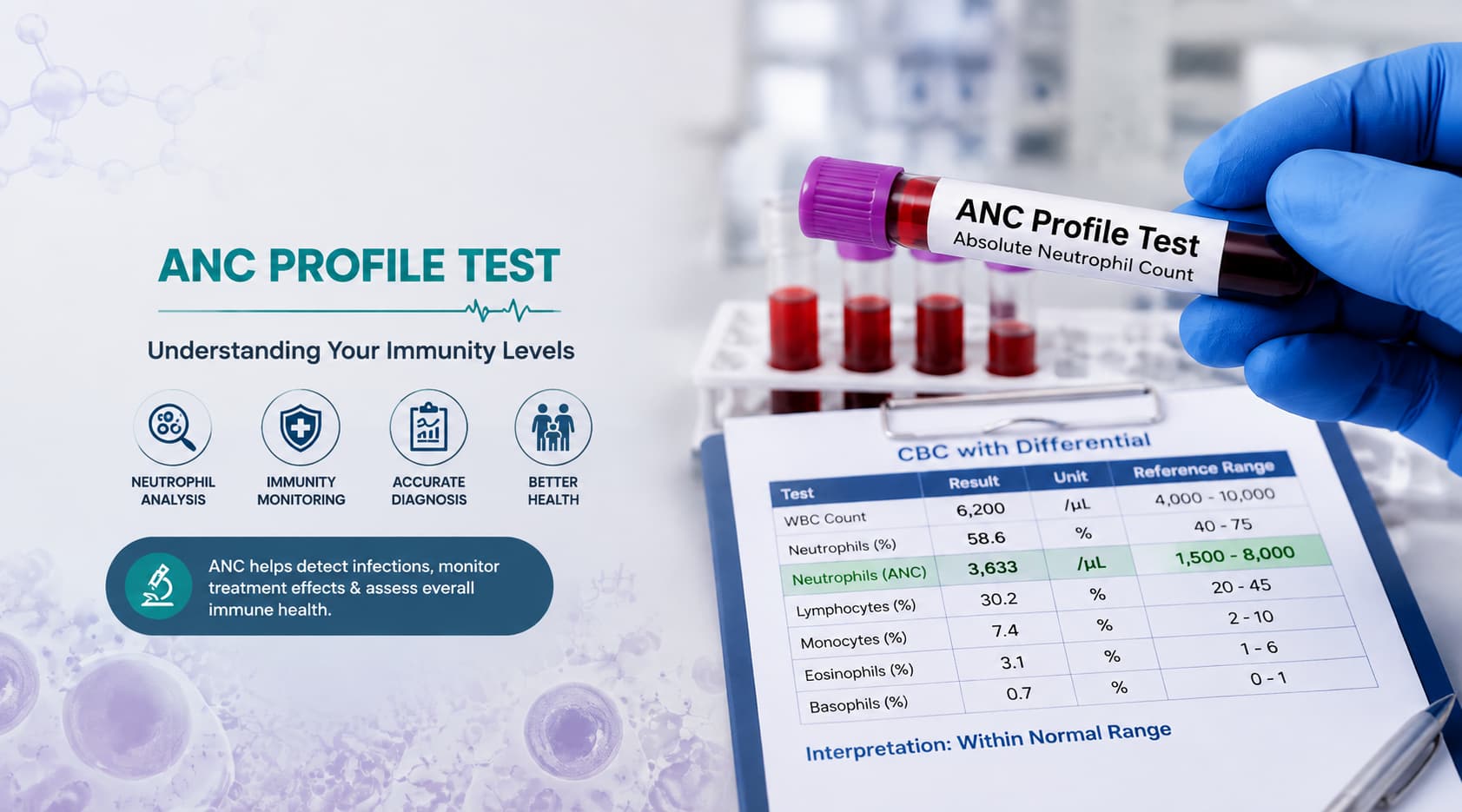
Welcome to our comprehensive guide on the Complete Blood Count (CBC) test! If you've ever wondered what those cryptic numbers on your lab report mean, you're in the right place. In this blog, we'll break down the CBC test, provide you with normal ranges for both males and females, explain the formulas used for calculating test parameters, and offer a simple interpretation guide. So, let's dive right in and demystify this important blood test.
What is a CBC Test?
The Complete Blood Count (CBC) test is a common blood test that measures the different components of your blood. It provides vital information about your overall health and can help diagnose a wide range of medical conditions. A CBC measures the following parameters:
- Red Blood Cells (RBCs): These carry oxygen throughout your body.
- White Blood Cells (WBCs): These are the infection-fighting cells.
- Hemoglobin (Hb): A protein in RBCs that carries oxygen.
- Hematocrit (Hct): The proportion of RBCs in your blood.
- Platelets: Tiny cell fragments that help with blood clotting.
- Mean Corpuscular Volume (MCV): The average size of your RBCs.
- Mean Corpuscular Hemoglobin (MCH): The average amount of hemoglobin in your RBCs.
- Mean Corpuscular Hemoglobin Concentration (MCHC): The concentration of hemoglobin in your RBCs.
- Red Cell Distribution Width (RDW): A measure of RBC size variation.
Now that you know what the CBC test measures, let's take a look at the normal ranges for males and females:
Normal Ranges for CBC Test
| Parameter | Male Range | Female Range |
|---|---|---|
| Red Blood Cells (RBCs) | 4.5 - 5.5 million/mm³ | 4.0 - 5.0 million/mm³ |
| White Blood Cells (WBCs) | 4,500 - 11,000/mm³ | 4,500 - 11,000/mm³ |
| Hemoglobin (Hb) | 13.8 - 17.2 g/dL | 12.1 - 15.1 g/dL |
| Hematocrit (Hct) | 38.3% - 48.6% | 35.5% - 44.9% |
| Platelets | 150,000 - 450,000/mm³ | 150,000 - 450,000/mm³ |
| Mean Corpuscular Volume (MCV) | 80 - 100 fL | 80 - 100 fL |
| Mean Corpuscular Hemoglobin (MCH) | 27 - 34 pg | 27 - 34 pg |
| Mean Corpuscular Hemoglobin Concentration (MCHC) | 32% - 36% | 32% - 36% |
| Red Cell Distribution Width (RDW) | 11.5% - 14.5% | 11.5% - 14.5% |
Formulas Used in CBC Test
Understanding the formulas used in CBC calculations can help demystify the results:
- Hematocrit (Hct) % = (Volume of RBCs / Total Blood Volume) x 100
- Mean Corpuscular Volume (MCV) = (Hct % / RBC count) x 10
- Mean Corpuscular Hemoglobin (MCH) = (Hb / RBC count) x 10
- Mean Corpuscular Hemoglobin Concentration (MCHC) = (Hb / Hct) x 100
- Red Cell Distribution Width (RDW-CV) = (Standard deviation of RBC volume / MCV) x 100
Also check HCG Levels in Ectopic Pregnancy
Interpretation for CBC
Understanding your CBC results is crucial for assessing your health. Here's a simplified guide:
RBC Count: High values may indicate dehydration or kidney disease, while low values could suggest anemia.
WBC Count: Elevated counts may signify infection or inflammation, while low counts can result from certain medications or bone marrow disorders.
Hemoglobin and Hematocrit: Low levels can indicate anemia, while high levels may point to dehydration or lung disease.
Platelet Count: High counts may suggest clotting disorders, while low counts may lead to bleeding problems.
MCV and MCH: Abnormal values can help identify types of anemia and nutritional deficiencies.
RDW: Elevated RDW may indicate a mix of small and large RBCs, suggesting various types of anemia.
CBC test sample report : Complete Blood Count Report Format | Free PDF Download
Learn How to Read a Pathology Report
Understanding your CBC test is easier when you know how laboratory reports are organized. Explore our pathology report format to learn how pathology reports are structured, what each section means, and how to interpret your test results with greater confidence.
Conclusion
A CBC test provides important information about your overall health by measuring key blood components like red blood cells, white blood cells, hemoglobin, and platelets. Understanding normal ranges and basic interpretations can help you read your lab report better, but abnormal results should always be discussed with a healthcare professional for proper diagnosis and guidance.
CBC (Complete Blood Count) Test: Understanding Blood Health with Normal Ranges
Get More from Your CBC Test Results
Understanding your CBC test is only the first step. Interpreting the values in the context of your overall health can help you make more informed decisions about your care.
With Flabs AI Smart Reports, you can access clearer, easier-to-understand explanations of your CBC test results, identify potential health patterns, and gain actionable insights to support discussions with your healthcare provider.
Explore AI Smart Reports to make your lab reports more meaningful and easier to understand.
Also Read: Kidney Function Test (KFT)
Get Started at ₹1!
Try Flabs for a full month for just ₹1.
Follow us on