A diagnostic lab needs capital before it runs a single test. Equipment, accreditation, and staff all demand money upfront. Most pathologists raise it through a bank loan or an investor. Both want the same thing first: a solid diagnostic lab business plan on paper. The opportunity is real and large.
India's diagnostic services market is valued at roughly USD 18-35 billion today. Forecasts see it crossing USD 37 billion by 2032 as it close to doubles. Demand is proven. Your task is to show that your lab can capture a share of it and repay every rupee you borrow.
What Goes Into a Diagnostic Lab Business Plan
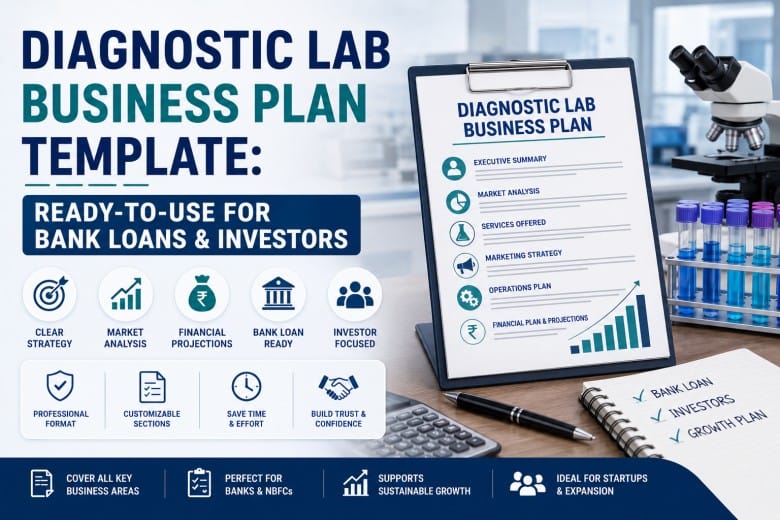
A diagnostic lab business plan is a structured document that proves your lab can earn revenue, control costs, and repay borrowed capital. Banks read it to measure risk. Investors read it to measure return. A strong diagnostic lab business plan answers both groups across the same pages.
Nine sections form the backbone.
- Executive summary stating the funding ask and the use of funds.
- Company description, ownership, and legal structure.
- Service menu, from routine tests to specialised panels.
- Market analysis and target referral base.
- Marketing and referral strategy.
- Operations, equipment, and technology.
- Management team and key roles.
- Financial projections across three to five years.
- Funding requirement and repayment schedule.
Skip any one of these and a reviewer notices the gap within minutes. The executive summary carries the most weight. A funder who likes the first page reads the rest with intent. A funder who stalls there rarely continues.
What Should a Diagnostic Lab Business Plan Include for Bank Approval?
A bank-ready diagnostic lab business plan should clearly explain five things: the business model, investment requirement, revenue potential, operational setup, and repayment strategy.
Before approving a loan, banks typically evaluate:
Business feasibility: What diagnostic services will the lab offer, and who are the target patients?
Investment requirement: How much capital is needed for equipment, infrastructure, licenses, and working capital?
Revenue projections: How many tests can the lab perform daily, expected pricing, and monthly revenue estimates.
Operational capability: Availability of pathologists, technicians, laboratory systems, quality controls, and compliance processes.
Loan repayment plan: Expected cash flow, break-even timeline, and ability to repay the borrowed amount.
A complete diagnostic lab business plan template should include these sections along with financial projections, market analysis, marketing strategy, and risk management. This structure helps entrepreneurs present a clear funding proposal to banks, investors, and healthcare partners.
The Financial Section Lenders Read First
Numbers carry your case. A lender opens your diagnostic lab business plan and turns straight to the financials. Show capital expenditure, running costs, and projected revenue in clean tables. Round figures look invented, so quote real vendor prices and real salary bands.
| Line item | Amount (₹) | Notes |
|---|---|---|
| Analyzers and equipment | 25,00,000 | Purchase or lease |
| Lab setup and interiors | 8,00,000 | One-time capital cost |
| Reagents and consumables | 6,00,000 | Recurring, scales with volume |
| Staff salaries | 12,00,000 | Pathologist, technicians, front desk |
| LIS and IT systems | 1,50,000 | Annual subscription |
| Projected revenue | 60,00,000 | At 70% capacity |
Pair the table with three assumptions: test volume per day, average realisation per test, and the capacity ramp over months.
A diagnostic lab business plan that names its assumptions earns more trust than one that buries them. Reviewers respect honesty about timelines more than they respect optimism. Lease options lower the upfront ask, so present both purchase and lease scenarios where equipment cost runs high. A lower entry cost widens the pool of lenders willing to say yes.
Sizing Your Market and Competition
Lenders fund demand, not hope. Map the catchment around your lab. Count the clinics, hospitals, and existing diagnostic centres within reach. List the referring physicians you already know.
Pathology labs in India compete on three fronts: turnaround time, accuracy, and price. Your plan should state where you win on each.
Pathology drives the bulk of the demand, holding close to 45% of the market. Radiology and other services account for the remaining percentage. That split favours a lab built on strong pathology operations. Demand across pathology labs in India keeps rising as chronic disease and preventive screening grow. A diagnostic lab business plan in India gains weight when it cites local catchment data rather than national averages. A bank in your city wants to see your street, not a press release.
Referral relationships drive volume in the early months. Name the physicians and clinics likely to send samples your way. A funder reads named partners as proof of traction, not as a wish list. Add a short note on pricing too. State your rate card against the nearest two competitors, and explain how you stay profitable at that price.
Operations and Technology
Investors tend to ask a quiet question: can the lab run without chaos? Your operations section answers it. Strong systems lower errors, speed up reporting, and protect margins. Downtime and rework scare funders, because both eat into the cash flow that repays a loan.
A modern lab information system anchors the answer. FLABS LIS, trusted by 2000+ NABL labs, automates the tasks that drain staff hours. Naming such a system inside a diagnostic lab business plan indicates operational maturity.
What funders like to see:
- AI-powered reporting with smart reports, AI flagging, and voice reporting.
- Real-time TAT tracking, automated QC, and barcode-based sample tracking.
- Automated invoicing, payment management, and referral commission tracking.
- Bulk registration, approvals, and report sharing over WhatsApp, SMS, and email.
Each feature maps to a cost saved or a delay removed. Reviewers also ask about data security and report integrity. Secure, QR-coded reports and audit trails answer that concern before it surfaces. That direct linkage strengthens the financial story your plan tells. Automation also frees a pathologist to focus on reporting accuracy instead of paperwork.
Turning the Plan Into Funding
A document earns money only when it speaks the reader's language. Tailor the same diagnostic lab business plan for two audiences with different priorities.
| Reviewer | Reads closely | Wants to see |
|---|---|---|
| Bank | Repayment capacity, collateral | Steady cash flow, DSCR above 1.5 |
| Investor | Growth, scalability | Market size, margin expansion |
Banks want safety. Investors want upside. Lead with the section each one values, and your diagnostic lab business plan converts faster. For a bank, open with the debt service coverage ratio and the repayment schedule. For an investor, open with the three-year growth curve. One core document, two front doors.
Mistakes That Sink an Application
Reviewers see the same errors on repeat. Avoid them and you stand apart from the pile.
- Revenue projections with no volume assumptions behind them.
- Capital costs listed without vendor quotes or names.
- A market section built on national figures, not local demand.
- No repayment schedule and no break-even point.
- Accreditation and compliance are treated as an afterthought.
Each error reads as inexperience. Fix every one before you submit. A funder forgives a modest forecast, but rarely forgives a careless one.
A Template You Can Adapt
Starting from a blank page wastes weeks. A diagnostic lab business plan template gives you the structure, the headings, and the financial tables ready to fill. Replace the sample figures with your own. Adjust the service menu to match your specialisation.
A reliable lab business plan template covers:
- Pre-built financial models with editable assumptions.
- Section prompts for market size and competition.
- Repayment and break-even calculators.
- Space for NABL accreditation and compliance notes.
Use the diagnostic lab business plan template as a frame, not a script. Your numbers and your local market make it credible. A polished template removes the formatting burden so you spend your energy on accuracy.
From Document to Decision
Funding rarely fails on the medicine. It fails on the plan. A clear, evidence-backed document moves a lender from doubt to a sanction letter, and an investor from interest to a cheque. Build the financials honestly. Show the operations. Name your market with real data. Do those three well, and the funding conversation grows shorter and the answer turns into a yes.
Also check- All Licenses & Registrations Required for a Diagnostic Lab in India
Get Started at ₹1!
Try Flabs for a full month for just ₹1.
Follow us on