When it comes to opening a diagnostic lab, standards, registration rules, and enforcement differ sharply from one state to the next. For anyone doing that, the state you choose shapes the licensing road ahead.
When opening a diagnostic lab in India, the real hurdle is the stack of approvals that decides if you can legally open. When you miss anything, you face fines or a shutdown notice in week one. Rules also change from state to state, which trips up even seasoned owners.
Diagnostic Lab License in India: The Full List of Requirements
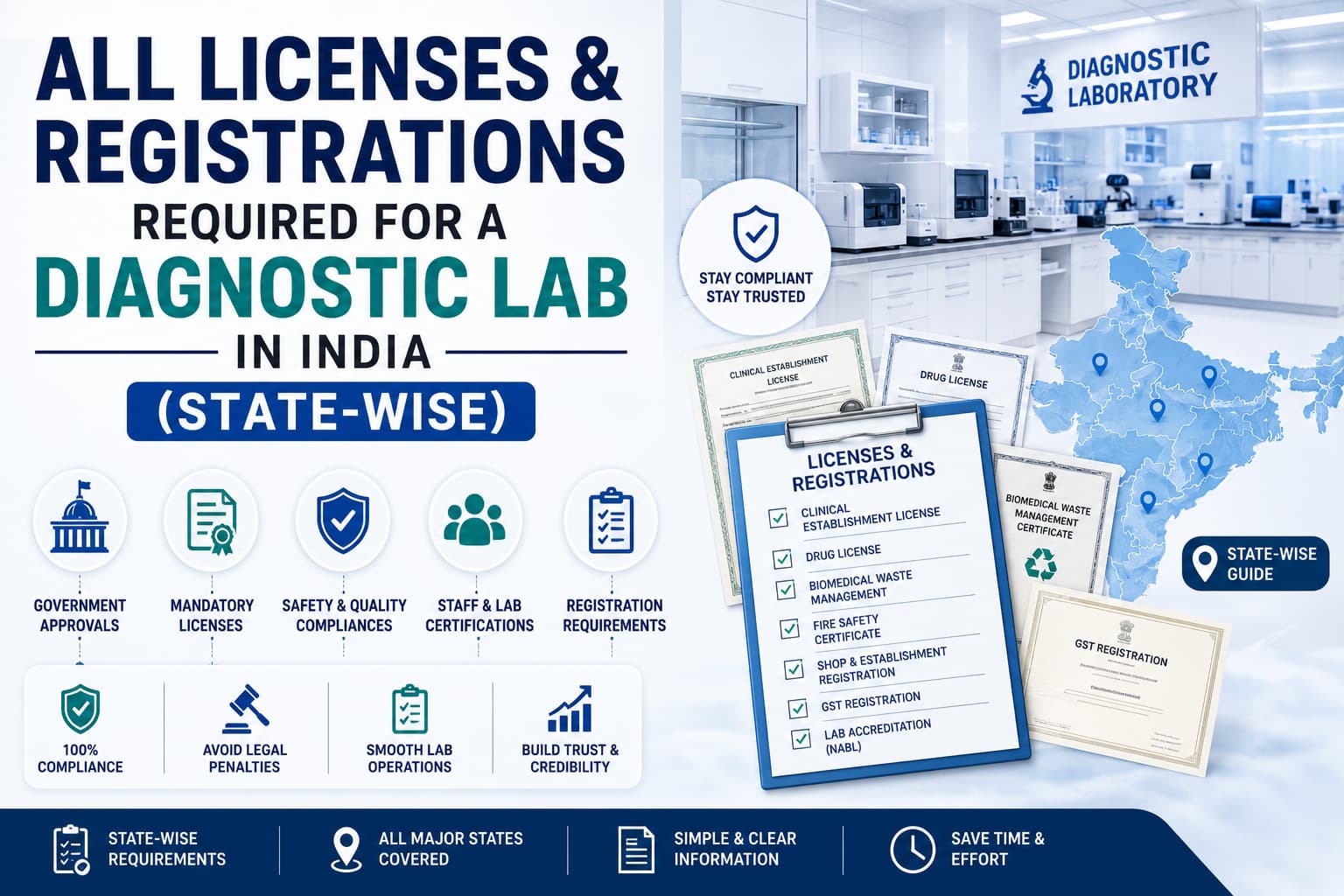
A diagnostic lab license in India is not a single document. It is a bundle of registrations from different authorities. Each one covers a separate area of compliance. Some apply to every lab in the country. Others depend on your state, your test menu, and the equipment you run.
| Registration/License | Issuing Authority | Applies To |
|---|---|---|
| Business Registration & Trade License | Local Municipal Body / Registrar of Companies | Every lab |
| Shops and Establishment Act Registration | State Labour Department | Every lab |
| GST Registration | GST Department (Central + State) | Labs above the turnover threshold |
| Clinical Establishment Act Registration | State Health Department | Most labs (state-dependent) |
| Biomedical Waste Management Authorisation | State Pollution Control Board | Every lab |
| Pollution Control Board Consent | State Pollution Control Board | Every lab |
| Fire Safety Certificate | State Fire Department | Labs above a size threshold |
| Drug Control License | State Drug Control Authority | Labs storing reagents and drugs |
| NABL/NABH Accreditation | Quality Council of India Bodies | Optional, recommended |
Pathology lab registration under the Clinical Establishment Act forms the spine of the whole set. The other approvals support it. Treat the registration certificate as the document that lets you open the doors, and the rest as the conditions attached to keeping them open.
At a Glance
- Total steps: 6.
- Timeline: 3-6 months.
- Estimated cost: ₹20,000 to ₹2 lakh for core licenses.
- Key authorities: State Health Department and State Pollution Control Board.
- Difficulty: Moderate, given the documentation, inspections, and ongoing compliance.
Why Does it Matter
Proper registration protects patients by enforcing minimum standards for equipment, staff, and reporting. It governs how you handle biomedical waste, which carries real public health weight. It also builds trust with referring doctors and patients who check credentials before they walk in. Down the line, clean licensing records smooth your route to NABL accreditation.
Skipping steps carries hard consequences.
- Monetary penalties that climb with each repeat offence
- Forced closure of the lab
- Legal action against owners and staff
Under the Clinical Establishment Act, running an unregistered facility can draw a fine up to ₹50,000 on a first offence. Repeat breaches push penalties far higher.
The Process: Step by Step
| Step | What It Covers | Estimated Cost | Time |
|---|---|---|---|
| 1. Business Registration | Entity setup, trade license, GST | ₹5,000–₹20,000 | 3–7 days |
| 2. Clinical Establishment/CEA Registration | State health department approval | ₹10,000–₹50,000 | 2–4 weeks |
| 3. Biomedical Waste Authorisation | Waste handling tie-up and consent | ₹5,000–₹25,000 | 1–3 weeks |
| 4. Staff Qualification Compliance | Qualified pathologist and technicians on record | Salary-linked | Ongoing |
| 5. Inspection & Approval | Site visit, fire and pollution clearance | ₹10,000–₹50,000 | 1–2 weeks |
| 6. NABL Accreditation (Optional) | Quality accreditation for credibility | ₹2–10 lakh | 3–6 months |
Business registration comes first. You pick a structure such as proprietorship, partnership, LLP, or private limited. You then file for a trade license and GST.
Clinical Establishment Act registration follows. State health authorities check your premises, staff records, and equipment against notified minimum standards.
Staff qualification is non-negotiable. Labs usually require a registered pathologist plus trained technicians. Inspectors verify their certificates during the site visit.
The final inspection bundles fire safety and Pollution Control Board consent. Clear it, and your registration certificate follows.
State-wise Differences
India runs no single, uniform diagnostic lab license in India that works identically everywhere. The central Clinical Establishments (Registration and Regulation) Act, 2010 set a national template. Health, though, is a state subject. Each state decides how to register and regulate labs.
Group 1 (States that follow the central Clinical Establishment Act): Arunachal Pradesh, Himachal Pradesh, Mizoram, Sikkim, Bihar, Jharkhand, Rajasthan, Uttar Pradesh, Uttarakhand, Assam, and most union territories apply the central Act. Labs in these regions register through the national clinical establishments portal under state rules.
Group 2 (States with their own laws): Several states run separate legislation that predates or replaces the central Act.
| State | Governing Law for Labs |
|---|---|
| Tamil Nadu | Tamil Nadu Private Clinical Establishments (Regulation) Act |
| Karnataka | Karnataka Private Medical Establishments Act |
| West Bengal | West Bengal Clinical Establishment Act, 2017 |
| Kerala | Kerala Clinical Establishments Act, 2018 |
| Andhra Pradesh / Telangana | AP Allopathic Private Medical Care Establishments Act |
| Maharashtra | Maharashtra/Bombay Nursing Homes Registration Act |
| Delhi | Delhi Nursing Homes Registration Act |
| Madhya Pradesh, Punjab, Odisha, Chhattisgarh | State-specific Clinical Establishment Acts |
In Delhi and Maharashtra, the older nursing-home laws do not clearly cover standalone diagnostic labs. Owners there should confirm the exact route with the state health department before they file.
Group 3 (States still firming up rules): A few states have neither fully adopted the central Act nor updated older laws for labs. Requirements there can change with little notice. Direct confirmation with local authorities saves trouble.
Adoption status keeps shifting as states amend their rules. Treat the groups above as a starting map, not a frozen record. Always verify your laboratory license in India requirements with your district registering authority before you commit money.
What a License in India Costs
Total spend depends on lab size and location. Core licensing for a small lab stays modest. Accreditation is the big variable that moves the number.
| Lab Type | Core Licensing Cost |
|---|---|
| Basic Lab | ₹20,000–₹50,000 |
| Mid-size Lab | ₹50,000–₹1 lakh |
| Advanced Lab | ₹1–₹2 lakh |
| NABL Accreditation (Add-on) | ₹2–10 lakh |
NABL accreditation stays optional, yet most growing labs pursue it. It signals tested quality to doctors, insurers, and corporate clients. A diagnostic lab license in India gets you running. Accreditation gets you preferred.
Build Solo or Join a Franchise
Some owners skip part of the setup grind by partnering with an established brand. Joining the best lab franchise in India can bundle branding, supply chains, and sometimes licensing support into one package. The trade-off is reduced independence and recurring fees.
Where Lab Software Fits In
Licensing gets you open. Staying compliant and audit-ready is the longer game, and software carries much of that load. Inspectors and NABL assessors look for clean records. They check sample tracking, turnaround times, quality control logs, and signed reports. Manual files struggle under that scrutiny.
Flabs LIS, trusted by 2000+ NABL labs, brings the operational side under one roof:
Real-time turnaround tracking and automated quality control for audit-ready records.
Barcode and QR-coded reports for the traceability inspectors expect.
AI-powered reporting, smart reports, and a built-in assistant for faster sign-off.
Automated invoicing, referral commission tracking, and bulk sharing over WhatsApp, SMS, and email.
Strong systems do not replace a diagnostic lab license in India. They keep you on the right side of the standards your license depends on, especially as you scale toward accreditation.
The Bottom Line
A diagnostic lab license in India is a layered set of approvals. The base layer applies almost everywhere. It covers business registration, Clinical Establishment Act registration, biomedical waste authorisation, and pollution and fire clearances.
The state layer decides the exact forms, fees, and authority you deal with. Map both before you sign a lease. Confirm your state's route, budget for accreditation early, and put systems in place that keep you audit-ready from day one.
Also check- Diagnostic Lab Setup Cost in India
Get Started at ₹1!
Try Flabs for a full month for just ₹1.
Follow us on