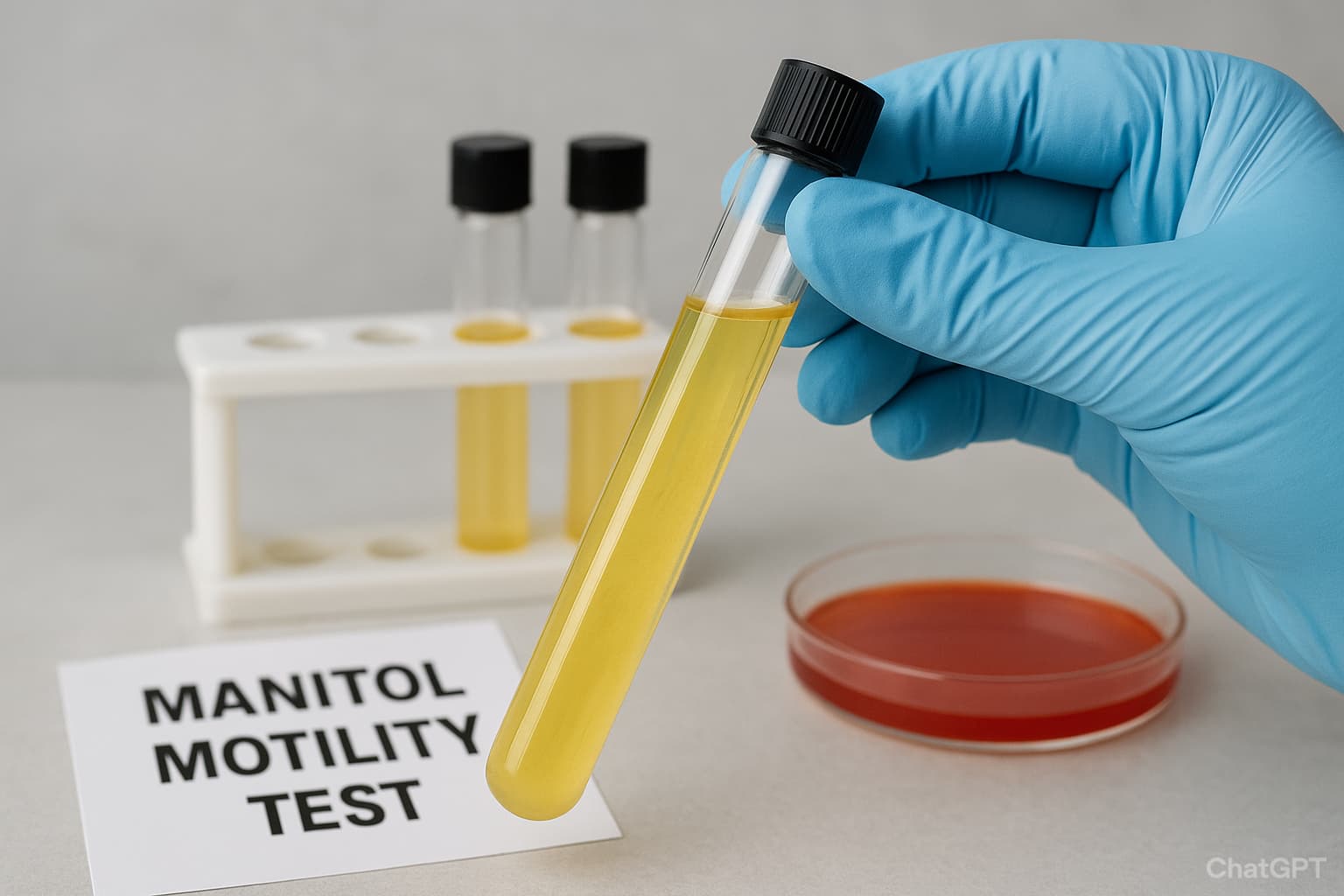
The mannitol motility test is a diagnostic laboratory method designed to evaluate two bacterial traits in a single medium: motility and carbohydrate fermentation. By combining these assessments, it offers pathologists and healthcare professionals a straightforward approach for differentiating organisms.
The medium is semisolid, enabling the detection of bacterial movement, while the inclusion of mannitol allows for observation of fermentation through visible pH changes. The procedure requires inoculation of the test organism into prepared tubes, followed by incubation under controlled conditions, after which both motility and sugar utilisation patterns are interpreted.
Mannitol Motility Test Medium Composition
The performance of the test depends heavily on the design of the medium. The mannitol motility test medium contains a carefully balanced composition that supports growth and enables accurate differentiation.
| Component | Concentration | Function |
|---|---|---|
| Peptic digest of animal tissue | 20 g/L | Provides nitrogenous compounds and growth factors for fastidious bacteria (Staphylococcus spp.) |
| Mannitol | 2 g/L | Fermentable carbohydrate for acid detection |
| Potassium Nitrate | 1 g/L | Additional growth enhancer |
| Phenol Red | 0.04 g/L | pH indicator (red → yellow under acidic conditions) |
| Agar | 3 g/L (0.3%) | Maintains semisolid consistency for motility detection |
| Final pH | 7.6 ± 0.2 at 25°C | Standardised for consistent performance |
The above formulation ensures that both motility and fermentation reactions can be observed without interference, providing reliable results in routine diagnostic work.
Preparing the Medium
- Suspend 26.04 g of dehydrated powder in 1000 mL purified or distilled water.
- Heat with frequent agitation until dissolved.
- Dispense into sterile tubes.
- Choose the right autoclave to sterilise at 121°C (15 psi) for 15 minutes.
- Cool the tubes in an upright position before inoculation.
Mannitol Motility Test Principle
The mannitol motility test principle relies on two distinct biological phenomena.
Motility Detection: The semisolid nature of the medium allows motile bacteria to move away from the stab line of inoculation. As a result, the medium becomes turbid, indicating bacterial spread. Non-motile organisms remain confined to the stab line, leaving the surrounding medium clear.
Mannitol Fermentation: Organisms capable of fermenting mannitol produce acidic by-products. The pH indicator phenol red detects this shift, changing the medium colour from red (alkaline) to yellow (acidic). Non-fermenters leave the colour unchanged or deepen the red hue.
The dual-function design enables efficient differentiation of organisms based on metabolic and structural traits in a single tube.
Mannitol Motility Test Interpretation
After incubation at 35–37°C for 18–48 hours, interpretation involves assessing both motility and carbohydrate fermentation.
Positive fermentation: Medium turns yellow, indicating acid production from mannitol.
Negative fermentation: Medium remains red, suggesting no carbohydrate breakdown.
Positive motility: Diffused growth away from the stab line, with visible turbidity in the medium.
Negative motility: Growth is restricted to the inoculation line, with the surrounding medium remaining clear.
Results must be interpreted with both reactions in mind, as they collectively guide differentiation of organisms with similar morphology but distinct physiological behaviour.
Mannitol Motility Test Positive Organisms
Escherichia Coli: Positive for both motility and mannitol fermentation.
Proteus Mirabilis and Proteus Vulgaris: Positive motility, negative fermentation.
Salmonella Typhi: Motile and capable of fermenting mannitol.
Shigella Sonnei: Ferments mannitol but shows no motility.
Staphylococcus Aureus: Mannitol fermenter without motility.
Staphylococcus Epidermidis: Negative for both motility and mannitol fermentation.
Practical Applications
For pathologists and healthcare professionals, the mannitol motility test is not only a differentiation tool but also a time-efficient diagnostic approach. Instead of performing separate motility and fermentation assays, the combined medium provides both sets of information simultaneously. This reduces workload, conserves resources, and shortens turnaround time for clinical decision-making.
Furthermore, its use extends beyond routine bacteriology into specialized testing for enteric pathogens, quality control in laboratories, and academic training for students in microbiology.
Storage and Stability
To maintain accuracy, storage conditions for the medium must be observed:
- Dehydrated medium: Store below 30°C in tightly sealed containers.
- Prepared medium: Refrigerate at 2–8°C and avoid prolonged exposure to light or temperature fluctuations.
- Shelf life: Use before the labelled expiration date to ensure test reliability.
Adherence to these storage guidelines preserves the physical integrity of the medium and ensures consistent test performance.
Conclusion
The mannitol motility test remains a dependable method for assessing two important bacterial characteristics in a single assay. By integrating motility observation with mannitol fermentation detection, it provides clear differentiation between pathogenic and non-pathogenic organisms, supports accurate microbial identification, and streamlines laboratory workflows. For pathologists and healthcare professionals, it continues to serve as an essential part of diagnostic bacteriology.
Related - Motility Test: Understanding Bacterial Movement in Labs
Get Started at ₹1!
Try Flabs for a full month for just ₹1.
Follow us on