Patients trust a lab report without ever seeing the bench work behind it. NABL accreditation backs that trust with proof. For a pathology lab, it confirms that your results stay reliable, reproducible, and defensible under scrutiny. Government schemes like CGHS, ECHS, and Ayushman Bharat now expect it.
Private networks ask for it before they route a single referral. NABL for pathology lab owners has shifted from a badge to a basic entry ticket. So the real question is not why, but how.
The NABL Accreditation Process
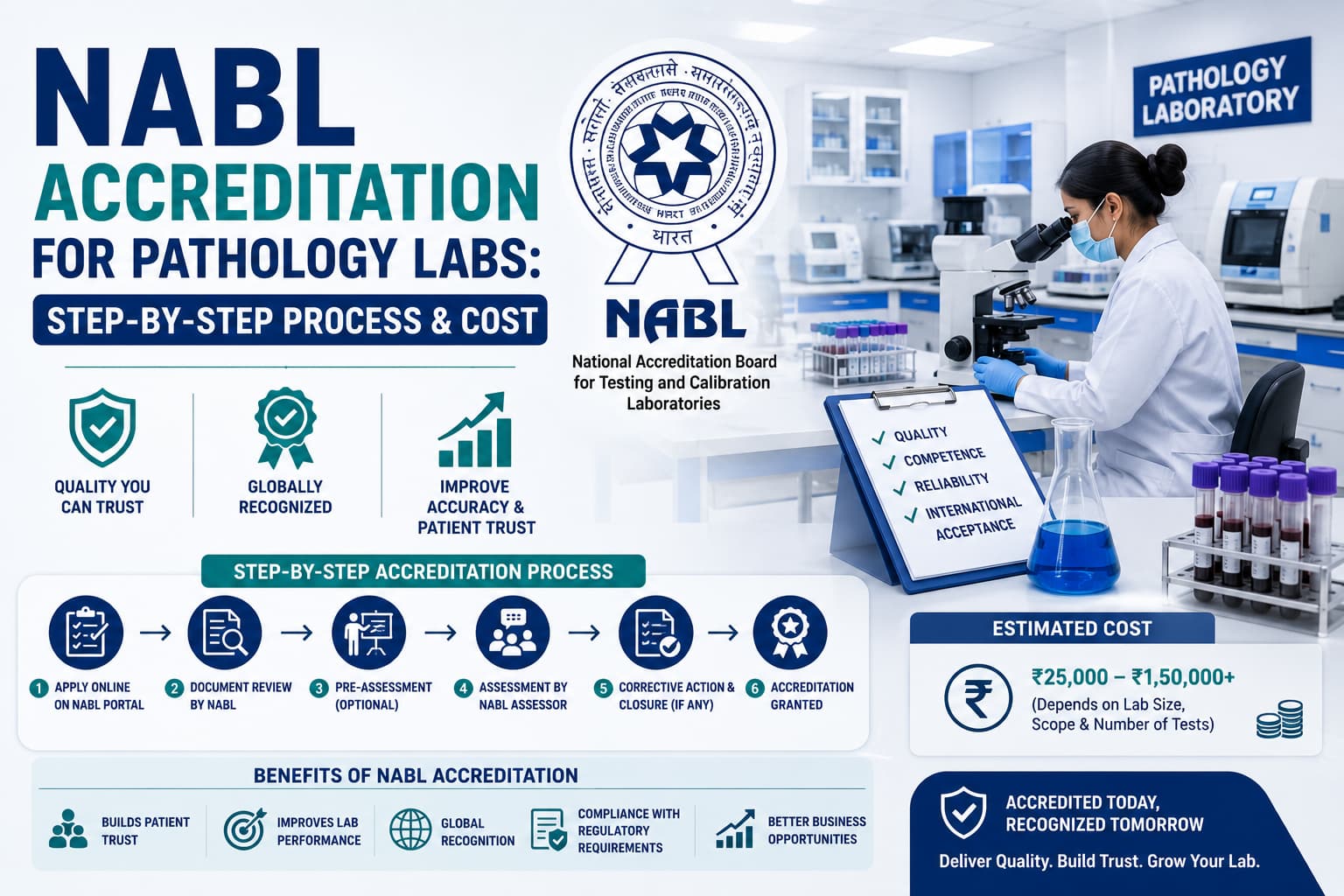
NABL accredits medical labs against ISO 15189:2022, the global standard for quality and competence. The NABL accreditation process examines one thing above all: can your lab stand behind every value it reports?
Assessors look past your analysers. They study your quality management system, staff competence, calibration records, and error controls. A certificate arrives only when your day-to-day practice matches your documented practice. Accreditation then runs for two years, with annual surveillance to confirm you have not drifted.
ISO 15189:2022 leans hard on risk-based thinking. You are expected to map where an error could harm a patient and show how you contain it. Across real assessments, three areas draw the most findings: examination procedures, personnel competence, and document control. Strengthen those three early and you remove most of the pain that follows.
How the NABL Accreditation Process Works
The NABL accreditation process moves through defined stages. Knowing each one upfront prevents the delays that catch most first-time applicants.
| Stage | What you do | Rough timeline |
|---|---|---|
| 1. Define scope | List the tests and disciplines you want accredited. | Week 1–2 |
| 2. Build the system | Write the quality manual and SOPs to ISO 15189:2022. | 1–2 months |
| 3. Implement and run | Run QC, internal audits, EQAS, and a management review. | 2–3 months |
| 4. Apply on the NABL portal | Submit the application and quality manual, pay the fee, and get a unique ID. | Week 1 |
| 5. Document review | NABL checks your system documents for adequacy. | 3–4 weeks |
| 6. Pre-assessment + assessment | Assessors visit, verify operations, and raise non-conformities. | 1–2 months |
| 7. Close non-conformities | Submit corrective actions with evidence, usually within 60 days. | 1–2 months |
| 8. Decision and certificate | The committee recommends approval, and NABL grants accreditation for two years. | 3–4 weeks |
Plan for six to eight months end to end. A pre-assessment is optional, yet it pays for itself. It surfaces weak spots before the real assessment, when fixes still cost you little. Labs that start with one department clear the visit faster than those who apply for everything at once.
Sequence matters as much as scope. Run your systems for a few months before you apply. Because assessors want evidence of real use, not a freshly printed manual.
Documents that Decide
Assessors do not accredit paperwork. They accredit the systems your paperwork describes. Still, your NABL documents for lab accreditation form the spine of the assessment.
- Quality manual aligned to ISO 15189:2022.
- SOPs for every examination, each with version control and approval signatures.
- Equipment calibration and maintenance logs.
- Staff competency and training files.
- Internal audit reports and management review minutes.
- IQC data with Levy-Jennings charts.
- EQAS and proficiency testing records.
- CAPA logs and risk assessments.
Every record needs an owner, a version number, and a retention period. Borrowed templates fail fast. An assessor spots a generic SOP within minutes. A document that contradicts your bench reality reads as a red flag and invites a deeper probe. Proficiency testing also carries weight here. You must clear at least one PT round within your scope before NABL grants accreditation, so enrol early.
Where the Money Goes
NABL accreditation cost splits into two layers. The first covers what you pay NABL directly. The second covers what you spend to get ready. The second usually dwarfs the first. Budgeting for the NABL accreditation process means planning for both from day one.
| NABL Fee Component | Indicative Amount (Medical Labs) |
|---|---|
| Application fee | ~₹5,500 for a small scope, increasing based on the size of the scope. |
| Accreditation / Annual fee | Starts at approximately ₹48,000, plus a per-test charge that scales with the scope. |
| Assessor charges | Charged per man-day, with travel, boarding, and lodging expenses borne by the laboratory. |
| GST | 18% applicable on NABL fees. |
Figures depend on your scope and the current NABL fee circular.
The readiness spend is where labs underestimate themselves. Calibration, EQAS subscriptions, staff training, an optional consultant, equipment upgrades, and a lab information system all add up. A consultant raises the bill, yet a strong one saves months for a large or first-time lab. Total outlay over a preparation cycle commonly runs into several lakhs. Spent well, the NABL accreditation process pays back. Accredited labs earn higher CGHS reimbursement rates, win more referrals, and waste less on repeat testing.
Maintaining Accreditation Status
The certificate marks a start. A NABL-approved lab runs QC daily, files EQAS results on schedule, and clears surveillance every year without scrambling. Slip on records and you risk a suspension that costs far more than the original effort. The NABL accreditation process does not end on the day your certificate prints.
Manual files and scattered spreadsheets are where audit readiness breaks down. A purpose-built system keeps records version-controlled, traceable, and ready for any surprise visit. Miss none of them and surveillance turns into a formality. Software shortens the NABL accreditation process by turning documentation from a quarterly fire drill into a quiet background routine.
The Takeaway
Treat the NABL accreditation process as a system upgrade. Define a tight scope, build real systems, document them honestly, and budget for both NABL fees and readiness costs. Labs that prepare that way complete the NABL accreditation process with fewer non-conformities and clear the assessment on the first attempt.
Also check - How to Apply for NABL Accreditation and NABL Accredited Labs in India
Get Started at ₹1!
Try Flabs for a full month for just ₹1.
Follow us on