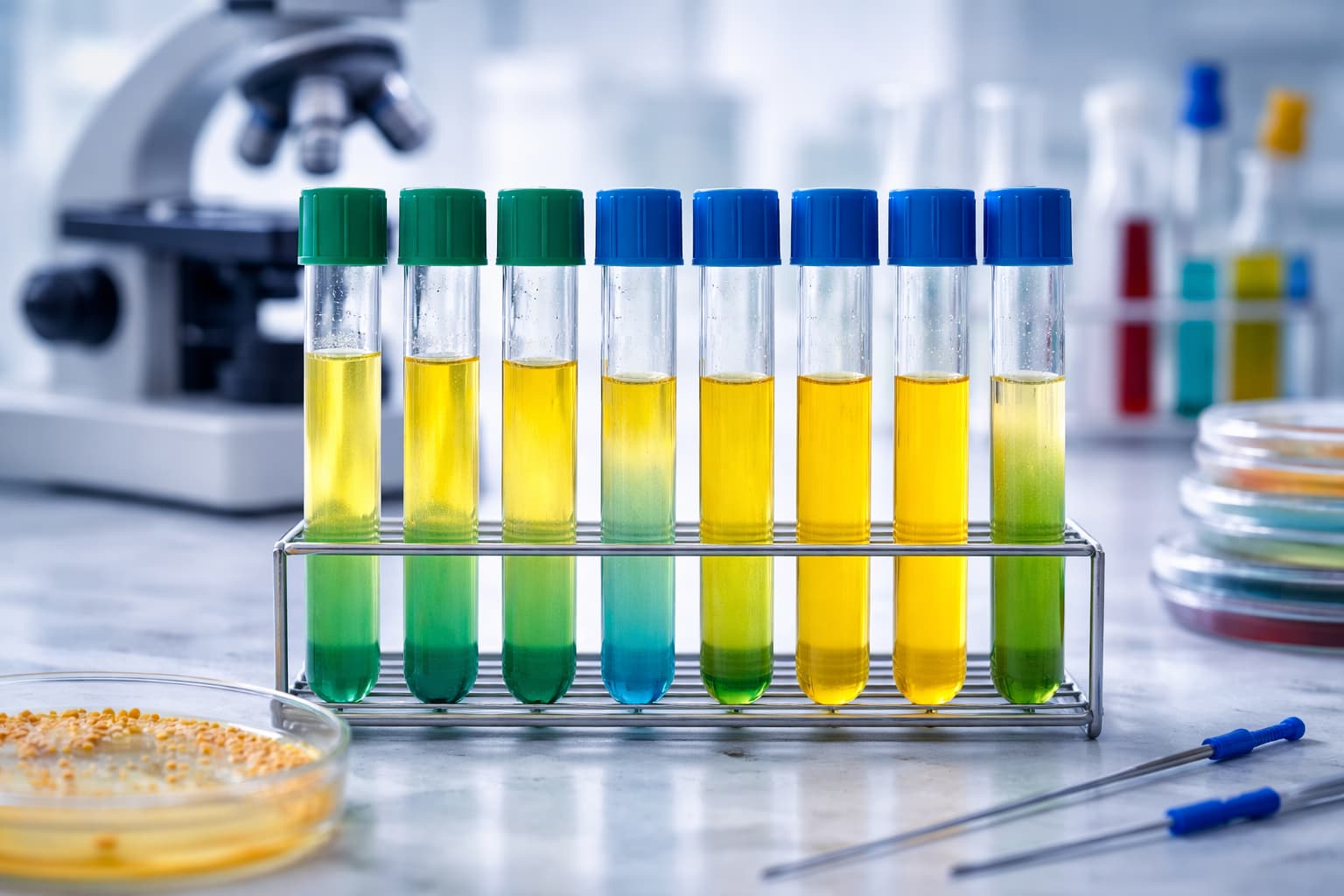
Accurate metabolic profiling separates routine microbiology from precision in diagnoses. Among aerobic gram-negative rods, how carbohydrate is utilised shapes identification and taxonomic placement.
The oxidation fermentation test addresses that gap. By distinguishing oxidative metabolism from fermentative acid production, it enables laboratories to gain metabolic clarity. The best part? It asks for no instrumentation.
The method traces back to Hugh and Leifson, whose formulation reshaped carbohydrate testing for non-enteric bacteria. For pathologists and laboratory professionals working with non-fastidious gram-negative isolates, the assay gives metabolic signals that align closely with organism physiology and laboratory workflow.
Oxidation Fermentation Test: Principle
Bacterial glucose metabolism takes two broad routes.
Fermentation (anaerobic): Glucose degradation generates mixed organic acids in substantial quantity, lowering pH throughout the medium.
Oxidation (aerobic): Glucose undergoes incomplete oxidation via respiratory methods, yielding smaller amounts of weak acids near oxygen-rich zones.
The oxidation fermentation test detects those metabolic differences by amplifying subtle pH shifts. The interpretation is decided through acid production rather than gas formation.
Composition of the OF Medium
| Component | Quantity (per liter) | Functional Role |
|---|---|---|
| Peptone (tryptone) | 2.0 g | Provides a minimal nitrogen source while limiting alkaline by-products |
| Sodium chloride | 5.0 g | Maintains osmotic balance |
| Glucose | 10.0 g | Primary carbohydrate substrate for metabolic differentiation |
| Bromothymol blue | 0.03 g | pH indicator for acid or alkaline reactions |
| Agar | 2–3.0 g | Produces a semi-solid consistency to restrict oxygen diffusion |
| Dipotassium phosphate | 0.30 g | Buffers the medium and stabilises pH |
| Final pH | 6.8–7.1 | Optimises indicator sensitivity and bacterial growth |
High glucose concentration improves acid formation. Reduced peptone limits alkaline by-products from protein metabolism. Dipotassium phosphate stabilises pH, preventing premature colour shifts.
Bromothymol blue serves as the indicator, shifting from green to yellow under acidic conditions and blue under alkaline conditions. Commercial OF medium frequently ships without carbohydrate, allowing substrate substitution.
OF Test Procedure
- Inoculate two tubes of OF medium by stabbing halfway to the bottom with a straight wire.
- Overlay one tube with sterile mineral or paraffin oil, establishing anaerobiosis.
- Leave the second tube exposed to air.
- Incubate at 35 °C for 24-48 hours.
Slow-growing organisms may require up to 5 days.
A heavy inoculum improves signal detection, particularly for oxidative organisms. Screw caps should remain loose to maintain oxygen diffusion in open tubes.
Interpretation
| Open Tube | Oil-Covered Tube | Interpretation |
|---|---|---|
| Yellow | Yellow | Fermentative |
| Yellow | Green | Oxidative |
| Green/Blue | Green | Nonsaccharolytic |
In oxidative reactions, yellow discolouration begins at the surface, which advances downward with prolonged incubation. Blue colouration signals alkaline drift from peptone utilisation rather than carbohydrate metabolism.
References to an oxidation fermentation test with a positive result appear in laboratory notes.
Quality Control and Reference
In the oxidation fermentation test, quality control is essential for proper interpretation. The following are the recommended reference strains.
- Escherichia coli– fermentative
- Pseudomonas aeruginosa– oxidative
- Alcaligenes faecalis– nonsaccharolytic
Routine QC confirms medium integrity, performance of the indicator, and incubation conditions before clinical isolates undergo analysis.
Relationship to Other Microbiology Tests
The OF test complements additional microbiology tests rather than replacing them. Differentiation between oxidative and fermentative metabolism narrows organism groups prior to enzyme-based assays.
The oxidase test principle, for instance, evaluates cytochrome c oxidase activity, while the OF test assesses carbohydrate catabolism. Used together, both assays refine the identification of aerobic gram-negative rods with overlapping morphology.
Variations and Extended Applications
Beyond glucose, laboratories may assess alternative carbohydrates, e.g., Maltose, Lactose, Mannitol, and Sucrose.
Testing non-glucose substrates uses a single open tube without an oil overlay. Acid production limited to the surface indicates oxidative metabolism. A dense inoculum is necessary.
The oxidative fermentation glucose test is prominent when differentiating non-fermenters in clinical isolates. Educational labs also reference the Bacillus subtilis oxidation fermentation test, where alkaline reactions dominate due to peptone metabolism.
Precautions and Limits
- Carbohydrate solutions require sterilisation before addition.
- Acidic mineral oil may yield false fermentative reactions.
- Fastidious organisms may show limited growth.
- Late fermenters demand extended incubation.
- Uninoculated controls verify baseline colour.
- Overtightened caps restrict oxygen diffusion.
Historical Context
Developed in 1953, the Hugh and Leifson test came about in response to limitations of conventional fermentation broths. Many aerobic gram-negative rods failed to ferment carbohydrates anaerobically, yet metabolised sugars via oxidative procedures. Traditional tests blurred those distinctions.
The oxidation-fermentation test enabled laboratories to classify organisms as oxidative, fermentative, or non-saccharolytic using a single carbohydrate substrate.
Closure
The oxidation-fermentation test is recommended in diagnostic microbiology due to clarity, low cost, and specificity. Despite advances in automated identification systems, laboratories continue to rely on OF patterns to classify aerobic gram-negative bacteria and validate algorithm-based outputs.
For pathologists and laboratory professionals, the assay delivers metabolic insight that aligns closely with organism physiology and practical bench workflows.
Also check -
Get Started at ₹1!
Try Flabs for a full month for just ₹1.
Follow us on