Rubella remains a silent threat to reproductive health, and confirming immunity before conception gives clinicians a chance to prevent severe congenital disorders.
Pathologists and healthcare professionals already track infectious disease markers daily, yet rubella screening demands even sharper attention because fetal outcomes hinge on early decisions.
As rubella cases re-emerge in pockets across regions, a structured approach to serological testing reclaims importance.
The Rubella IgG Test sits at the centre of that strategy, revealing clarity on exposure, vaccination response, and long-term immunity.
What the Rubella IgG Test Measures
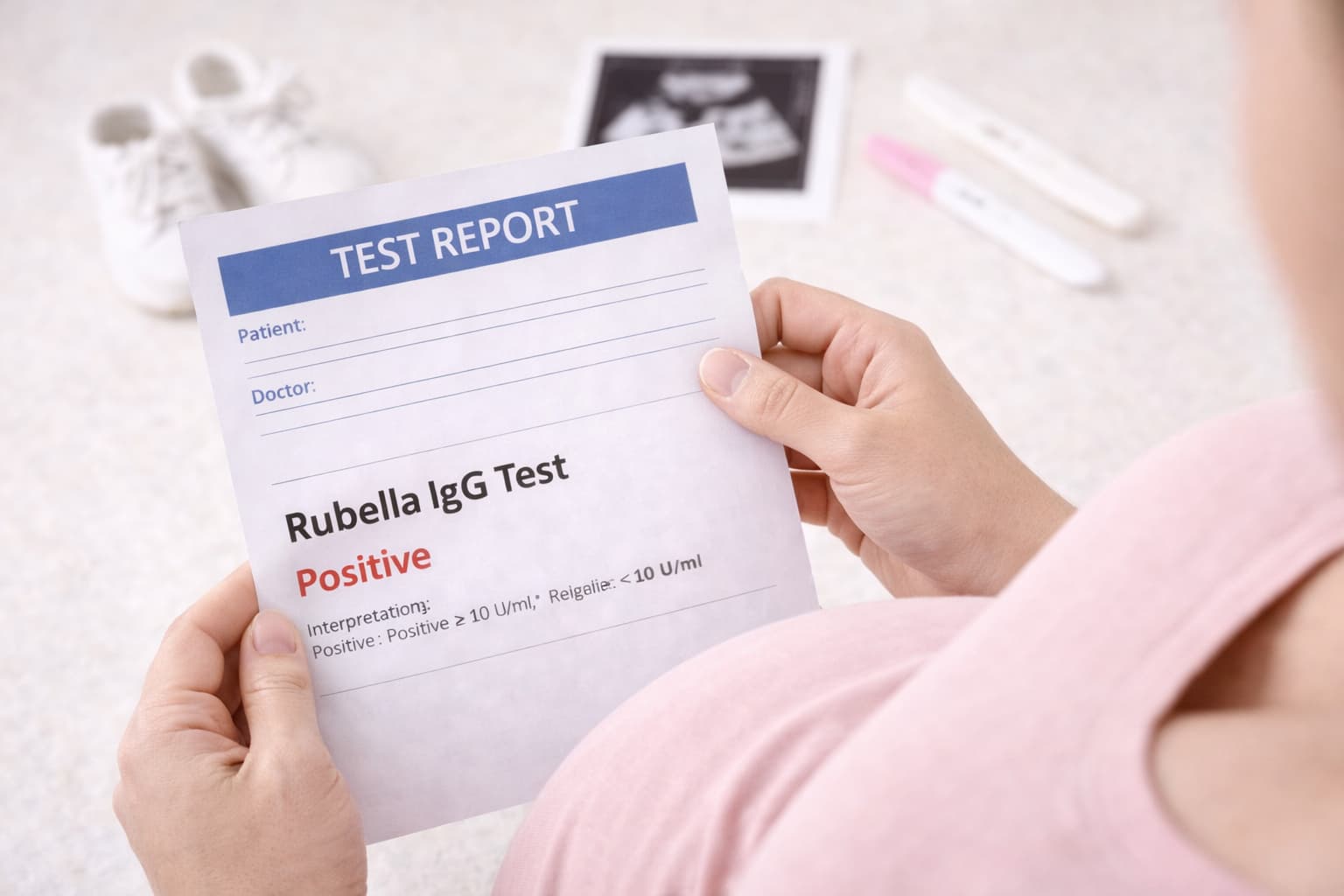
The rubella IgG test is a blood test designed to evaluate long-term antibody response after past infection or vaccination. The test is paired with IgM, which identifies recent or active infection. Both markers give pathologists a layered view of immune status, maternal risk, and potential congenital rubella syndrome implications.
A venous blood sample is sufficient for the test. For results, many pathology labs in India report a turnaround time of one to two days, depending on workload and equipment capacity.
Major immunoglobulin roles:
- IgG → Indicates previous infection or vaccination, thus signalling immunity.
- IgM → Indicates recent exposure and active viral response.
Because rubella antibodies behave predictably across infection stages, the combined assessment sharpens diagnostic accuracy.
Why it Matters Before Pregnancy
Rubella itself produces mild disease in many adults. Yet infection in early pregnancy increases the chance of miscarriage, fetal malformations, sensorineural deficits, or stillbirth. Even small lapses in preconception screening create gaps that expose expectant mothers.
A rubella immunity test validates whether a patient is adequately protected. For pathologists, it provides a foundation for advising clinicians on next steps, ranging from vaccination recommendations to further serological confirmation if IgM shows unexpected positivity.
Who Benefits Most From Testing
Demand for rubella serology usually rises in a few predictable scenarios.
- Women planning pregnancy or who are already pregnant.
- Newborns showing signs that resemble congenital infection.
- Individuals presenting with rash, fever, or lymphadenopathy similar to rubella.
- Persons exposed to confirmed cases.
- Healthcare workers and medical students require immunity documentation.
Pre-pregnancy status is particularly important because once conception occurs, rubella vaccination becomes contraindicated.
When Testing Should Be Initiated
Timing determines the diagnostic usefulness of IgG and IgM. Screening is standard for,
- Routine prenatal panels.
- Situations with suspected recent exposure.
- Community outbreaks where immunity verification becomes necessary.
- Decisions around preconception vaccination.
- Follow-up testing in borderline or discordant cases.
Pre-Test Considerations
The test requires no fasting. Patients simply need to disclose recent MMR vaccination, any current infection, all medications or supplements, particularly immunomodulators.
These details avoid unnecessary misinterpretation, especially because immune-modifying therapies occasionally distort antibody levels.
Interpreting IgG and IgM Values
Rubella serology is straightforward but demands attention when values drift near threshold zones.
Many clinicians ask about tiers such as rubella IgG more than 50, rubella IgG more than 100, or even rubella IgG more than 200.
These ranges usually reflect robust immunity. However, laboratories can differ slightly in calibration. The following table illustrates common interpretation parameters.
| Marker | Range | Interpretation | Notes |
|---|---|---|---|
| IgM | Positive | Recent or active infection | Confirmation may be required |
| IgM | Negative | No active infection | Retest if symptoms persist |
| IgG | ≥ 1.0 | Immune | Higher tiers like IgG >50 or >100 usually indicate strong immunity |
| IgG | 0.8–0.9 | Borderline | Repeat test recommended |
| IgG | ≤ 0.7 | Not immune | Vaccination is advised before pregnancy |
| IgM in newborns | Positive | Congenital or perinatal infection | Requires prompt evaluation |
*For newborn screening, positive IgM signals intrauterine infection rather than transfer of maternal antibodies.
Factors That Influence the Result
Rubella serology may shift for several reasons.
Unexpected IgM positivity can appear after recent vaccination. Testing very early after exposure sometimes underestimates IgG. Minor analytical interferences occur when cross-reactivity with unrelated viruses amplifies background noise.
High-quality pathology lab equipment reduces these issues. But timing and clinical correlation still matter.
The Role of Labs and LIS Platforms
As demand for rubella IgG in pregnancy screening grows, pathology labs in India face rising volumes of serological tests. Streamlining workflows becomes essential. Laboratories with manual or fragmented processes encounter delays that extend beyond simple turnaround time pressures; errors increase, staff bandwidth narrows, and patient communication suffers.
Modern LIS platforms lift that burden. This is where Flabs Pathology Software brings value for labs running high-frequency serology panels.
How Flabs Supports Rubella IgG and Other Serology Testing
Flabs uses an AI-enabled LIS architecture that introduces structure across pre-analytical, analytical, and post-analytical steps.
Operational Efficiency
Processes such as patient registration, automated analysis routing, and QR-coded reporting compress administrative workload. Integration with WhatsApp creates instant patient communication, reducing repeated calls for rubella blood test updates or follow-ups.
Patient-Centred Report Access
Patients log into a dedicated portal using their phone number to view results, including rubella IgG or IgM reports, without depending on reception desks.
Usability for Lab Teams
A streamlined interface reduces training requirements. Technicians and pathologists move through workflows without friction, which prevents reporting delays.
Scalability for Expanding Labs
Small labs, mid-sized centres, and networks with growing collection points can scale Flabs across sites.
Data Protection
Patient data remains tethered only to the authorised lab. Backups and disaster-recovery features maintain compliance with healthcare security standards.
Rubella Workflow Inside Flabs
Pathology departments can design a rubella testing pipeline within Flabs that tracks sample receipt, IgG and IgM processing stages, validation by the pathologist, and automated report dispatch. Setting predefined reference ranges removes manual input errors.
Such a structure shortens processing time and strengthens traceability for audit requirements.
Why Pathologists Gain from a Modern LIS
Laboratory leaders deal with rising expectations across accuracy, communication, and compliance. Serology, including rubella antibodies, requires meticulous data entry and reporting.
An LIS capable of consolidating these responsibilities empowers pathologists to direct more attention toward interpretation rather than administrative load.
A refined digital workflow supports:
- Lower error rates.
- Faster review cycles.
- Uniform reporting formats.
- Better resource planning.
These gains improve reliability for clinicians who rely on IgG values for preconception counselling.
Conclusion
Rubella immunity evaluation remains a core preventative measure in reproductive health. The rubella IgG test, combined with IgM, equips clinicians to safeguard pregnancies and assess immunity with confidence. As demand grows, pathology labs can strengthen reliability and efficiency through structured digital systems.
Flabs Pathology Software creates an integrated foundation for serology workflows, from registration to report delivery, with minimal operational friction. Advance your laboratory’s serology workflows with a system engineered for accuracy and operational clarity.
Start your 5-day free trial of Flabs Pathology Software or request a demo to explore how an AI-powered LIS enhances productivity, reporting speed, and patient experience.
Get Started at ₹1!
Try Flabs for a full month for just ₹1.
Follow us on