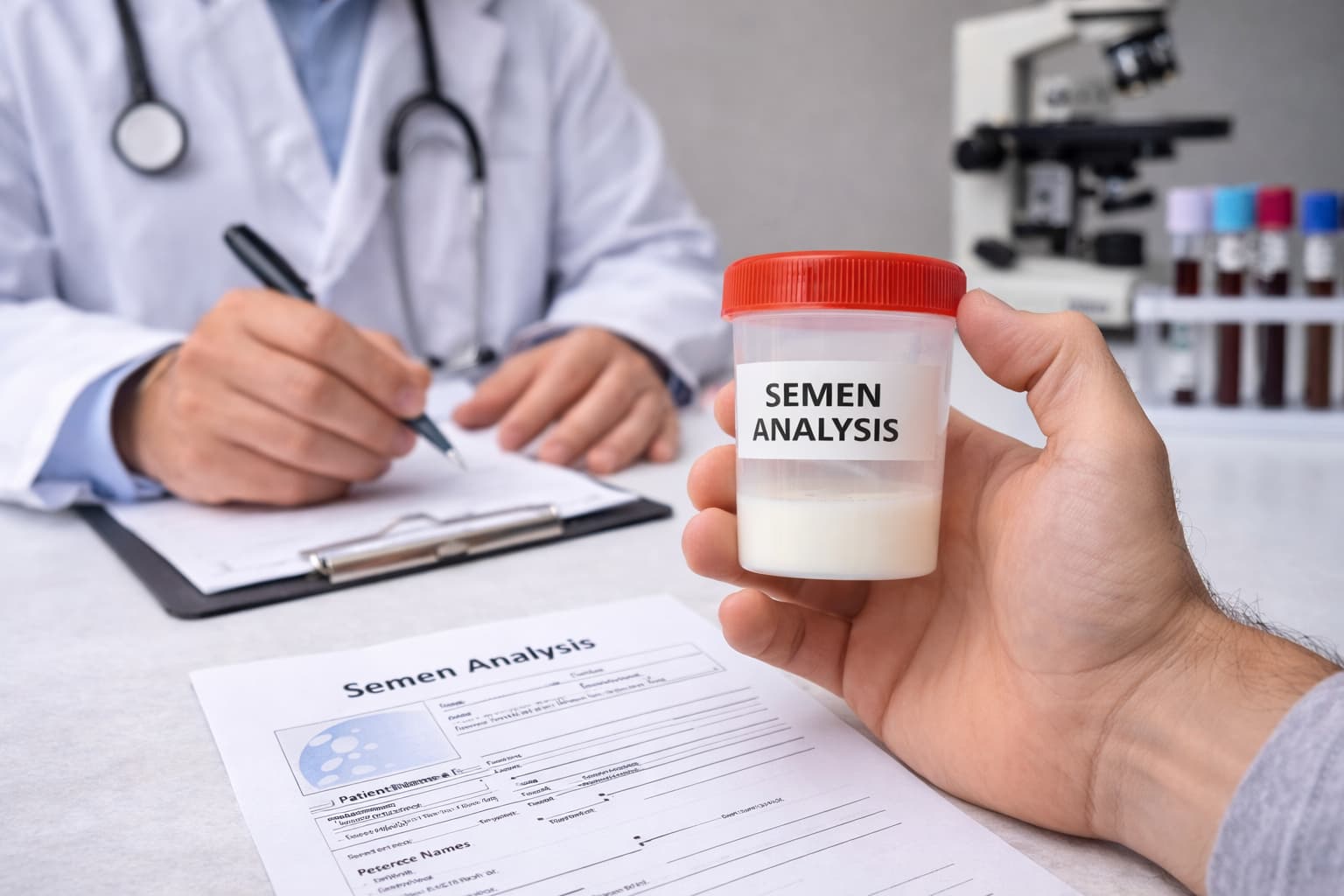
A semen analysis test gives you a detailed snapshot of male reproductive potential by assessing sperm count, motility, morphology, and the physical examination of semen. Pathologists and healthcare professionals rely on this test to initiate fertility evaluations, monitor treatment, or confirm post-vasectomy success.
Because patient expectations around fertility testing keep rising, you need reporting that stays accurate, fast, and easy to scale.
Below, you’ll find an exploration of semen analysis parameters, interpretation logic, and workflow considerations, paired with a look at how Flabs LIS streamlines every stage of the process.
Why a Semen Analysis Test
Male infertility affects a meaningful portion of the population. About 1 in 6-10 men face fertility challenges. Around 1 in 20 may produce no sperm at all (azoospermia).
Even then, nearly 70% can still achieve fatherhood with appropriate treatment.
You see these patients daily, so you know the first actionable step usually begins with semen analysis.
You request this test to evaluate:
- Total sperm concentration.
- Motility in sperm analysis, including progressive and active motile sperm count.
- Morphology in semen analysis.
- Semen quality indicators, e.g., pH in semen analysis, viscosity, liquefaction, and white blood cells.
- Post-vasectomy clearance
Because semen varies day to day, repeating the test twice gives a more stable picture of true fertility potential.
Test Preparation
Preparation for sperm analysis influences accuracy more than many patients realise.
- Abstinence for two to seven days.
- No lubricants, saliva, or spermicidal products.
- Masturbation into a sterile container.
- Delivery of the sample within thirty to sixty minutes.
- Use of a special non-lubricated condom when collection by intercourse is preferred.
Transport matters. You want the patient to keep the sample close to body temperature, such as inside a jacket pocket.
How the Sample Is Collected
The sperm test procedure revolves around controlled collection. Most samples come from masturbation into a sterile cup. If a patient struggles with discomfort or cultural barriers, you may allow partner-assisted stimulation.
When the collection occurs outside the lab, a rapid delivery within an hour at near-physiological temperature may be requested.
A semen culture test may be added if infection or pyospermia is suspected. It is relevant when an elevated pus cell in semen analysis appears.
Semen Analysis Parameters to Evaluate
A routine semen analysis report includes quantitative and qualitative parameters. A quick table below summarises the latest WHO criteria for sperm analysis and commonly referenced benchmarks.
WHO-Based Parameter Table
| Parameter | Reference Range | Notes |
|---|---|---|
| Volume | ≥ 2.0 ml | Low volume may indicate obstruction or incomplete collection |
| pH | ≥ 7.2 | Acidic samples may suggest ejaculatory duct obstruction |
| Total sperm concentration | ≥ 20 million/ml | Used for calculating the total motile sperm count |
| Total motility | ≥ 40% | Includes progressive and non-progressive motility |
| Progressive motility | ≥ 32% | Directly influences fertility outcomes |
| Morphology | ≥ 4% normal forms | Based on strict criteria |
| Liquefaction | ≤ 60 minutes | Delayed liquefaction impacts motility |
| Vitality | ≥ 58% | Assessed when motility is low |
| WBCs | < 1 million/ml | Higher levels suggest inflammation |
Motility, Morphology, and Additional Metrics
Motility in sperm analysis is one of the most requested data points. You assess sperm motility grade from rapid progressive movement to immotile sperm percentage. Some labs categorise sluggish motile normal range separately.
Morphology in semen analysis relies on strict criteria that evaluate head shape, midpiece, and tail defects. Even when morphology appears poor, conception is still achievable through ICSI or other ART procedures.
Total motile sperm count (TMC) often becomes the deciding metric for treatment. A TMC above twenty million is near-normal. A TMC above five million still gives enough scope for IUI or IVF. Severe oligospermia, defined as fewer than one million motile sperm, calls for advanced work-ups or surgical sperm retrieval.
Azoospermia, Asthenospermia, and Other Patterns
- Azoospermia: complete absence of sperm.
- Oligospermia: low sperm count.
- Asthenospermia: weak or low motility.
- Teratozoospermia: abnormal morphology.
- Pyospermia: raised white blood cell count.
Interpretation
Semen analysis results rarely give the entire story. A patient with borderline parameters can still achieve a pregnancy, while a patient with seemingly healthy semen analysis readings may struggle due to functional sperm deficits that are not seen under light microscopy.
Daily fluctuation also matters. Stress, fever, medication, alcohol, and even sampling errors influence outcomes. This is why two separate analyses spaced a few weeks apart generate a more reliable baseline.
Clinicians may also reference digital tools like a sperm analysis calculator to estimate TMC or compare parameters across repeated samples. Although calculations are simple, many labs now automate these steps.
Challenges in Semen Testing
You already manage sensitive patient expectations, tight reporting deadlines, and sample-quality constraints. On top of this, inefficient manual workflows slow down operations. Manual entry errors, fragmented communication, and delayed report sharing all reduce productivity.
That’s where intelligent lab tools become pivotal.
Using Flabs LIS Software to Streamline
Flabs Pathology Software introduces automation layers that create a smooth semen analysis test workflow in your lab.
Faster Operations
Flabs enables automated patient registration, structured test templates, and streamlined analysis inputs. You can configure semen analysis parameters, motility breakdowns, morphology reporting fields, and total sperm concentration calculators directly within your LIMS. Automated WhatsApp integration sends sample-ready alerts or report notifications without interrupting your routine.
Cleaner Reporting
With QR-coded reports, your patients and referring clinicians get instant, secure access. You deliver a semen analysis report with consistent formatting, reduced entry errors, and reliable data backup. The system manages everything from immotile sperm percentage fields to advanced entries like active motile sperm count and semen analysis rate.
Better Patient Experience
A dedicated patient portal lets individuals download their reports using a phone number login. That alleviates repeated front-desk inquiries and gives your lab a professional digital presence.
User-Friendly and Ready to Scale
Flabs stands out with an interface that avoids clutter and reduces training time. Small labs as well as large diagnostic chains can expand through additional collection centres inside the same platform.
Your data stays protected through industry-compliant security standards, encrypted storage, and disaster-recovery options.
Post-Test
Once results are available, you may recommend:
- Hormonal testing.
- Scrotal ultrasound.
- Genetic panels when azoospermia or severe oligospermia appears.
- Repeating the semen analysis test for confirmation.
- Treatments range from lifestyle changes to advanced reproductive technologies.
Even when parameters fall below the latest WHO criteria for sperm analysis, many treatment routes are open.
At-Home Semen Analysis
Some patients request a semen analysis test kit. While these kits have convenience, they rarely include morphology or detailed motility grading. They also cannot provide insights into pus cells in semen analysis or semen culture testing.
Final Thoughts
Semen analysis is foundational in male fertility evaluation. Yet, your workflow, reporting, and communication channels determine how quickly patients move toward treatment. Improving the operational side of your lab strengthens clinical output, and the right software greatly reduces friction.
If you ever wanted a cleaner, faster, more automated workflow for semen testing, Flabs LIS Software is built precisely for laboratories like yours.
Start Your Free Trial
Transform your semen analysis workflow with AI-powered automation.
Start Your 5-Day Free Trial of Flabs Pathology Software.
Just enter your name, email, and lab details to get a demo and explore streamlined reporting, secure patient portals, and simplified operations.
Your data stays safe, encrypted, and exclusively linked to your lab.
Get Started at ₹1!
Try Flabs for a full month for just ₹1.
Follow us on