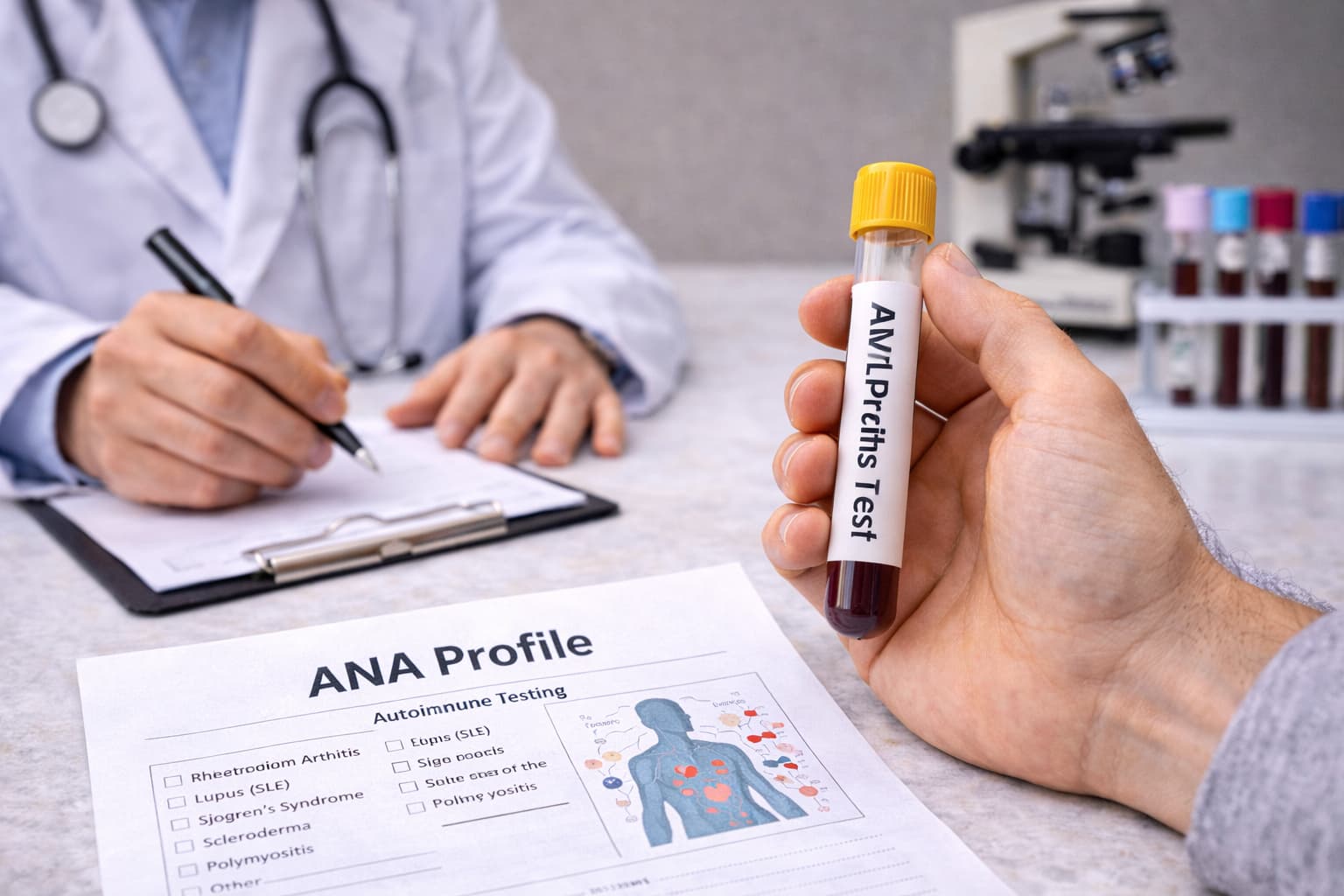
The ANA profile test belongs to the autoimmune department in pathology. Healthcare professionals rely on it to pick up antibody patterns that point toward conditions such as lupus, Sjögren’s disease, scleroderma, autoimmune thyroid disease, autoimmune hepatitis, dermatomyositis, and many others.
While a standard ANA screening flags the presence of antinuclear antibodies, the broader profile goes further and reveals antibody subsets with strong clinical associations.
Autoantibodies can show up in healthy individuals too, although at low levels. That nuance makes interpretation an acquired skill.
Hence, what follows is a detailed review tailored for specialists who want a fresh, practitioner-focused take on the ANA profile blood test. We shall also discuss how pathology labs can improve testing speed and accuracy through Flabs LIS.
What is the ANA Profile Test
Antinuclear antibodies target cell nuclei by mistake. When they appear alongside symptoms such as fatigue, unexplained fever, or musculoskeletal issues, the immune system’s activity moves into diagnostic territory. A single ANA result rarely tells the full story.
The ANA profile test illuminates specific antibodies, including dsDNA, SS-A, SS-B, Scl-70, Mi-2, Jo-1, AMA-M2, PM-Scl, and U1-nRNP / Sm, among others.
Each one holds its own importance. Hence, the panel is more like a map of immune dysfunction.
Why ANA Profile Test is Done
Patients reach rheumatology and pathology centres with a wide spectrum of symptoms. Some appear vague at first glance; others signal clear autoimmune pathways.
The ANA profile lab test is ordered when signs lean toward systemic inflammation.
- Fluctuating fever
- Prolonged fatigue
- Joint swelling or stiffness
- Diffuse muscle pain
- Skin rashes or pigment changes
- Numbness or tingling
- Recurrent gland swelling
- Abdominal discomfort
- Hair thinning
- Kidney-related abnormalities
- Clotting irregularities
However, no single symptom prompts the panel automatically. The decision tends to build over serial visits when patterns persist.
How is it Conducted?
The ANA profile test procedure is a standard venipuncture. A blood sample is collected from a peripheral vein.
- No fasting is required. Inform your physician about all the medications you’re taking.
There is no procedural risk. Occasional bruising or brief discomfort at the puncture site may occur; nothing more.
ANA, ANA Profile, and How They Differ
A recurring source of diagnostic confusion involves the difference between the ANA test and ANA profile panels.
| Test Type | Measures | Use Case | Output |
|---|---|---|---|
| Standard ANA Test | Presence of antinuclear antibodies | First-line screening | Titer and fluorescence pattern |
| ANA Profile Test | Multiple specific autoantibodies | Disease differentiation and planning next steps | Detailed panel listing antibody subsets |
The ANA profile test report gives pathologists a more granular view. Instead of a single titer like 1:160 or 1:320, labs receive a structured panel with multiple antibody markers. That structure guides further imaging, organ-specific screening, or referrals.
Interpreting ANA Profile Test Parameters
| Titer Range | Meaning | Notes |
|---|---|---|
| Negative ANA | No measurable antinuclear antibodies detected. | Autoimmune conditions become less likely, although not ruled out entirely. Symptom-driven follow-up may still be required. |
| Borderline ANA (1:40–1:80) | Low-level antibody presence. | It may appear in individuals without disease. Can accompany nonspecific symptoms such as intermittent fatigue, mild joint pain, or thyroid irregularities. |
| Positive ANA (≥1:160) | Higher probability of autoimmune activity. | Requires correlation with history, examination findings, and extended markers from the ANA profile panel. Temporary positivity may arise due to infections, medications, or ageing. |
Around 15% of healthy individuals show positive ANA results without an underlying autoimmune disorder, creating another layer of complexity.
Medical Conditions Associated with the Test
| Condition | ANA Profile Markers | Notes |
|---|---|---|
| Lupus (SLE) | ANA positivity in more than 95% of cases; dsDNA | dsDNA significantly boosts suspicion and may correlate with disease activity. |
| Rheumatoid Arthritis | ANA may appear alongside RF or anti-CCP | ANA presence is not diagnostic but can accompany systemic features. |
| Sjögren’s Syndrome | SS-A and SS-B | These antibodies dominate the profile and support diagnosis when combined with dryness symptoms. |
| Scleroderma | Scl-70 or centromere antibodies | Antibody type often indicates disease subtype, influencing monitoring strategy. |
| Primary Biliary Cholangitis | AMA-M2 | Strong specificity; aligns with cholestatic liver abnormalities. |
| Inflammatory Myopathies | Mi-2 or Jo-1 | Marker choice varies with phenotype, aiding distinction between myositis subgroups. |
ANA Profile Test Normal Range and Result Reporting
Although ranges vary across pathology labs in India, the most accepted interpretation aligns as follows.
- Normal ANA titer: values below 1:80
- Borderline zone: 1:40 to 1:80
- Abnormal/positive: 1:160 or greater
Profile antibodies are usually reported qualitatively as positive or negative. Some labs quantify dsDNA or other markers to improve longitudinal tracking.
Transparent formatting inside the ANA profile test report reduces misreads between clinicians, especially in multi-speciality settings.
Turnaround Time
The turnaround time of the ANA profile test tends to range from 24-72 hours. Smaller centres that batch samples might extend this window, while fully automated labs shorten it significantly.
Operational pressure rises when reporting delays accumulate. That is where modern LIS (Laboratory Information Systems) platforms create meaningful gains.
While many labs explore upgrades in pathology lab equipment, remember that software optimisation also drives large performance shifts.
Follow-Up
Once the ANA profile flags concerns, clinicians proceed through focused steps. These may involve dsDNA quantification, ENA panels, rheumatoid factor, complement levels, imaging, or physical assessment. Many rheumatologists prefer longitudinal monitoring before committing to long-term immunotherapy.
No immediate treatment is warranted on the basis of a single positive ANA result. Continued observation and symptom documentation create a more reliable clinical narrative.
Integrating Flabs LIS Into ANA Profile Testing
Streamlined ANA workflows rely on more than analysers. Reporting, record organisation, patient communication, and quality control all influence lab throughput.
Flabs Pathology Software aligns neatly with autoimmune testing procedures by reducing manual handoffs and automating repetitive tasks.
- Smooth patient registration.
- Automated analysis routing and structured ANA panel formatting.
- QR-coded report delivery for rapid clinician access.
- WhatsApp integration for automatic communication of test completion.
- A patient portal so individuals can retrieve reports using their phone number without assistance.
The interface stays clean and direct, which shortens training periods for technicians. As labs expand into satellite collection centres, Flabs scales without creating new data fragmentation issues.
Security features support confidentiality with compliant data-handling protocols, secure backups, and safeguarded patient linkage.
Pathologists looking to reduce reporting friction around the ANA profile test will notice immediate workflow clarity with structured templates and automated formatting inside the LIS environment.
The Path Forward
Autoimmune diagnostics keep evolving. The ANA profile test includes panels that grow more precise year by year. Pathology labs that refine operational systems stand to interpret these advancements with greater clarity and speed. Choosing the right LIS platform elevates both technician workflow and clinician engagement.
For pathologists who want stronger reporting efficiency and lower administrative strain, Flabs LIS provides a practical upgrade.
Ready to streamline ANA profile reporting?
Begin your 5-day free trial or request a demo and explore how Flabs supports modern diagnostic centres aiming for faster, more accurate autoimmune testing tools.
Also read - eGFR Test: Evaluating Kidney Function Accurately
Get Started at ₹1!
Try Flabs for a full month for just ₹1.
Follow us on