BERA Test is a hearing assessment test, usually conducted on infants, to evaluate any hearing issues. However, it can also be conducted on adults to determine any hearing-related neurological problems. BERA test interpretation goes a long way in determining the health issue that might interfere with your hearing ability. But it's simpler said than done because the BERA test for hearing is a sensitive procedure that can be affected by even the minutest causes like patient movement.
Interpreting them in the right context requires careful attention to the patient's health history and test procedure. In this post, we will discuss the implications of BERA test interpretation and what it involves.
What is the BERA Test?
The BERA (Brain Evoked Response Audiometry) test is a diagnostic tool for assessing an individual's hearing ability by evaluating the brainstem's electrical response to sound stimuli. The test is also known as Auditory Brainstem Response. It's an objective test for determining how the electrical waves emanating from the 8th cranial nerve respond to clicking noises sent from outside the ear.
It is more commonly used to test infants for their hearing ability. Children with Brain tumours and multiple sclerosis might require a BERA test for hearing. BERA test interpretation reveals issues related to hearing, auditory nerve disorders, and neurological issues that can interfere with hearing. BERA audiometry is also used to determine the hearing threshold of a healthy individual.
BERA Test Procedure
The BERA test for hearing requires proof of your government ID and a valid doctor's prescription. A trained lab technician will conduct the test procedure, which requires different precautions for babies and elders.
Preparation
- Avoid caffeine and sedatives on the day of the test.
- Get a good night's sleep before the test, as drowsiness can affect BERA test interpretation.
- Wash your hair and scalp thoroughly, but don't use any hair products, as these can interfere with electrode placement.
- Remove any metallic objects like jewellery or hearing aids.
- Wear comfortable clothing that doesn't produce static electricity.
- If you bring a child for the test, bring familiar toys or objects to keep them calm.
- Inform the audiologist about ongoing medications or your health conditions to help them give a holistic BERA test interpretation.
- Try to schedule the BERA test for babies during their usual nap time, as they can remain still.
Process
- Patients will lie comfortably, and electrodes will be attached to the scalp and earlobes. Earphones or ear inserts are placed.
- The test environment is kept quiet, possibly in a soundproof room. There will be dimmed lights to encourage relaxation.
- Sound stimulation is initiated by clicking sounds or tone bursts played through earphones. Separate testing is done for each ear.
- The brain's response to sounds is recorded via electrodes. Multiple sound stimuli were given for accurate BERA test interpretation.
- During the examination, the patient should remain still and relaxed. The best way is to sleep, especially for infants.
- Depending on patient cooperation, the BERA test usually takes 30-90 minutes.
Post-Examination
The technician will guide you if further care is required after the test. If you have any concerns, you should meet your referring physician.
BERA Test Interpretation
In BERA audiometry, the brainstem produces audio-evoked signals recorded as waves with peaks and troughs. Seven waves are recorded and labelled as Wave I, Wave II, Wave III, and so on. They indicate an individual's positive potential for hearing ability.
The BERA test checks for hearing sensitivity in the 1000-4000 Hz range. A BERA test regular report contains seven waves (Wave I-VII) produced in the first 10ms.
As the results are out, your audiologist or hearing specialist will look to assess how your hearing nerves respond to sound. They will analyse the computer printout of these responses (the BERA graph) and interpret the markers. These markers typically align with the softest or loudest sound the child can hear at different frequencies of pitches.
Otherwise, underlying hearing conditions may be diagnosed and discussed with people concerned about the patient.
BERA Test Graph
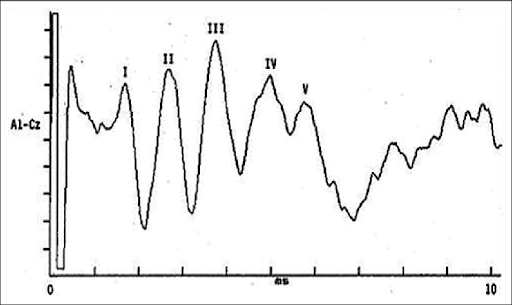
The image shows a Brainstem Evoked Response Audiometry (BERA) test graph. Here's an interpretation based on standard wave patterns:
The BERA graph shows distinct peaks labelled I through V, representing different neural relay stations in the auditory pathway.
- Wave I: Represents the auditory nerve.
- Wave II: Cochlear nucleus.
- Wave III: Superior olivary complex.
- Wave IV: Lateral lemniscus.
- Wave V: Inferior colliculus (most significant in clinical assessments).
Points to Remember
- Examine the shape, amplitude, and latency of waves I-V. Average waveforms should be identifiable.
- Measure the time from stimulus onset to each wave peak. Compared to normative data, considering age and gender.
- Assess the time between wave peaks in BERA test interpretation, especially I-III, III-V, and I-V intervals. These reflect neural transmission times
- Compare amplitudes of different waves, like the V/I ratio. This can indicate issues in specific auditory pathways.
- Compare results between ears. Significant asymmetry may suggest unilateral pathology.
- Conductive hearing loss typically affects early waves, while later waves are more affected in retro-cochlear pathologies.
- Identify the lowest stimulus intensity that produces a reliable wave V response.
- Evaluate how wave V latency changes with decreasing stimulus intensity.
Check all Pathology Tests Interpretation
BERA Test Side Effects
Practically, the BERA test has no side effects as it is noninvasive. However, there can be risks associated with it that vary from person to person.
- Discomfort or pain from electrodes placed on the scalp.
- Minor skin irritation or redness in places where electrodes are attached.
- Risk of false positives or false negatives in BERA test interpretation.
- Risk of electric shock in extreme cases.
- The conductive gel used in the test can be allergic.
Conclusion
Audiologists should consider integrating findings with other diagnostic tools and the patient's clinical history to maximise the value of BERA test interpretation. Regular calibration of equipment, ongoing training in interpretation techniques, and staying updated on the latest research can further improve the utility of BERA assessments in clinical practice.
Suggested - ECG Test Interpretation
Get Started at ₹1!
Try Flabs for a full month for just ₹1.
Follow us on