Accurate disease diagnosis depends on direct evaluation of tissue samples. Biopsies remain the definitive procedure for detecting malignancies, inflammatory disorders, and various tissue abnormalities. Pathologists rely on precise sampling techniques to interpret histological changes and cellular patterns.
Each method serves a defined diagnostic purpose, guided by the organ involved and the suspected pathology. From bone marrow evaluation to targeted skin sampling, biopsy methods continue to refine diagnostic accuracy and patient care.
Biopsy Types in Diagnostic Medicine
“Biopsy types” refer to the range of methods used to extract cells or tissues for microscopic evaluation. These procedures differ by access route, sampling depth, and intended diagnostic yield. Selecting the right method depends on lesion location, patient stability, and clinical question. Below is a structured overview of common biopsy types and their diagnostic contexts.
1. Bone Marrow Aspiration and Biopsy
Purpose: To examine hematopoietic activity and marrow architecture in conditions like leukaemia, lymphoma, and aplastic anaemia.
Technique: A needle biopsy is performed on the posterior iliac crest. Aspiration removes liquid marrow, while the trephine biopsy retrieves a cylindrical core of bone and marrow for histopathology. Both are complementary—the aspiration provides cytological detail, and the core biopsy preserves structural features.
Subtypes:
- Types of bone marrow biopsy: Aspiration and trephine biopsy.
- Needle selection: Reusable or disposable Jamshidi or Klima needles, depending on institution preference.
2. Cardiac Biopsy
Purpose: To assess myocardial tissue for inflammation, rejection, or infiltrative disease. Common after heart transplantation.
Technique: A bioptome is advanced via the jugular or femoral vein into the right ventricle. Small tissue fragments are excised for light and electron microscopy. The cardiac biopsy requires fluoroscopic or echocardiographic guidance due to procedural sensitivity.
3. Core Biopsy
Purpose: To obtain cylindrical tissue samples from deep-seated lesions in organs like the liver, kidney, breast, and prostate.
Technique: A spring-loaded biopsy gun or Tru-Cut needle extracts cores under ultrasound or CT guidance. Compared with fine-needle aspiration biopsy, core biopsy yields more tissue for histological grading.
Variants:
- Liver biopsy needle types: Menghini and Tru-Cut designs.
- Biopsy needle types: Side-cutting and aspiration needles, depending on target density.
4. Endometrial Biopsy
Purpose: To assess hormonal response or exclude malignancy in abnormal uterine bleeding.
Technique: A small curette or Pipelle device collects endometrial tissue trans-cervically. The sample indicates proliferative, secretory, or hyperplastic patterns. Endometrial biopsy remains essential before hormonal therapy or hysterectomy.
5. Endoscopic Biopsy
Purpose: To visualise and sample mucosal lesions throughout the gastrointestinal or respiratory tract.
Technique: Flexible endoscopes carry forceps or brushes that retrieve small tissue fragments under direct vision. Gastric, colon, bronchial, and duodenal biopsies are common examples. These specimens enable the diagnosis of inflammatory, infectious, or neoplastic disease.
6. Excisional and Incisional Biopsy
Purpose: To remove part or all of a lesion for diagnosis and therapeutic planning.
Technique:
- Excisional biopsy removes the entire lesion with margins.
- Incisional biopsy removes a representative section.
- Used frequently in breast, lymph node, or skin lesions where architecture influences diagnosis. Each type provides ample tissue for immunohistochemistry and molecular tests.
7. Fine-Needle Aspiration Biopsy (FNAB)
Purpose: To examine cellular morphology from palpable or image-detected lesions such as thyroid nodules, lymph nodes, and breast lumps.
Technique: A thin (22–25 gauge) needle attached to a syringe extracts cellular material with suction. Smears or liquid-based preparations are stained for cytological review. FNAB minimises complications while maintaining diagnostic reliability.
Distinguishing Feature:
Unlike core biopsy, FNAB lacks tissue architecture but offers faster results and reduced invasiveness.
8. Lymph Node Biopsy
Purpose: To diagnose lymphoproliferative disorders, metastases, and infectious etiologies.
Technique:
- Needle biopsy or core biopsy for deep nodes.
- Excisional biopsy for superficial nodes when lymphoma is suspected.
- Tissue processing includes immunophenotyping and molecular assays for clonality and translocation studies.
9. Needle Biopsy
Purpose: To collect tissue using hollow needles of varying calibres.
Technique: Performed under ultrasound, CT, or stereotactic guidance. Needle biopsy encompasses several subtypes, including fine-needle aspiration and core techniques. Choice of needle diameter and tip design determines tissue integrity and diagnostic yield.
Common Applications:
Lung biopsy types: Transthoracic needle and transbronchial approaches.
Liver and renal biopsies for parenchymal disease assessment.
10. Open Biopsy
Purpose: To obtain larger or complex samples when percutaneous access is insufficient.
Technique: A surgical incision exposes the target lesion. Performed under general anaesthesia, often in bone, muscle, or thoracic cases where closed techniques are non-diagnostic. Enables simultaneous resection or reconstruction if required.
11. Punch Biopsy
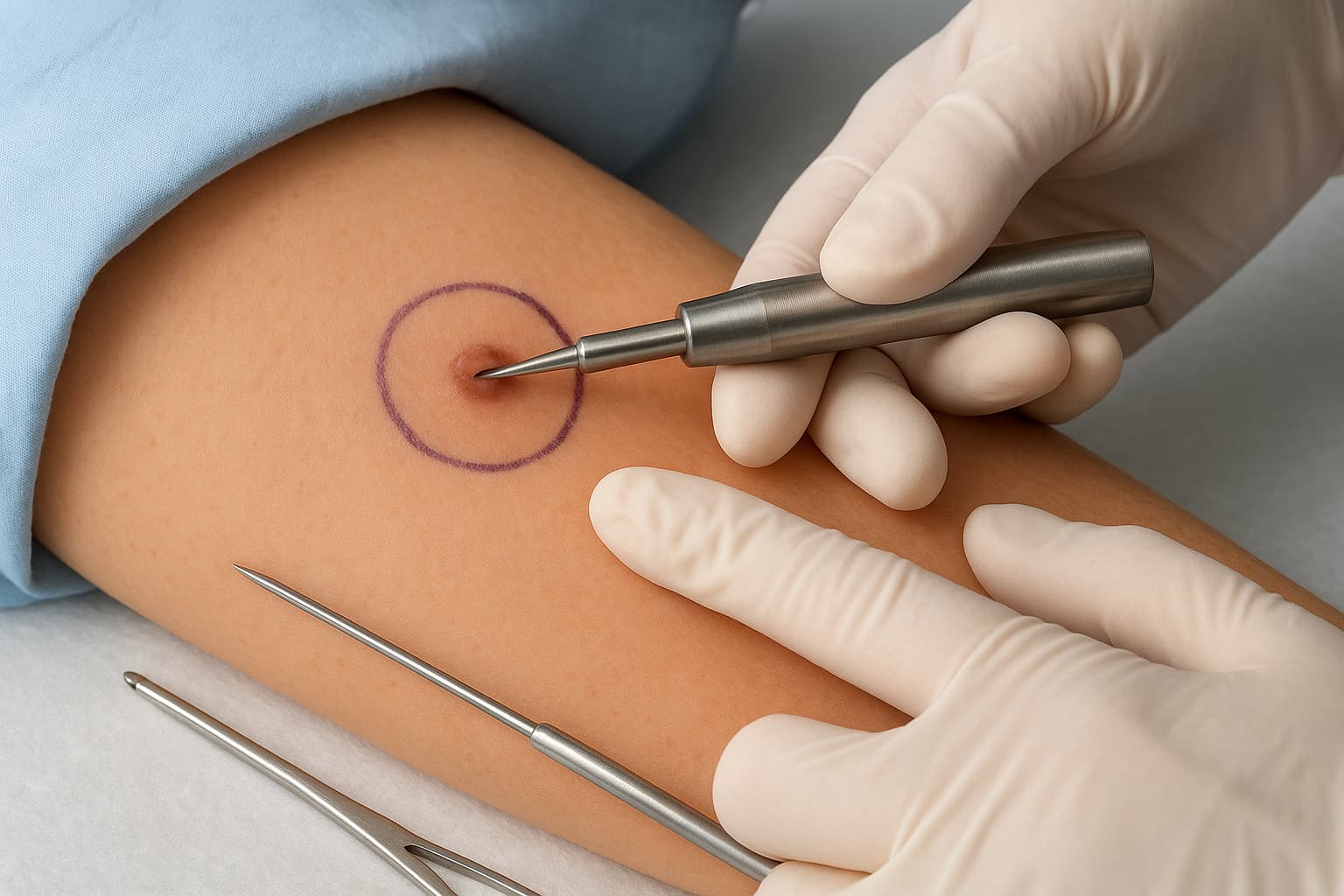
Purpose: To sample full-thickness skin lesions.
Technique:
- A circular blade (2–8 mm) removes a cylindrical plug, including epidermis, dermis, and superficial subcutis. Punch biopsies aid in diagnosing inflammatory dermatoses and cutaneous malignancies.
- Relation to Other Methods: Classified under the type of skin biopsy, along with shave and excisional procedures.
12. Sentinel Lymph Node Biopsy
Purpose: To identify the initial lymph node draining a primary tumour site.
Technique: A radioactive tracer or dye maps lymphatic drainage. The sentinel node is excised for histopathologic and molecular assessment. Widely used in breast carcinoma and melanoma to avoid unnecessary lymphadenectomies.
13. Shave Biopsy
Purpose: To remove raised epidermal lesions confined to the superficial dermis.
Technique: A surgical blade or razor shaves across the lesion base. Minimal scarring and ease of performance make it appropriate for seborrheic keratosis, papillomas, and nonpigmented nevi. It belongs to the type of skin biopsy classification.
14. Skin Biopsy
Purpose: To diagnose dermatoses, infections, and neoplastic conditions.
Technique: Performed by punch, shave, or excision depending on lesion morphology. Specimens undergo routine hematoxylin-eosin staining and immunohistochemical workup.
Variants:
| Type of Skin Biopsy | Sampling Depth | Diagnostic Application |
|---|---|---|
| Shave Biopsy | Epidermis and upper dermis | Benign epidermal growths |
| Punch Biopsy | Full thickness | Inflammatory and autoimmune dermatoses |
| Excisional Biopsy | Complete lesion with margin | Suspected melanoma or neoplasm |
Biopsy Procedure: Standard Steps
While biopsy techniques vary, procedural integrity remains consistent across methods.
- Preparation: Review imaging, coagulation profile, and consent.
- Anaesthesia: Local or general, based on site and depth.
- Sampling: Use of an appropriate instrument– needle, punch, or scalpel.
- Fixation: Immediate preservation in formalin or specialised media.
- Processing: Embedding, sectioning, staining, and microscopic evaluation.
- Reporting: Integration of histological findings with clinical and radiologic data.
Proper documentation of biopsy needle types, sample adequacy, and procedural notes improves diagnostic reproducibility.
Biopsy Uses and Types Across Organs
The application of biopsy extends across multiple organ systems. Below is an overview of the connection between use and procedural type.
| Organ/System | Common Biopsy Type | Diagnostic Focus |
|---|---|---|
| Bone Marrow | Aspiration and Trephine | Hematologic disorders |
| Heart | Endomyocardial Biopsy | Transplant rejection, myocarditis |
| Liver | Core or Needle | Hepatitis, fibrosis, malignancy |
| Lung | Transthoracic Needle, Transbronchial | Tumour, infection, interstitial disease |
| Endometrium | Pipelle Sampling | Hormonal status, carcinoma |
| Skin | Shave, Punch, Excisional | Dermatoses, melanoma |
| Lymph Node | Excisional | Lymphoma, metastasis |
Ongoing studies on types of lung biopsy continue to evaluate diagnostic yield and complication rates for transbronchial versus transthoracic methods.
Biopsy Definition and Types: Conceptual Summary
A biopsy represents the extraction of living tissue for microscopic examination. The defining parameters include access route, sample size, and diagnostic scope. Fine-needle, core, and excisional procedures exemplify the type of biopsies most relevant to daily pathology.
Selection depends on balancing diagnostic adequacy with procedural safety. In hematologic, dermatologic, or organ-based pathology, biopsy selection determines interpretation accuracy and subsequent patient management.
Role Technology
Advances in image-guided sampling and molecular diagnostics have expanded biopsy precision. Digital pathology, cryosectioning, and next-generation sequencing now integrate directly with biopsy workflows. Refinement in liver biopsy needle types and automated devices enhances tissue preservation. Continuous refinement supports accurate cellular characterisation and targeted therapy planning.
Conclusion
Diverse biopsy types remain fundamental for accurate disease characterisation. Each technique—whether endoscopic, needle-based, or surgical—serves a defined diagnostic function aligned with tissue structure and suspected pathology. For pathologists and healthcare professionals, procedural selection reflects a balance between invasiveness, yield, and patient safety. The evolution of biopsy methodology continues to advance diagnostic precision, ensuring that tissue evaluation remains at the core of modern medical practice.
Also read- Biopsy Test for Cancer: Purpose, Process & What to Expect
Get Started at ₹1!
Try Flabs for a full month for just ₹1.
Follow us on