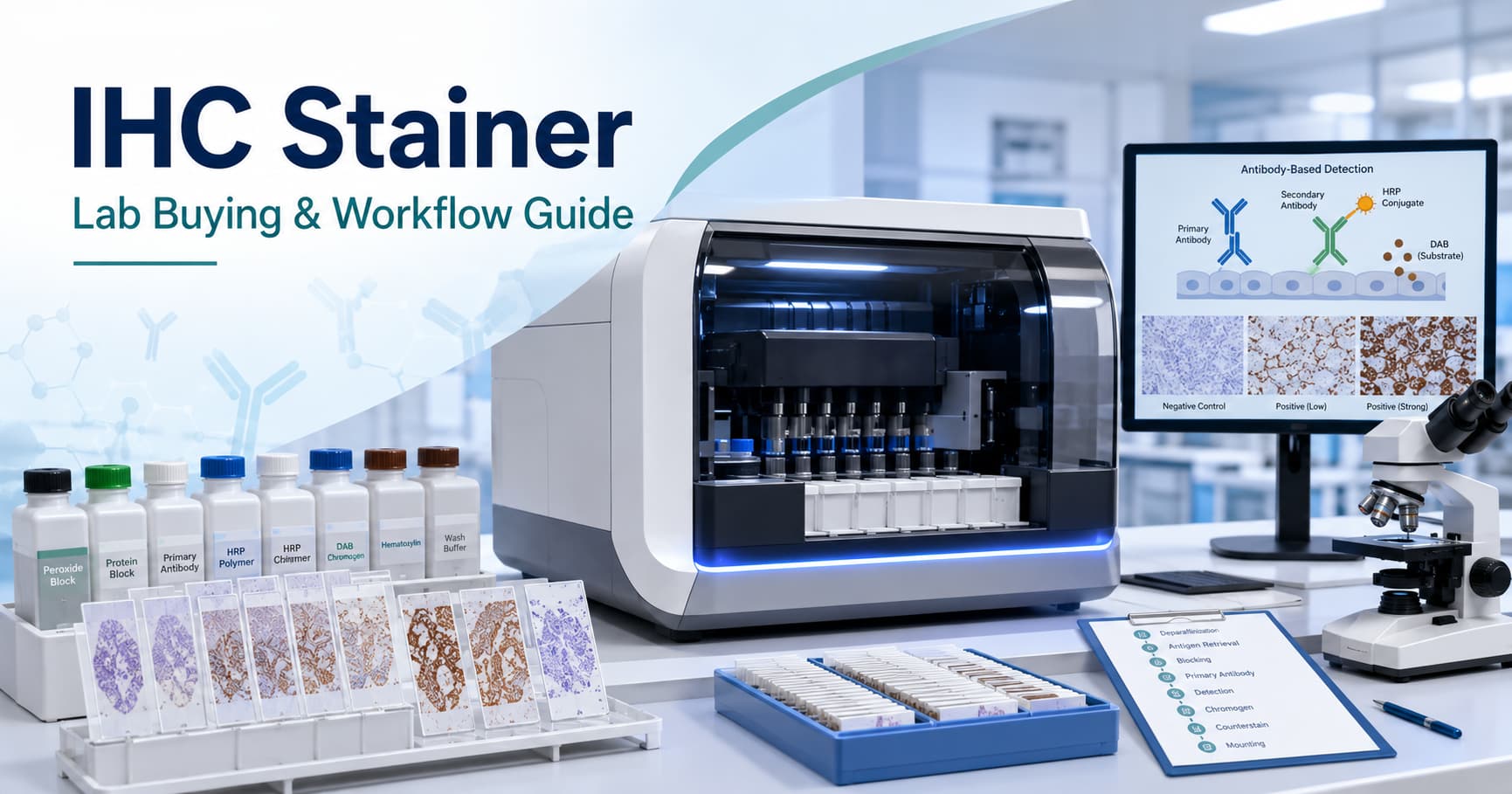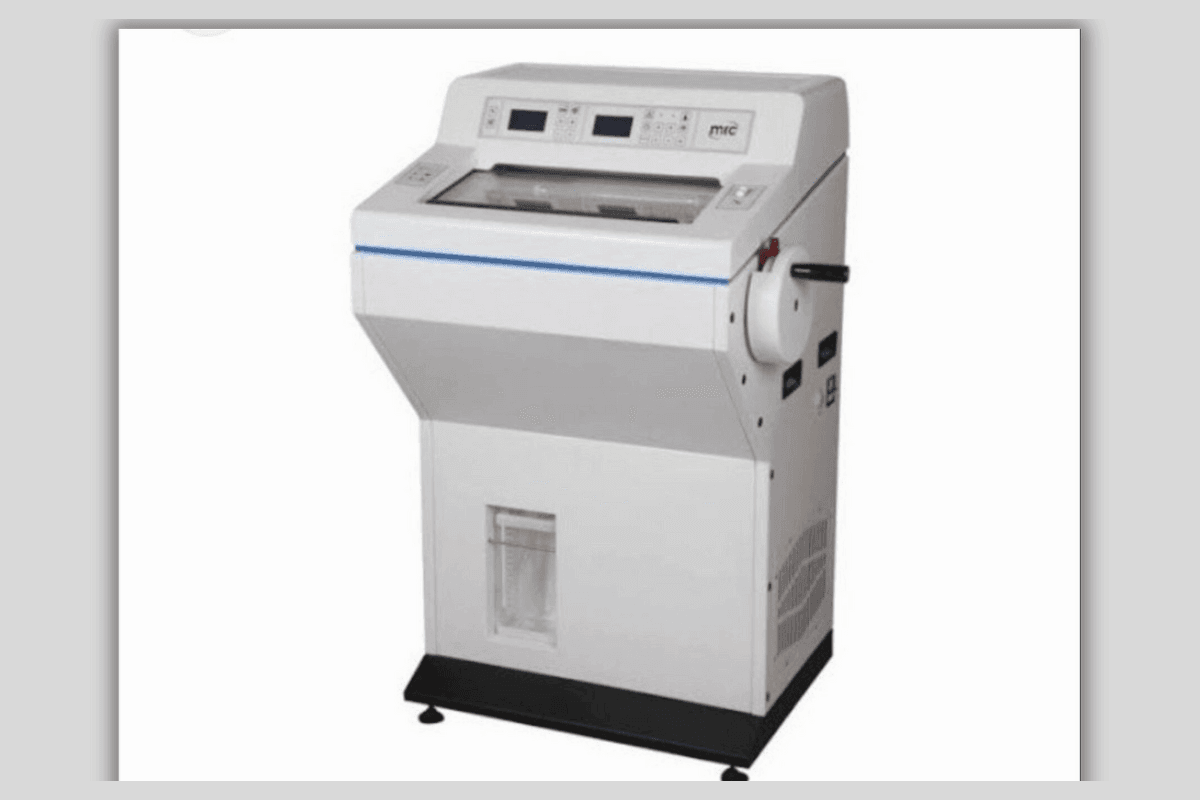
A cryostat is a specialised laboratory machine used in histopathology and research to prepare frozen tissue sections for microscopic examination. A cryostat ensures that biological tissues remain preserved and structurally intact during sectioning by maintaining ultra-low temperatures. The use of a cryostat microtome allows thin slicing of samples, supporting accurate assessment.
Understanding the use of cryostat in histopathology can help labs improve both turnaround time and section quality, especially when immediate tissue evaluation is necessary.
What Is a Cryostat and How Does It Work?
A cryostat machine is essentially a refrigerated chamber that houses a microtome– an instrument responsible for slicing tissues. The chamber maintains cryogenic temperatures around -150°C to freeze and preserve tissue samples before sectioning.
Once the tissue is frozen, it is mounted onto a specimen holder (or chuck), where the microtome slices the sample into thin sections measured in microns. These sections are then mounted onto slides for further histological staining and evaluation. The consistency of the temperature ensures the sample's structural preservation, minimising ice crystal formation or mechanical distortion during cutting. In surgical pathology, cryostat sectioning enables rapid intraoperative evaluations.
Components of a Cryostat Machine
To appreciate the workflow efficiency that a cryostat offers, it’s useful to know its internal architecture.
| Component | Function |
|---|---|
| Freezing Chamber | Maintains consistent low temperatures for optimal tissue preservation |
| Specimen Holder (Chuck) | Secures tissue samples in place for accurate and stable sectioning |
| Cryostat Microtome | Slices tissues into uniform, thin sections for microscopic analysis |
| Blade Holder | Holds the blade firmly, ensuring cutting precision and user safety |
| Anti-Roll Guides | Prevent tissue sections from curling, aiding smooth transfer onto slides |
Many modern cryostats are equipped with integrated safety mechanisms. These include temperature alarms, emergency shut-off switches, and interlocking covers that protect users from exposure to cryogenic surfaces or blades. Such features ensure operational reliability and user safety, especially in high-throughput lab environments.
Types of Cryostat in Histopathology
Laboratories may choose different cryostat models depending on workload, tissue type, and sectioning precision required. Common options include:
Single Compressor Cryostat: It manages both the freezing plate and the chamber with one compressor. It works well for routine use where simultaneous control over multiple temperature zones is not essential.
Double Compressor Cryostat: A dual-compressor setup allows separate control over the freezing plate and chamber, enabling better temperature regulation. It is suitable for sensitive tissues that require rapid and uniform freezing.
Rotary Cryostat: Rotary cryostats operate manually using a handwheel. These models are preferred when fine manual control is prioritised. While they demand more effort, they provide better sectioning precision for complex samples.
Motorised Cryostat: These are automated systems designed for higher workloads and consistency. With adjustable speed controls and motor-driven slicing, they help reduce operator fatigue.
More Cryostat Machine Types
While cryostats used in histopathology focus on integrated microtomes and tissue sectioning, several other designs cater to broader scientific and industrial requirements.
Closed-Cycle Cryostats: These cryostats operate without frequent refills of cryogenic liquids. Instead, they use helium vapour and an external refrigerator to circulate coolant in a sealed loop. Closed-cycle cryostats enable operational continuity but require higher power consumption. Hence, these are suitable for long-term experiments.
Bath Cryostats: Bath cryostats immerse the specimen directly in a bath of liquid nitrogen or helium. Though basic in design, they provide stable temperatures and are easy to operate. However, they require periodic replenishment of cryogen.
Flow Cryostats: In these types, coolant flows continuously through the system, offering steady temperature maintenance over extended periods. Flow cryostats are particularly suited for materials science experiments.
Cryogen-Free Cryostats: These systems use mechanical coolers instead of liquid nitrogen or helium, eliminating the need for refilling. Cryogen-free cryostats are more convenient and environmentally sustainable.
Main Benefits of Using a Cryostat
The cryostat machine brings several advantages in histological processing and research workflows.
Fast sectioning for frozen samples: Supports immediate evaluation, especially useful in intraoperative consultations.
Tissue preservation: Maintains cellular structure by preventing thermal degradation.
Precision in cutting: Adjustable thickness settings allow for fine control in cryostat sectioning.
Versatility: Compatible with various tissue types used in histopathology and research.
By integrating a cryostat into lab operations, pathologists can obtain consistent frozen sections suitable for staining, enzyme histochemistry and immunohistochemical studies.
Considerations When Selecting a Cryostat Machine
Every lab requirements are different. Tissue preservation needs are also different for different tasks. Hence, selecting a cryostat machine should consider the full context of what task it is intended to perform.
Temperature Control
Reliable cryogenic control is central to preserving sample quality. Look for models that provide independent controls for different zones, especially in dual-compressor types.
Some models use liquid nitrogen or helium-based refrigeration to reach ultra-low temperatures. Alternatively, cryogen-free models use mechanical compressors to eliminate dependency on liquid coolants.
Sectioning Precision
The cryostat microtome should offer micron-level thickness adjustment with minimal vibration. The inclusion of anti-roll mechanisms ensures smooth, flat sections suitable for slide mounting.
Blade Configuration
Options for both disposable and reusable blades provide flexibility based on lab preferences. Disposable blades privide convenience, while reusable ones reduce long-term costs with regular sharpening.
Cleaning and Maintenance
Ease of disinfection and maintenance access can affect operational uptime. Choose models that facilitate quick cleanup between procedures to minimise contamination risk.
Cryostat vs. Microtome: Functional Differences
Although closely related, the cryostat and microtome serve distinct roles.
Cryostat: Combines a freezing chamber with an integrated microtome for frozen tissue sectioning. Operates at sub-zero temperatures.
Standalone Microtome: Used primarily for paraffin-embedded tissue sectioning at room temperature. Does not include freezing functionality.
Application in Biotech and R&D
| Field | Application of Cryostat Sections |
|---|---|
| Molecular Biology | Preserves nucleic acids and proteins for assays like FISH, PCR, and Western blotting |
| Drug Discovery | Provides thin sections to observe cellular-level drug effects, aiding efficacy and toxicity studies |
| Tissue Engineering | Enables analysis of scaffold integration, cell distribution, and tissue development |
Cryostat machines are also used in various industrial applications. In semiconductor fabrication, cryostats are employed to test material behaviour under low temperatures, to ensure component reliability.
In materials science, researchers use cryostats to analyse how metals, polymers, and ceramics respond to temperature fluctuations. It contributes to the development of new materials for aerospace, defence and consumer electronics.
Cost of Cryostat Machines
In general, the cost of Cryostat machines is influenced by the type of compressor system (single vs. dual), Motorised vs. manual microtome, temperature range and control features, brand reputation and service availability, etc. Accordingly, the investment required depends on model complexity and usage demands.
- Basic models: Range from $10,000 to $20,000
- Advanced systems: With automation or dual-compressor designs, prices extend up to $50,000+
Keep in mind additional costs for maintenance, blade replacements, and potential upgrades.
Leasing vs. Buying
Deciding between leasing and purchasing a cryostat should be guided by budget flexibility and long-term goals:
- Leasing: Offers lower upfront costs, includes maintenance, and allows equipment upgrades, ideal for labs with evolving technology needs.
- Buying: Suitable for facilities with stable budgets and long-term equipment use. It eliminates ongoing payments and allows full customisation.
Each lab must weigh operational needs, financing structure, and sectioning workload when making this choice.
Conclusion
The use of a cryostat in histopathology continues to enhance the speed and accuracy of tissue analysis. From frozen section preparation to molecular research, cryostats support a wide range of applications that require both tissue preservation and precision. With a thoughtful approach to model selection and usage, laboratories can significantly improve workflow efficiency and sample integrity.
Also Check - Tissue Processors for Histopathology Labs
Get Started at ₹1!
Try Flabs for a full month for just ₹1.
Follow us on