Digital pathology has changed the way histological images are handled, shared, and interpreted. At the centre of it is the digital pathology scanner—a device that captures high-resolution images of microscope slides. It turns them into digital files that can be stored, analysed, and shared electronically. For pathologists and healthcare professionals, this isn’t about replacing traditional methods—it’s about expanding diagnostic capabilities and enabling more efficient workflows.
What Is a Digital Pathology Scanner?
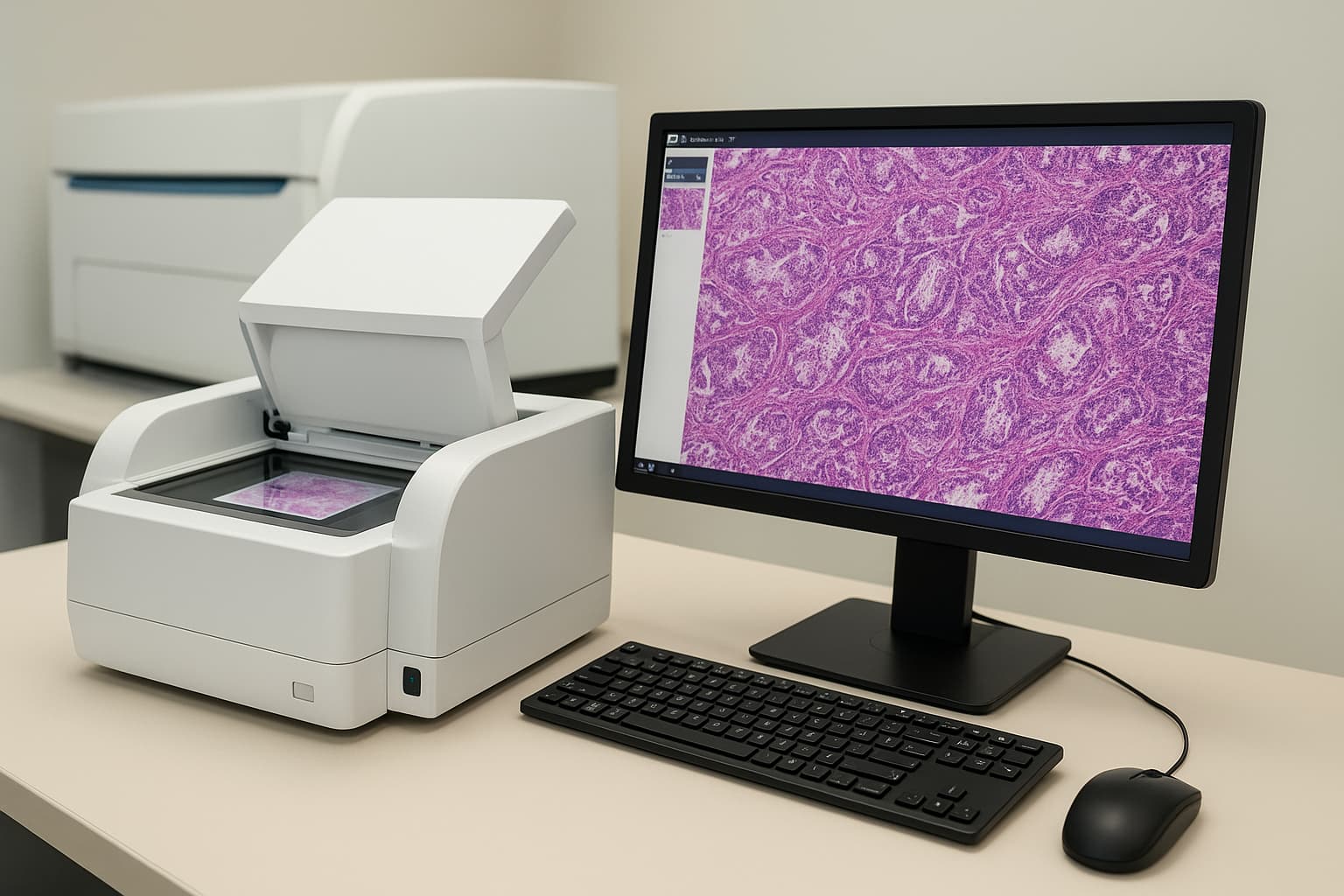
A digital pathology scanner, or microscope slide scanner, uses advanced optical components, motorised stages, and high-resolution cameras to create whole slide images (WSIs) of histological or cytological samples. These digital files preserve the full integrity of the specimen. They can be examined on a screen with magnification that often surpasses that of standard microscopy.
These systems combine:
- High-grade microscope optics for precise magnification.
- Motorised stages that automatically move the slide to ensure full area coverage.
- Digital cameras capture thousands of tile images per slide.
- Integrated software that stitches these images into a seamless WSI and manages storage.
The best digital pathology scanners usually have resolution capabilities ranging from 20x to 40x. They can flawlessly support standard histopathology workflows and more detailed oncology investigations.
How Digital Scanning Enhances Diagnostic Practice
By converting physical slides into digital format, pathologists can review cases on a screen without relying on the physical presence of the slide or microscope. It supports remote diagnosis, multi-location case discussions and easy archival. Moreover, digital tools can assist in measuring structures. They can annotate regions of interest and compare with prior cases—all within the same software environment. Imagine the cost-reduction it entails.
In cancer diagnostics, scanning slides allows for consistent review and re-review. It supports AI integration for pre-screening. Doctors can get second opinions if necessary through secure cloud access. Above all, the extended zooming capabilities empower pathologists to discover subtle morphological changes and protein biomarker expression.
Benefits in Daily Workflow and Collaboration
Digital scanners free laboratories from the constraints of physical space. Instead of sending slides via courier for second opinions or specialist consultation, files can be transmitted instantly. It is helpful for institutions participating in tumour boards, multicenter studies, or telepathology services.
In education and research, digitised slides enable consistent access to the same material for multiple users. Faculty can prepare teaching collections with annotations, while research teams can collaborate with standardised datasets across institutions.
Laboratories that adopt scanning technology also benefit from reduced slide handling errors, less wear and tear on fragile specimens. Archived digital slides stay intact, unlike their glass counterparts.
Furthermore, whole slide imaging supports automated quantitative analysis. Researchers and labs can measure features like nuclear pleomorphism, mitotic figures, and marker expression with a level of objectivity not possible through manual review. These quantifiable insights support research, clinical trials, and drug development, particularly in the context of personalised medicine.
Choosing a Digital Pathology Scanner
The choice of scanner depends on a lab’s volume, speciality needs, and budget. Here are some factors that healthcare professionals assess before investing.
Scan Quality: Resolution, colour fidelity and focus depth matter.
Throughout: Labs processing hundreds of slides daily benefit from high-capacity autoloaders, while low-volume users may choose manual or semi-automated systems.
Slide capacity: Single-slide scanners may suit smaller labs or educational setups, while multi-slide scanners enable batch processing and higher throughput.
Image Format: Open formats like DICOM are preferred for integration into hospital PACS systems.
Software Features: Good software enables image annotation, zooming, measurement, and integration with lab information systems (LIS).
Maintenance and Uptime: Reliable service and ease of use are non-negotiable for busy labs.
Those seeking the best digital pathology scanner compare features using online reviews, user case studies, and digital pathology scanner comparison matrices provided by manufacturers or third-party evaluators.
Digital Pathology Scanner Pricing in India
The digital pathology scanner market in India is growing steadily, with hospitals, diagnostic labs, and medical colleges adopting the technology. Several global and domestic manufacturers offer systems tailored to different scale requirements.
When considering the digital pathology scanner price in India, factors such as scanner capacity, support packages, and integration requirements come into play. Long-term cost planning should also include storage infrastructure, training, LIS integration, and post-sales support.
Basic single-slide models start around ₹10–15 lakhs, while high-throughput systems can exceed ₹80 lakhs. Government institutions sometimes secure scanners through grants. Private labs may opt for leasing or modular purchases.
Regulatory Standards and Approval
In clinical environments, device reliability is non-negotiable. That’s why institutions prefer FDA-approved digital pathology scanners when using the system for primary diagnosis. FDA clearance ensures that the scanner and software have met rigorous validation for diagnostic accuracy and reliability. In India, CDSCO approval may be required depending on the intended use.
However, non-FDA-cleared scanners may suffice for non-diagnostic applications like teaching and research.
Integration with Laboratory Systems
Digital pathology works best when integrated into the broader lab workflow. Seamless connections with laboratory information systems (LIS), electronic health records (EHRs), and AI tools improve efficiency. As labs look to incorporate automation, many also consider systems that support barcoding, image indexing, and cloud access.
Automation in haematology and chemistry labs has already shown what efficient integration can achieve, and digital pathology is following a similar path. The rise of AI-assisted diagnostics makes scanner integration even more meaningful, with scanners feeding image data into algorithms trained to detect cancer subtypes, grade tumours, or screen large sample sets.
Ensuring compatibility with teleconsultation platforms and real-time viewer tools is essential when implementing scanners in geographically dispersed networks.
Supporting Digital Pathology with Smart Lab Information Systems
As pathology laboratories adopt digital scanners for whole slide imaging, integrating a reliable Laboratory Information System (LIS) becomes increasingly important. It mandates efficiency in registration, testing, reporting and case management. You need a robus LIS system in place. A system like Flabs Pathology Software complements digital pathology and effortlessly achieves these aspects.
Flabs supports digital labs by automating patient registration, enabling QR-coded reporting, and simplifying communication through integrations like WhatsApp. These features help reduce manual intervention and ensure the timely delivery of results.
Laboratories using digital pathology benefit further from Flabs’ secure patient portal, where reports can be accessed using mobile login credentials. Labs can manage communication effectively without relying on physical document delivery.
The system is built to accommodate labs of all sizes. Whether working with a single digital pathology scanner or running a larger diagnostic centre with multiple collection points, Flabs can scale accordingly. Its intuitive interface ensures lab owners, technicians and clinicians can work productively without requiring extensive software training.
From automated workflows to secure data backups and compliance-ready infrastructure, Flabs is engineered to support labs moving toward digital pathology. When implementing scanners for image capture and analysis, a robust LIS like Flabs can bridge the gap between raw data, efficient reporting, and real-world clinical application.
Considering a move to digital pathology? Pair your scanner with the right lab information system.
Start your 5-day free trial of Flabs Pathology Software.
Conclusion
The shift to digital pathology is no longer hypothetical—it’s underway. The microscope slide scanner is central to this progress, allowing pathologists to work with speed, flexibility, and accuracy across distances. From improved case collaboration to streamlined research and better archival, the advantages are clear for those willing to invest in the transition.
While comparing scanner options, it’s important to evaluate throughput, image quality, software compatibility, and long-term support. Those considering adoption will find a variety of digital pathology scanner comparison tools online, as well as local vendors familiar with the digital pathology scanner market in India.
Labs that adopt the right technology today are positioning themselves for more connected, efficient, and insight-driven diagnostics tomorrow.
Get Started at ₹1!
Try Flabs for a full month for just ₹1.
Follow us on