Prenatal screening has moved well beyond reassurance. Pathology now plays a defining role in shaping early clinical decisions during pregnancy. Among first-trimester investigations, the dual marker blood test holds a distinct place due to its predictive value, safety profile, and reliance on robust laboratory processes.
For pathologists and healthcare professionals, the test is not simply a screening panel. It represents a convergence of biochemical accuracy, gestational timing, ultrasound correlation, and reporting discipline. As testing volumes grow across pathology labs in India, operational efficiency and proper reporting increasingly influence clinical trust.
What Is the Dual Marker Blood Test?
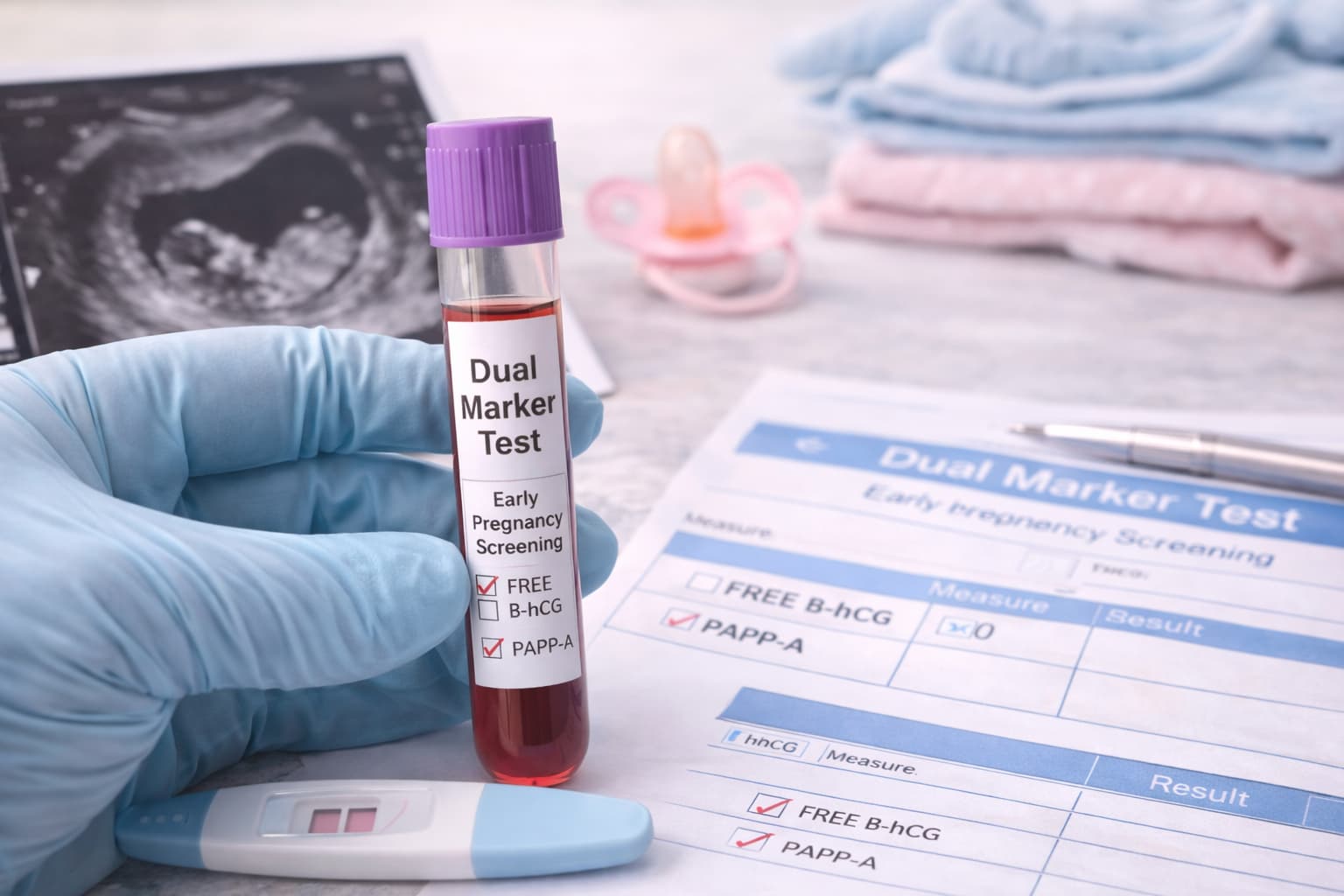
The dual marker blood test in pregnancy is a first-trimester prenatal screening assay performed between 9 and 13 weeks of gestation, with some protocols extending to week 14. The test evaluates the statistical risk of fetal chromosomal aneuploidy rather than confirming a diagnosis.
The screen focuses on three chromosomal conditions:
- Down syndrome (Trisomy 21)
- Edward syndrome (Trisomy 18)
- Patau syndrome (Trisomy 13)
Each condition arises from the presence of an additional chromosome. It carries distinct developmental and neurological implications.
Biochemical Basis of the Test
The blood test dual marker panel measures two placentally derived analytes from maternal serum.
- Free Beta-hCG.
- Pregnancy-Associated Plasma Protein-A (PAPP-A).
Altered expression of either marker shifts the calculated risk. Elevated beta-hCG paired with reduced PAPP-A raises suspicion for trisomy 21. Reduced levels of both markers suggest alternative aneuploidies.
Laboratory precision at low gestational weeks determines the reliability of downstream risk stratification.
Why the Dual Marker Blood Test
Early pregnancy presents a narrow window for screening. The dual marker approach fits squarely within that timeframe while remaining non-invasive. When combined with a nuchal translucency ultrasound, predictive sensitivity improves substantially.
From a pathology perspective, the test has:
- High clinical demand across obstetric practices.
- Clear gestation-linked reference modelling.
- Dependence on analytical consistency rather than invasive sampling.
Its predictive nature also demands clarity in reporting language to prevent misinterpretation.
How to Take Blood for a Dual Marker Test
The test involves a blood draw. Blood is collected via routine venipuncture during an antenatal visit. Serum separation follows standard centrifugation protocols.
No fasting is required.
Timing remains non-negotiable. Even minor gestational miscalculations can alter MoM values. Coordination with ultrasound scheduling improves interpretive accuracy.
Pathology teams benefit from LIS prompts that validate gestational age at the time of accession.
Result Interpretation
| Risk Category | Typical Reporting Pattern | Clinical Direction |
|---|---|---|
| Low Risk | Above 1:250 | Routine antenatal follow-up |
| Moderate Risk | Near laboratory threshold | Clinical correlation advised |
| High Risk | Below 1:250 | Diagnostic testing recommended |
Ratios such as 1:1000 indicate low probability. Ratios closer to 1:100 signal increased concern.
The test remains predictive. Confirmation requires non-invasive prenatal testing, amniocentesis, or chorionic villous sampling.
Turnaround Time
The turnaround time for dual marker testing generally ranges between 3 and 7 days. Delays beyond that window risk clinical irrelevance due to gestational progression.
Factors influencing turnaround include:
- Analyser throughput
- Manual data entry dependence.
- Risk calculation workflows.
- Report authorisation latency.
Automation at the LIS layer plays a decisive role in maintaining predictability.
Report Format and Communication
An effective report format balances statistical clarity with clinical restraint. Pathologists recognise the need to avoid alarming language while still conveying risk.
A structured report includes,
- Absolute marker values.
- MoM calculations.
- Gestational age confirmation.
- Risk ratios with interpretive notes.
Digital delivery now complements printed formats. QR-coded access and secure portals reduce dependency on physical report movement.
Operational Challenges
Demand for prenatal screening has expanded across urban centres and secondary cities. Pathology labs in India face rising expectations around accuracy, speed, and patient communication.
Manual workflows introduce friction at scale. Risk calculation errors, report delays, and transcription mistakes undermine clinician confidence.
Laboratories performing high volumes of dual marker screening benefit from software-driven standardisation rather than technician-dependent processes.
Flabs LIS Software for Medical Labs
Dual marker screening relies on data accuracy across multiple touchpoints. Flabs AI-Powered LIS Software aligns naturally with such requirements.
Flabs enables:
- Automated patient registration with gestational validation.
- Analyser integration for beta-hCG and PAPP-A values.
- Rule-based risk calculation workflows.
- Standardised report format generation.
- QR-coded reports for clinician access.
- WhatsApp-enabled report delivery.
- Secure patient portals using phone-number login.
The platform scales from single labs to multi-centre diagnostic networks without workflow redesign. Data security protocols ensure patient confidentiality while maintaining regulatory compliance.
For labs managing prenatal panels, reduced manual intervention translates into predictable turnaround time and consistent reporting.
Clinical Value Without Invasiveness
The dual marker blood test occupies a distinct clinical space. No needles beyond venipuncture. No procedural fetal risk. Yet the information influences major decisions.
Pathologists act as stewards of clarity rather than arbiters of outcome. Report phrasing, timing, and accessibility shape downstream care.
Digital infrastructure now determines how effectively that responsibility is fulfilled.
Looking Ahead
Prenatal screening volumes will continue to rise alongside maternal age trends and heightened genetic awareness. Laboratories equipped with adaptable LIS platforms remain better positioned to absorb that demand without compromising accuracy.
Dual marker testing exemplifies a diagnostic area where software maturity directly influences clinical confidence.
A Practical Step for Diagnostic Laboratories
Flabs Pathology Software supports laboratories performing prenatal screening with automation, security, and scalability at the core.
Start Your 5-Day Free Trial of Flabs Pathology Software Today.
Experience AI-powered LIS capabilities built for high-stakes testing environments. Register with basic details or request a demo to explore workflows designed for dual marker screening and beyond.
Reliable screening begins with reliable systems.
Also read - HCG Levels in Ectopic Pregnancy
Get Started at ₹1!
Try Flabs for a full month for just ₹1.
Follow us on