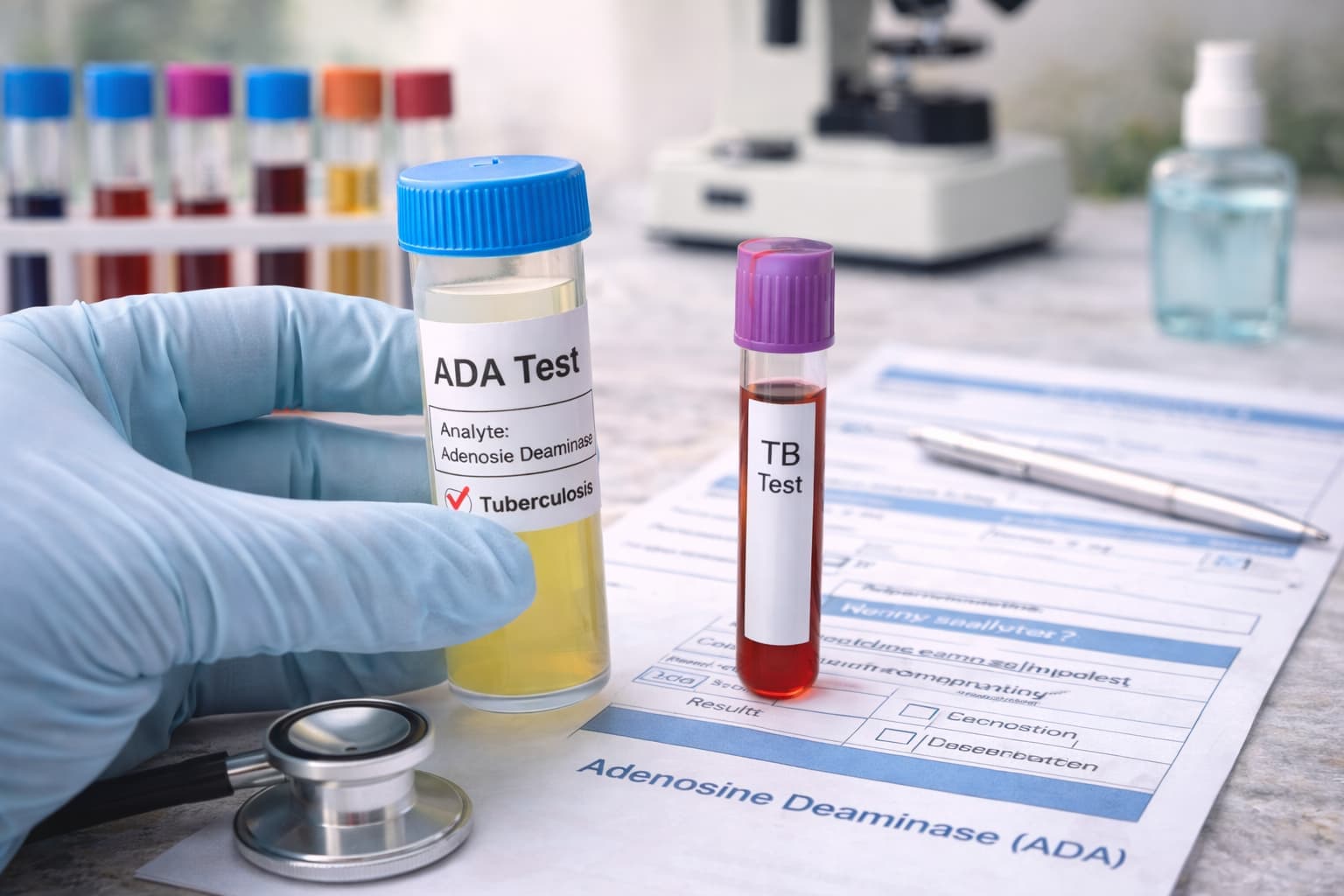
Adenosine Deaminase testing evaluates patients with suspected tuberculosis in fluid compartments. Pathologists across India encounter a range of presentations where the ADA test guides early decision-making, especially when radiology and clinical findings create ambiguity.
The enzyme reflects T-cell activity; when those cells react to infection inside closed spaces such as the pleura or pericardium, ADA activity tends to rise. Because of that biological link, ADA supports microbiological and molecular investigations rather than replacing them.
Below is a detailed exploration designed for pathologists, laboratory physicians, and healthcare professionals who want a concise but thorough overview of ADA behaviour, interpretation, and workflows inside modern diagnostic environments.
ADA Test Full Form
The ADA test full form is Adenosine Deaminase Test. ADA is an enzyme involved in purine metabolism. Beyond its metabolic role, it signals the presence of activated lymphocytes. In TB-related effusions, lymphocytic predominance drives the enzyme to climb, sometimes rapidly, especially when Mycobacterium tuberculosis triggers cell-mediated immunity inside the pleural or peritoneal cavity.
That immunologic behaviour explains why ADA aligns more strongly with TB effusions than with bacterial pneumonias that produce neutrophilic responses.
Where ADA Testing Fits Into Clinical Practice
- Doctors order the ADA test mainly to help detect tuberculosis (TB).
- It is most often used in pleural fluid when TB is suspected in the lungs.
- It is also commonly used in abdominal (peritoneal) fluid when TB ascites is suspected.
- In some cases, ADA is checked in cerebrospinal fluid if TB meningitis is possible.
- It may be used in pericardial fluid when TB is considered around the heart.
- The test is especially useful in high-risk groups such as immunocompromised patients, migrants from TB-endemic areas, pregnant people, children with positive TB screening, and exposed healthcare workers.
- ADA alone does not confirm TB. But it strongly supports the diagnosis when combined with other tests like smear, culture, and molecular assays.
ADA Test Normal Range and Interpretation
The ADA test normal range for results varies slightly among laboratories, depending on method and fluid type.
Reference intervals of pleural fluids are near 40 U/L. Lower values reduce the likelihood of TB in lymphocytic effusions. Higher values shift the probability toward tubercular disease. But they should always be evaluated alongside clinical judgement.
| ADA Value (Pleural Fluid) | Interpretation | Notes |
|---|---|---|
| < 40 U/L | Unlikely pleural TB | Does not fully exclude disease in elderly or immunosuppressed individuals |
| 40–70 U/L | Possible TB, requires corroboration | Compare with differential count, protein levels, ADA isoenzymes, and NAAT |
| > 70 U/L | Strong suspicion of pleural TB | It can also appear in malignancy, lymphoma, or inflammatory disorders |
High ADA may appear in malignant pleural effusion, lymphoma, leukaemia, autoimmune conditions, sarcoidosis, pulmonary embolism, and parapneumonic effusion. Pneumonia, typhoid fever, liver disease, infectious mononucleosis, and rheumatoid synovitis also influence values.
Low ADA can surface in ADA deficiency, a condition that disrupts lymphocyte development. Children with severe combined immunodeficiency present with chronic diarrhoea, recurrent pneumonia, and persistent rashes.
Atypical TB in elderly or critically ill patients may also display unexpectedly low ADA because their immune response cannot generate a measurable rise.
Fluid Types: Pleural, Serum, CSF, and Peritoneal Samples
In the ADA test, pleural and peritoneal fluids are the most validated matrices.
CSF ADA, while informative, displays greater variability and demands cautious interpretation. The serum ADA test and ADA blood test have limited diagnostic clarity in TB because systemic inflammation and hepatic disorders push ADA values in unrelated directions.
For that reason, fluid-based assays retain priority.
Sampling procedures depend on the clinical site. Thoracentesis, paracentesis, and lumbar puncture carry their own procedural risks and require coordination between treating teams and laboratory services.
No fasting is required. A quick medication review prevents potential assay interference.
Methodology and Turnaround Time
Most pathology labs in India use spectrophotometric or colourimetric methods. The reaction rate of ammonia formation or absorptive change reveals ADA activity. Output units vary; therefore, reports should state the method and reference interval clearly.
Turnaround time depends on lab load and workflow. Many laboratories release ADA reports within the same day, especially when effusion analysis influences urgent admission decisions. Efficient sample routing, automated data entry, and standardised report generation significantly shorten delays.
Limitations
- ADA can suggest TB, but it is not definitive
- Results depend on how likely TB was before testing.
- False positives can occur in cancer or chronic inflammation.
- False negatives can occur in early TB, low bacterial load, steroid use, or weak immunity.
- Poor sample handling can falsely raise ADA levels.
- Blood contamination can affect test accuracy.
- Labs must maintain strict quality control.
- ADA should always be interpreted with other tests (smear, culture, NAAT, etc.).
- Borderline ADA values require clinical judgment and supporting findings.
Reporting and Modern LIS
Pathologists need clear, structured reporting. A well-formatted ADA report outlines fluid type, assay method, value, reference interval, and interpretive comments without ambiguity.
Laboratories also need a system that manages large volumes of fluid analyses while minimising manual entry.
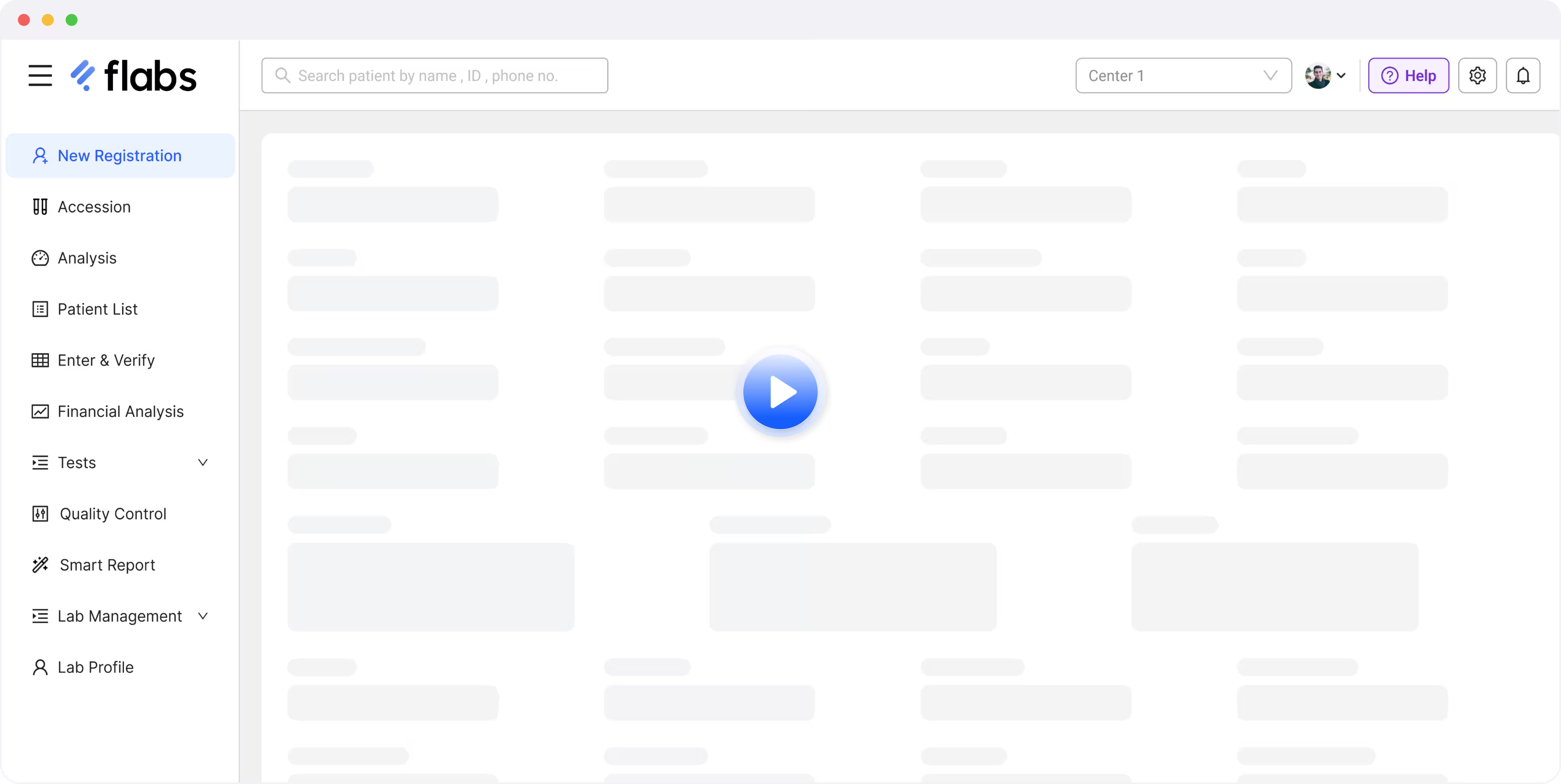
This is where digital workflow platforms create noticeable advantages. Solutions such as Flab's Pathology Software bring high-efficiency handling to routine and complex assays.
- Flabs LIS enables automated registration, QR-coded report generation, and WhatsApp-integrated communication, making ADA reporting smoother.
- It has a patient portal where individuals can retrieve their ADA results with their phone number. That feature reduces inbound calls, lowers administrative strain, and ensures that physicians receive reports without delays.
- The design of Flabs LIS emphasises simplicity, allowing technicians and consultants to handle menus without long training sessions.
Many labs run ADA alongside cytology, cultures, biochemistry, and molecular assays. For such settings, scalability matters. Flabs can expand with collection centres and growing workloads.
Further secure backups and compliance-driven data protection maintain data reliability for longitudinal patient care.
ADA Test Within a Digitised Workflow
When laboratories process pleural or peritoneal fluid, they often rely on speed. A delayed ADA result can shift clinical momentum in emergency wards. Automated workflows cut unnecessary waiting.
With Flabs, ADA entries feed directly into a structured report format that remains consistent across departments. Large diagnostic centres with multiple benches find that a unified system reduces scattered paper records and manual cross-checking.
For labs attempting to standardise turnaround time, Flabs provides streamlined operations. Automated communication ensures that clinicians receive completed ADA reports instantly. Rapid data retrieval also benefits follow-up comparisons, especially when sequential ADA testing is performed.
Integrating ADA Into Diagnostics
Clinicians look beyond absolute ADA values. They interpret them alongside imaging findings, symptom duration, HIV status, nutritional state, and comorbidities. Given those complexities, laboratories must supply cleanly formatted results that suit rapid clinical reasoning.
ADA becomes more actionable when the lab’s reporting platform provides clarity rather than clutter.
Flabs’ user-friendly interface and scalable structure give laboratories the consistency needed for complex effusion panels. Since ADA requests rise during monsoon seasons and regional TB surges, a system capable of managing fluctuating workloads adds meaningful stability for laboratory teams.
Final Thoughts
The ADA test supports early evaluations of pleural, peritoneal, and occasionally CSF abnormalities where tuberculosis is a clinical concern.
ADA gives pathologists and physicians prompt insight into immune activation patterns inside closed spaces. With well-structured reporting and reliable laboratory workflows, clinicians gain timely clarity.
For laboratories looking to strengthen ADA workflow efficiency, reporting, and introduce automation without disrupting staff routines, Flabs is an advanced, AI-driven LIS built for modern diagnostic needs.
Further Action
Start your 5-day free trial of Flabs Pathology Software today and experience effortless operations, organised reporting, and scalable LIS performance designed for real clinical workloads.
Also read - Fecal Calprotectin Test: Detecting Gut Inflammation
Get Started at ₹1!
Try Flabs for a full month for just ₹1.
Follow us on