Pathologists and clinicians encounter cases where symptoms point toward plasma cell activity yet the diagnostic trail feels incomplete. Bone pain lingers without an obvious source, kidney markers shift in unpredictable patterns, and electrophoresis results tease abnormality without clarity. These grey zones create pressure on the teams to pinpoint the cause swiftly.
The SFLC blood test steps into that space by revealing information that can narrow uncertainty. Its value rises in scenarios where monoclonal protein levels stay low or where disease hides behind subtle signals. When interpreted with discipline, the test gives a clearer view of plasma cell behaviour.
The SFLC Blood Test
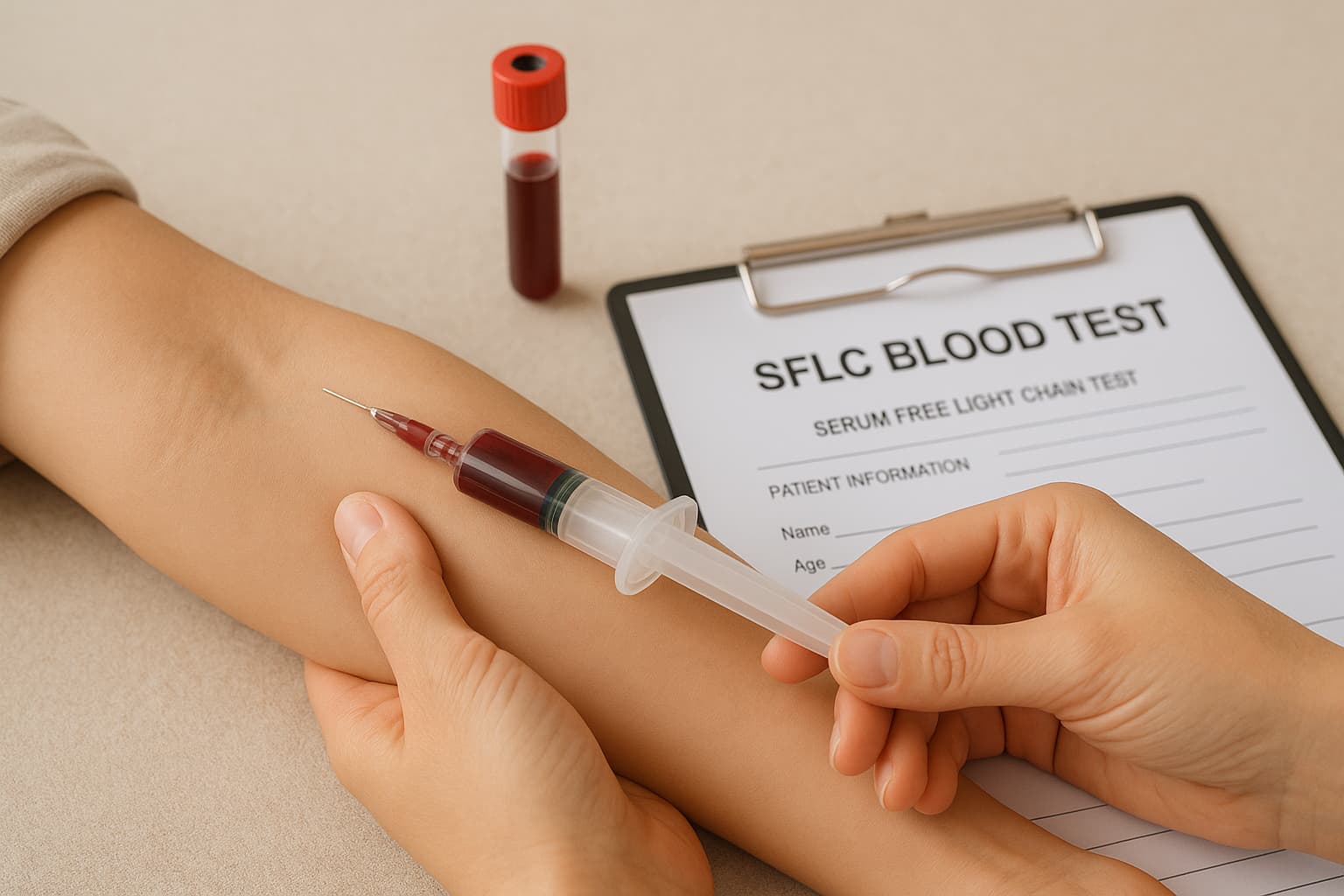
The SFLC blood test measures serum free light chains in circulation, viz., kappa and lambda. Plasma cells produce these proteins as part of antibody formation. A portion remains unbound. These become free light chains. The test quantifies each chain and calculates the kappa/lambda ratio. Shifts in this ratio are tied to abnormal plasma cell expansion.
The free light chain test is crucial when intact immunoglobulin secretion stays low, as seen in oligosecretory, non-secretory, or light chain-only myeloma.
In these cases, SPEP or UPEP (Serum or Urine Protein Electrophoresis Tests) data can appear deceptively quiet. The serum-free light chain assay adds clarity. It captures even small fluctuations in free light chain production.
Relevance of Serum Free Light Chains
The FLC blood test supports the evaluation of,
- Multiple myeloma
- Light chain amyloidosis
- MGUS progression risk
- Waldenström macroglobulinemia
- Light chain-driven renal involvement
The test reacts rapidly to treatment shifts because free light chains have a short half-life. Intact immunoglobulins remain in circulation for many days. Free chains clear within hours. The difference allows clinicians to track early therapy.
A spike in high free lambda light chains may indicate lambda-dominant disease. Elevated kappa values can point toward kappa-dominant clones.
Kidney dysfunction complicates the picture because impaired clearance raises both markers while the ratio remains near normal.
Sampling
The test requires venous blood. The blood collection procedure follows standard steps. No preparation is necessary.
The turnaround time is around forty-eight hours. Some laboratories process it faster. For serial monitoring, consistency in timing may be checked. Because diurnal variations may introduce mild changes.
Why the SFLC Test?
The SFLC test is used in situations where symptoms point toward plasma cell dysregulation. Bone tenderness that resists explanation. Anaemia with normal cell size. Recurrent infections in the absence of obvious immunosuppression. Kidney function decline is accompanied by protein abnormalities. Muscle weakness or neuropathy without structural lesions. These concerns guide clinicians toward deeper investigation.
The test also plays a long-term role. Patients with MGUS undergo periodic measurements to assess transformation risk. Those with established myeloma receive monitoring to judge how therapy alters free chain load. Abnormal serum free light chains can also signal organ involvement, particularly in the kidneys, where filtered light chains drive tubular injury.
Integration With Other Diagnostic Tools
The SFLC result sits alongside SPEP, UPEP, and IFE. The test provides complementary angles. SPEP detects M-proteins when intact immunoglobulin secretion is present. UPEP reveals Bence-Jones proteins. IFE confirms heavy chain type and light chain type.
However, in oligosecretory or non-secretory disease, electrophoresis may show little. The serum-free light chain assay detects production that electrophoresis cannot capture.
Interpreting SFLC Results
When there is a high free lambda light chain in the results paired with a low kappa/lambda ratio, it suggests a lambda-dominant plasma cell clone. A high ratio, influenced by elevated kappa values, points toward a kappa-dominant disorder.
| Component | Normal Range | Clinical Interpretation |
|---|---|---|
| Free Kappa | 3.3 to 19.4 mg/L | High values may indicate plasma cell disorders or CLL. Low values may signal suppressed kappa production. |
| Free Lambda | 5.7 to 26.3 mg/L | High values may occur in myeloma and other lymphoproliferative conditions. Low values may imply reduced lambda output. |
| Kappa/Lambda Ratio | 0.26 to 1.65 | A high ratio suggests kappa-type myeloma. A low ratio suggests lambda-type disorders. |
A markedly abnormal ratio raises concern for MGUS progression or active myeloma. Treatment response becomes visible when free light chain values fall and the ratio moves toward normal limits.
Normal values cannot fully exclude disease. Abnormal values cannot specify which condition is present.
Laboratories that process serial measurements should apply the same method each time. Platform differences lead to variation in values.
Operational Aspects for Pathology Labs
Modern laboratories run high sample volumes. Precision and consistency matter. Workflow efficiency can influence accuracy. Many labs transition toward laboratory information systems to centralise reporting, automate communication, and reduce manual error.
This is where Flabs Pathology Software aligns well with pathology laboratories. SFLC data demands reliable storage, clean formatting, and quick retrieval. Flabs has several features that support this.
- A structured pathology report format that presents values, flags, and reference ranges in a clean layout.
- QR-coded reporting for easier clinician access.
- Automated WhatsApp integration that reduces manual staff workload.
- A patient portal that allows patients to see their reports through phone number login.
- Scalable infrastructure that accommodates growth, including new collection centres.
- Secure backups and patient-linked data protection.
For labs trying to reduce processing bottlenecks, the software streamlines registration, analysis tracking, sample management, and delivery of digital reports. These improvements support a smoother workflow for complex tests such as the SFLC assay.
Clinics and labs interested in evaluating the Flabs LIS can explore a 5-day free trial without obligations. You can start today!
Conclusion
The SFLC blood test provides a sensitive window into plasma cell activity. It strengthens diagnostic confidence in disorders marked by abnormal light chain production. It improves treatment assessment. And in high-risk groups, it supports early recognition of disease progression. When paired with consistent laboratory methods and integrated reporting through platforms like Flabs, the SFLC test becomes even more efficient.
Also check - Serum CA 125 Test: What It Means for Ovarian Health
Get Started at ₹1!
Try Flabs for a full month for just ₹1.
Follow us on