Chromatography is a laboratory technique used to separate components within a mixture. In diagnostic medicine, laboratories use chromatography to identify chemicals, drugs, proteins, and other biological molecules in clinical samples. The method works by moving a mixture through a system containing a stationary phase and a mobile phase. Each compound travels at a different speed, which leads to separation.
In pathology and clinical diagnostics, chromatography supports many analytical procedures. Labs analyse blood, urine, and tissue samples to detect substances such as hormones, metabolites, and toxic compounds. They use different types of chromatography to achieve that.
For pathologists and laboratory professionals entering diagnostic practice, a clear grasp of what chromatography is, the principle of chromatography, and its laboratory applications improves many aspects.
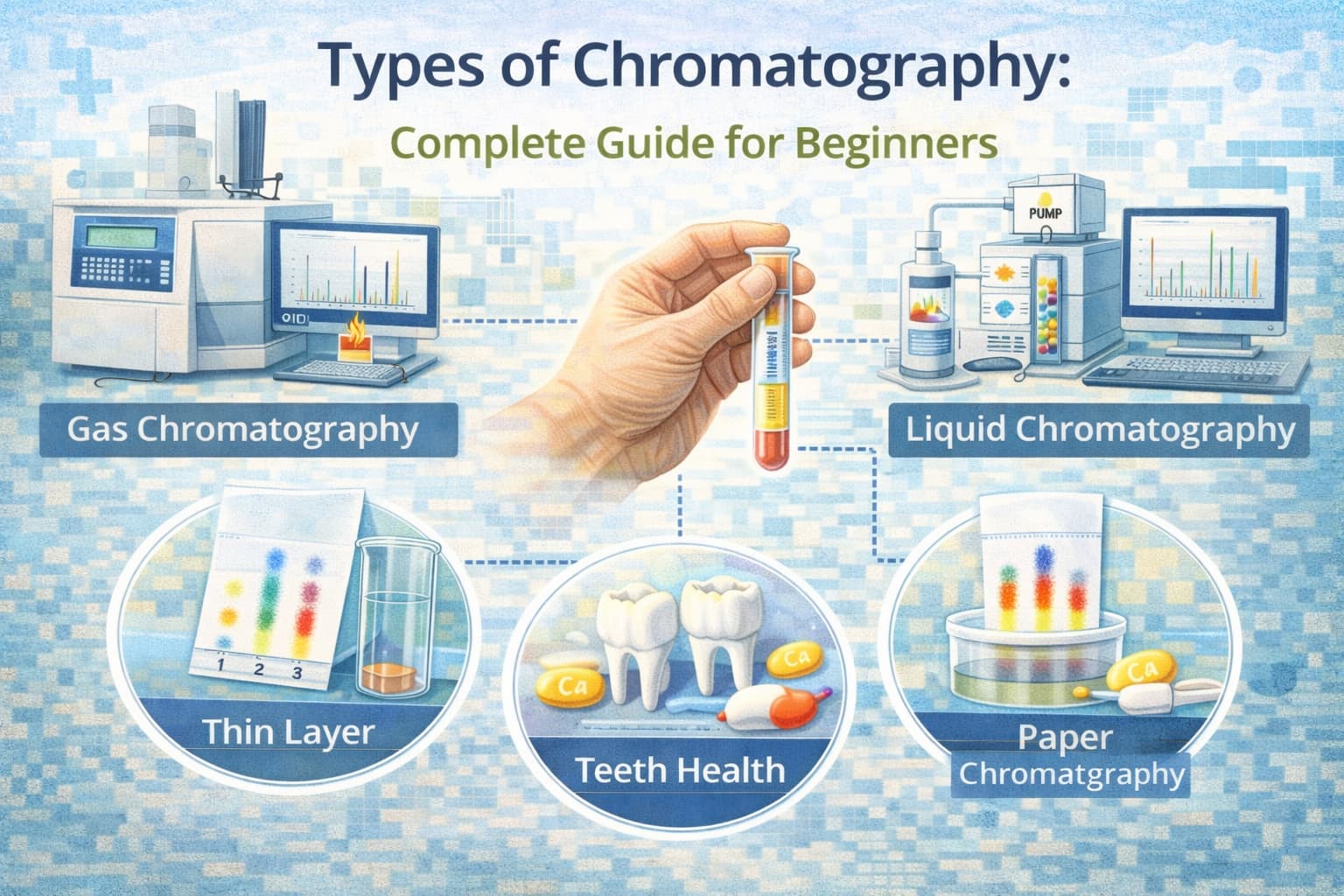
Types of Chromatography: A Short Guide for Beginners
In laboratory diagnostics, the phrase types of chromatography refers to multiple analytical methods used to separate compounds within a mixture. Each method uses a stationary phase and a mobile phase to separate molecules based on chemical or physical properties.
| Technique | Mobile Phase | Stationary Phase | Common Laboratory Applications |
|---|---|---|---|
| Paper chromatography | Liquid solvent | Cellulose paper | Amino acid separation, teaching labs |
| Thin-layer chromatography | Liquid solvent | Silica or alumina plate | Drug screening, toxin analysis |
| Gas chromatography | Inert gas | Liquid-coated column | Toxicology, volatile compounds |
| HPLC chromatography | Liquid solvent under pressure | Packed column | Hormones, drugs, biomarkers |
| Ion exchange chromatography | Liquid buffer | Charged resin | Protein purification, enzyme analysis |
When you study the types of chromatography, you will notice that every technique relies on differences such as the following.
- Molecular size
- Charge
- Polarity
- Affinity to a surface
- Volatility
Your choice of chromatography method depends on the sample, required sensitivity, and available lab equipment.
Before exploring individual techniques, let’s reiterate the definition of chromatography.
It is a laboratory method that separates chemical components of a mixture as they move between a stationary phase and a mobile phase.
How Chromatography Works
Every separation technique follows the same basic principle of chromatography.
A mixture moves through a stationary phase, carried by a mobile phase. Different compounds travel at different speeds due to variations in interaction with the stationary surface.
There are 4 main elements in any chromatographic system.
- Stationary phase: Solid surface or liquid-coated solid.
- Mobile phase: Liquid solvent or gas carrier.
- Sample mixture: Analytes being separated.
- Detector: An instrument that records separated compounds.
As compounds migrate through the system, each substance interacts differently with the stationary phase. Strong interaction slows movement, while weaker interaction allows faster migration.
When you analyse clinical samples, chromatographic separation allows clear identification of drugs, proteins, metabolites, and toxins.
Paper-Based Separation
Among early laboratory methods, paper chromatography remains one of the simplest techniques for compound separation.
In paper chromatography, cellulose paper acts as the stationary phase. A solvent travels upward through capillary action, carrying the sample along the paper surface. Different compounds move at different speeds depending on polarity and solubility.
You may see paper chromatography used for:
- Amino acid identification.
- Educational laboratory demonstrations.
- Basic metabolic analysis.
While modern diagnostic laboratories rely more on automated platforms, paper chromatography introduced many foundational ideas behind current types of chromatography.
Plate-Based Analytical Method
Thin-layer chromatography (TLC) improved upon paper systems by introducing a solid adsorbent layer, e.g., silica gel or alumina coated on glass or aluminium plates.
The thin-layer chromatography principle depends on adsorption. Compounds interact with the silica surface while the solvent moves upward along the plate.
Main characteristics include:
- Rapid separation.
- Visual detection using UV light or staining reagents.
- Low operational cost.
TLC still appears in toxicology screening and pharmaceutical analysis. Many laboratories use TLC as a preliminary method before more advanced types of chromatography.
Gas-Based Separation Technique
Gas chromatography separates volatile substances using an inert carrier gas such as helium or nitrogen.
- The sample vaporises inside an injector.
- The carrier gas transports molecules through a heated column.
- Compounds separate according to boiling point and interaction with the column coating
- A detector records the resulting peaks.
It is used in:
- Blood alcohol testing
- Drug and poison detection
- Organic solvent analysis
Clinical toxicology units rely heavily on gas chromatography due to its high sensitivity and reproducibility. In many advanced pathology labs in India, gas chromatography pairs with mass spectrometry for precise compound identification.
High-Performance Liquid Systems
Among modern laboratory technologies, HPLC chromatography stands out for its high precision and reliability.
High-performance liquid chromatography uses high pressure to push solvent through a tightly packed column. The pressure improves separation efficiency and detection sensitivity.
In diagnostic laboratories, hplc chromatography is used in:
- Haemoglobin variant analysis
- Vitamin assays
- Therapeutic drug monitoring
- Hormone measurements
Many automated analysers used in pathology labs integrate HPLC modules. These systems connect with digital laboratory platforms that track sample flow and instrument performance.
Advanced types of chromatography like HPLC, also integrate with laboratory information systems (LISs), which reduces reporting errors and improves workflow efficiency.
Charge-Based Separation
Another important laboratory technique is ion exchange chromatography.
Ion exchange chromatography separates molecules according to electrical charge. The stationary phase contains charged resin beads that bind molecules with opposite charge.
There are two common formats.
- Cation exchange chromatography: Captures positively charged molecules
- Anion exchange chromatography: Captures negatively charged molecules
Laboratory uses include Protein purification, Enzyme isolation, and Peptide separation.
Among modern types of chromatography, ion exchange methods play a major role in biotechnology laboratories and advanced clinical diagnostics.
Choosing the Right Laboratory Method
When you evaluate different types of chromatography, selection depends on analytical goals and available laboratory infrastructure.
Consider the following factors during method selection.
- Nature of the sample.
- Required detection sensitivity.
- Molecule volatility or polarity.
- Turnaround time.
- Availability of specialised equipment.
Clinical laboratories also consider regulatory compliance, quality control, and integration with laboratory information systems.
Many diagnostic centres now combine multiple types of chromatography within a single laboratory workflow to achieve accurate identification of complex analytes.
Chromatography in Diagnostic Labs
Chromatography is extensively used in laboratory medicine. Pathologists rely on separation techniques in multiple diagnostic areas.
- Clinical toxicology
- Endocrinology testing
- Haemoglobinopathy screening
- Newborn metabolic screening
- Drug monitoring programs
Large diagnostic networks and modern pathology labs increasingly deploy automated chromatography integrated with digital laboratory software.
Such systems track instrument calibration, maintain quality records, and streamline sample reporting.
In modern laboratory infrastructure, chromatography stands alongside immunoassays, molecular diagnostics, and mass spectrometry as a core analytical platform.
Final Thoughts
A clear grasp of types of chromatography allows you to interpret laboratory data with greater confidence. From simple paper systems to advanced HPLC platforms, each technique separates molecules using the same scientific principle.
As diagnostic medicine advances, laboratories continue adopting automated analysers and digital systems alongside established types of chromatography. Pathologists and laboratory professionals who understand these methods gain stronger analytical insight and greater control over laboratory workflows.
Also check - Serum Calcium Test: Importance and Normal Range
Get Started at ₹1!
Try Flabs for a full month for just ₹1.
Follow us on