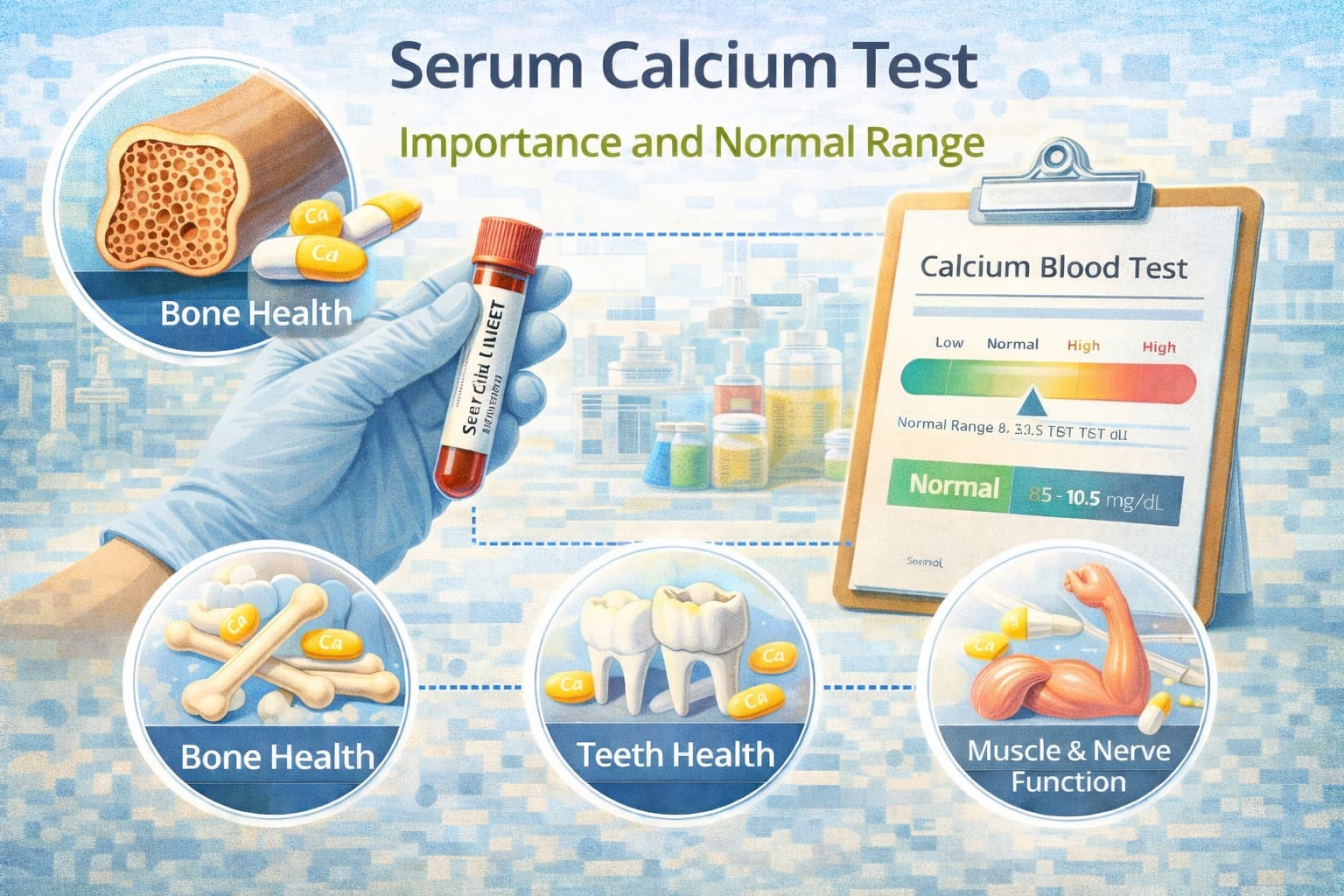
Calcium regulation reflects a broad spectrum of physiological functions, from neuromuscular stability to endocrine signaling. A calcium blood test measures the circulating concentration of calcium, which represents roughly 1% of total body calcium. The rest is stored in the skeletal matrix and dentition.
Adequate serum levels are essential for nerve conduction, muscle contraction, myocardial function, vascular tone, and hormone secretion. Any deviation can indicate primary or secondary systemic disorders, including parathyroid imbalance, renal impairment, vitamin D abnormalities, malignancy, and bone pathology.
This context positions the serum calcium test as a foundational investigation in diagnostics across general pathology, endocrinology, nephrology, critical care, and preventive diagnostics.
What is the Serum Calcium Test
A serum calcium test quantifies total calcium or ionised calcium in blood. Total calcium includes protein-bound (primarily albumin-bound), complexed, and free ionised fractions.
ionised calcium reflects physiologic activity and is unaffected by albumin shifts. So, it provides clearer clinical insight in acute care, renal disease, and critical metabolic disturbances.
| Parameter | Clinical Value | Considerations |
|---|---|---|
| Total Calcium | Widely used in routine panels and metabolic profiles | Influenced by albumin and pH; corrected values required |
| Ionised Calcium | Direct measure of active calcium | Needs strict pre-analytical handling and rapid processing |
Accurate interpretation of the test requires concurrent awareness of albumin, pH status, magnesium, phosphate, parathyroid hormone, and vitamin D levels.
Importance and Clinical Relevance
- Assessment of parathyroid activity (hyperparathyroidism, hypoparathyroidism).
- Evaluation of bone turnover abnormalities such as metabolic bone disease, osteolytic lesions, or malignancy-associated derangements.
- Monitoring renal function impairments, including failure-related hypercalcemia or secondary hyperparathyroidism.
- Investigation of neuromuscular symptoms driven by hypo- or hypercalcemia.
- Assessment of endocrine and oncologic disorders where calcium deregulation signals progression or underlying pathology.
- ICU monitoring, where acid–base disturbances alter ionised calcium.
Serum Calcium Test Normal Range
While reference intervals vary by laboratory methodology and population data, the serum calcium test normal range for adults generally aligns with the following.
| Parameter | Reference Range (Adult) | Notes |
|---|---|---|
| Total Calcium | 8.6 – 10.2 mg/dL | Interpret alongside serum albumin. |
| Ionised Calcium | 1.12 – 1.32 mmol/L | Sensitive to pH and specimen handling. |
Principle behind the Test
The serum calcium test principle in most analysers relies on one of two methods.
- Colorimetric assays using o-cresolphthalein complexone (OCPC) or Arsenazo III reagents. Calcium binds to a chromogenic compound, producing a measurable color shift proportional to concentration.
- Ion-selective electrode (ISE) technology for ionised calcium, measuring free calcium activity directly.
Colorimetric systems remain widely used for volume throughput, while ISE technologies integrate into critical care workflows.
Why is Serum Calcium Test Done
The serum calcium test purpose lies mainly on early identification of metabolic imbalance, treatment, medication adjustments, and risk detection for chronic endocrine disorders. For pathologists, structured incorporation of calcium values into interpretive algorithms adds precision in ruling in or ruling out systemic causes.
- Hypercalcemia screening in oncology.
- Hypocalcemia detection in neonatal and ICU settings.
- Pre-operative electrolyte profiling.
- Therapeutic monitoring for vitamin D and calcium supplementation.
- Calcium assessment during renal replacement therapy.
Sample Collection and Pre-Analytical Controls
A serum calcium test sample usually involves venous blood collected into plain tubes or serum separator tubes. For ionised calcium, stringent protocols are required to prevent pH shifts.
| Tube Type | Usage | Considerations |
|---|---|---|
| Plain/Red Top | Total calcium assay | No anticoagulants |
| Serum Separator Tube (SST) | Total calcium; convenient workflow | Gel barrier provides stability |
| Heparinized Syringe (Lithium Heparin) | Ionised calcium | Immediate analysis recommended |
Anticoagulants containing EDTA, citrate, or oxalate are unsuitable due to calcium chelation.
Pre-Test Requirements
For routine evaluation, fasting for the serum calcium test is not mandatory. But some labs prefer 8–12 hours without intake to maintain consistency when calcium is bundled within metabolic panels.
ionised calcium requires no fasting. But it needs controlled sampling conditions, including anaerobic handling.
Serum Calcium Test Procedure in the Pathology Lab
- Sample accessioning and barcoding to maintain traceability.
- Centrifugation for serum separation.
- Analyser calibration and QC verification.
- Loading samples into automated analysers.
- Colorimetric or ISE-based quantification.
- Result validation, including delta checks, albumin correction if required, and review of potential interferences (lipemia, hemolysis, paraproteins).
Turnaround Time and Reporting
The serum calcium test time varies across labs based on workflow efficiency, analyser throughput, and staffing. Most centers complete analysis within minutes once samples reach the bench. The overall turnaround time generally spans 1-3 hours for routine requests and significantly less for STAT cases.
A structured serum calcium test report includes the following.
- Measured total or ionised calcium.
- Reference interval.
- Albumin-corrected calcium (when indicated).
- Interpretive comments tailored to the clinical context.
- Flags for critical-high or critical-low values.
Integrating AI-Driven LIS for Superior Lab Workflows
Modern pathology demands precision, speed, regulatory compliance, and seamless coordination across departments. Flabs provides an AI-powered LIS ecosystem that strengthens every step of the serum calcium test lifecycle, from pre-analytical registration to interpretive reporting.
How Flabs Enhances Operations
- AI-Powered LIS Software for automated decision-support pathways.
- AI-Powered Pathology to elevate diagnostic accuracy.
- Lab Software trusted by NABL labs, aligning with stringent compliance standards.
- AI Interpretation to generate structured interpretive insights for calcium abnormalities.
- AI Test Suggestion to propose correlated investigations such as phosphate, magnesium, PTH, and vitamin D.
- AI Smart Report for clean, structured calcium reports.
- AI Flagger for critical alerts tied to calcium thresholds.
- AI Assistant that streamlines communication and workflow efficiency.
- TAT Management enabling real-time tracking and on-schedule report delivery.
- Lab Finance Management supporting invoicing and automated record maintenance.
- Multiple Referral Management to track sources and automate commissions.
- Bulk Actions including bulk registration, bulk approval, bulk report download, and bulk sharing through WhatsApp, SMS, and email.
- Quality Control (QC) automation to maintain regulatory standards for calcium assays.
- AI Voice Reporting to dictate calcium interpretations and convert them into polished reports.
- Patient Details customisation, essential for pediatric, geriatric, and condition-specific calcium evaluation.
- Custom test results formatting with controlled fonts and structured presentation.
- Note/Comment functions for rapid additions in reports.
- Dynamic QR Code for instant download of calcium reports.
- Bar Code integration for accurate tracking from sample receipt to report dispatch.
- Interpretation personalisation, ensuring calcium comments match lab protocols.
- Digital Signature management, supporting departments and multi-specialty setups.
Flabs creates a streamlined diagnostic pipeline for pathology labs in India, ensuring traceability, analytical precision, and operational scalability.
Common Interferences in Testing
- High bilirubin interferes with some colorimetric assays.
- Severe lipemia may require ultracentrifugation.
- Paraproteinemia affects total calcium interpretation.
- pH fluctuations alter ionised calcium rapidly.
Clinical Interpretation
Hyponormal and hypernormal levels prompt distinct diagnostic pathways:
Low Calcium (Hypocalcemia)
- Hypoparathyroidism
- Renal failure
- Magnesium deficiency
- Acute pancreatitis
- Massive transfusion
- Vitamin D deficiency
High Calcium (Hypercalcemia)
- Primary hyperparathyroidism
- Malignancy
- Granulomatous disease
- Endocrine disorders
- Immobilization-associated increases
Conclusion
The serum calcium test is indispensable in medicine due to its direct relationship with neuromuscular function, endocrinology, renal physiology, and systemic disease assessment. Strong analytical standards, robust pre-analytical controls, accurate reference intervals, and fast reporting strengthen clinical decision pathways across specialties.
With AI-driven digital infrastructure from Flabs, pathology labs gain operational discipline, traceability, and analytical excellence in handling high-volume serum assays.
Also check - Scrub Typhus Test: Detection and Procedure
Get Started at ₹1!
Try Flabs for a full month for just ₹1.
Follow us on