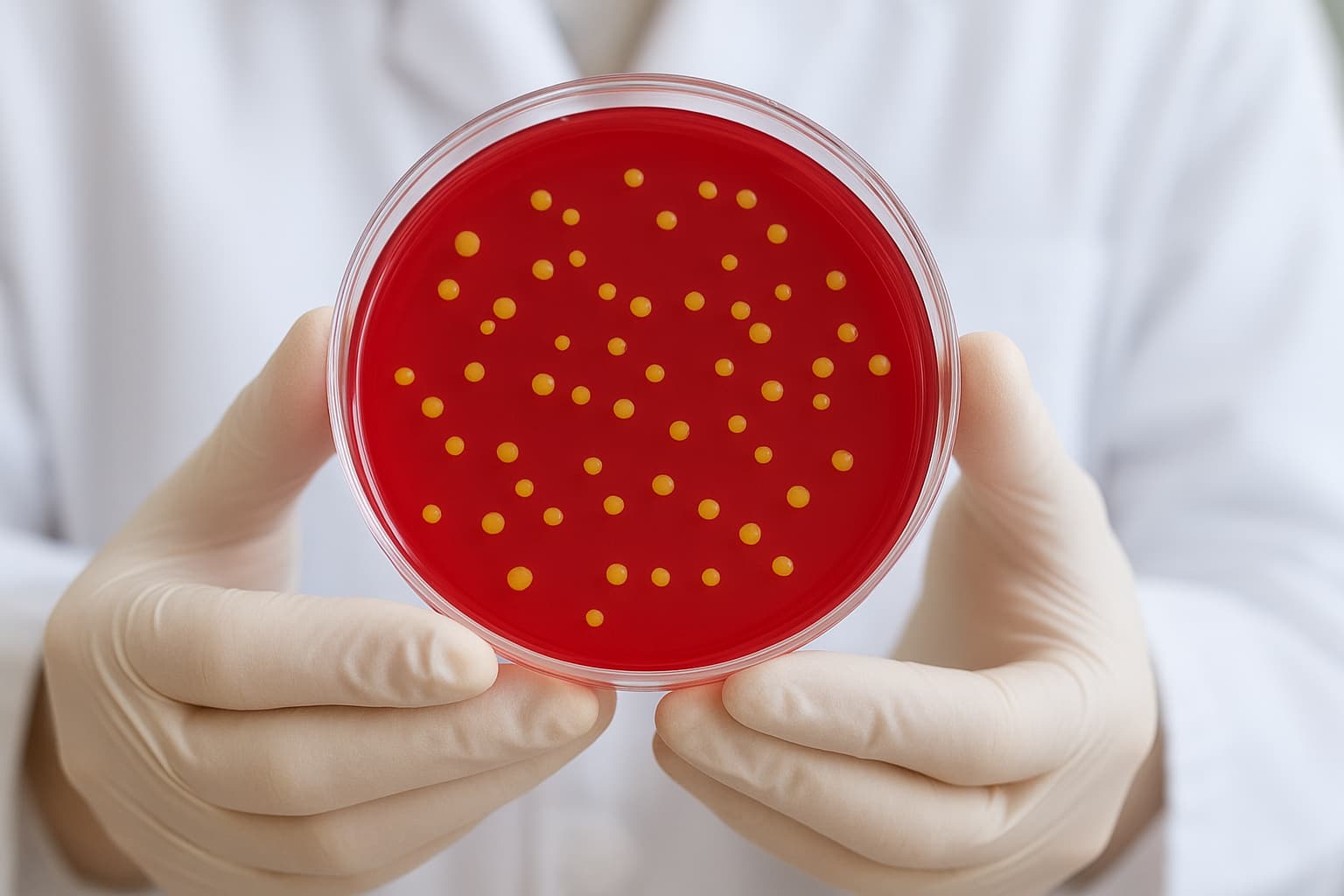
Agar plates remain a foundation of laboratory practice in pathology and clinical microbiology tests. From routine culture in diagnostic labs to research and pharmaceutical testing, microbiology agar plates deliver consistent, reproducible environments for microbial growth. Their reliability allows pathologists and healthcare professionals to isolate organisms, perform antibiotic susceptibility tests, and monitor environmental contamination with precision.
What Are Agar Plates?
An agar plate refers to a sterile Petri dish filled with a solidified agar-based nutrient medium. The gel is derived from red seaweed (traditionally called agar-agar in Malay) and has been part of human culture for centuries as a food ingredient. Its suitability for laboratory use surfaced in the 17th century in Japan, and its formal introduction to microbiology came later.
In 1882, Fanny Hesse suggested agar to Robert Koch’s laboratory as a heat-stable substitute for gelatin. Agar withstands high temperatures during sterilisation, remains firm during incubation, and melts only near ~85°C. The Petri dish, introduced in 1887, completed the system still used today.
Agar’s high gel strength and minimal interaction with bacterial enzymes keep the medium structurally stable. These characteristics support culture, isolation, and observation of bacteria, fungi, and select fastidious organisms.
Agar Plate Structure and Composition
| Component | Function |
|---|---|
| Agar (1–2%) | Solidifying agent; biologically inert |
| Water | Medium base |
| Peptones | Source of amino acids and nitrogen |
| Yeast or beef extract | Growth factors, vitamins |
| Salts | Osmotic balance |
| Additional supplements | For example, blood, carbohydrates, dyes, antibiotics for selective properties |
Why Agar?
Agar is favored because,
- It stays solid at incubation temperatures used for bacterial growth.
- Microbes rarely degrade it.
- Surface morphology and colony characteristics remain easy to inspect.
Not all organisms grow on agar plates. Viruses require living cells. Anaerobes need controlled oxygen environments. Fastidious species require enriched formulations.
Still, agar plates in microbiology provide standardised tools for a wide range of diagnostics.
Types of Agar Plates and Their Uses
| Type of Agar Plate | Primary Use | Key Feature |
|---|---|---|
| Nutrient Agar | General maintenance of non-fastidious isolates | Basic nutritionally rich medium |
| Blood Agar | Culture of fastidious pathogens | Supports hemolysis observation |
| Haemophilus, Neisseria | Haemophilus, Neisseria | Heated blood releases NAD and hemin |
| MacConkey Agar | Enteric Gram-negative identification | Selective and differential based on lactose fermentation |
| EMB Agar | Coliform differentiation | Metallic sheen for E. coli on lactose fermentation |
| Sabouraud Agar | Yeasts and fungi | Low pH discourages bacterial growth |
| Selective Antibiotic Media | MRSA, VRE, etc. | Target-specific inhibition |
| Chromogenic Media | Color-based species distinction | Rapid visual differentiation |
Agar Plate Method: Preparation Basics
- Measure and hydrate agar with chosen nutrient formulation.
- Sterilise through autoclaving.
- Cool to 45–50°C to avoid condensation and thermal shock.
- Pour into sterile Petri dishes.
- Allow solidification.
- Store sealed to maintain sterility and moisture balance.
Although many clinical labs purchase pre-poured plates, staff still monitor storage conditions and acceptance quality.
Inoculation Approaches
- Streak plate technique: Used for isolating single colonies from mixed specimens.
- Spread plate: Used for colony quantification (CFU enumeration).
- Pour plate: Useful for samples requiring growth throughout the medium, not only surface.
- Dilution methods: Applied when microbial load is high to ensure readable distribution.
Applications in Healthcare
Pathologists and microbiologists apply agar plates for,
- Pathogen identification in patient samples.
- Antimicrobial susceptibility testing, including standard zones of inhibition.
- Environmental screening in hospitals, pharma cleanrooms, and water systems.
- Food and beverage microbiology.
- Research on microbial diversity and behavior.
Performance and Quality Control
While agar plates have indispensable uses, their functionality depends heavily on how they are handled during testing processes. Maintaining optimal conditions is mandatory to get accurate results.
Growth Promotion Testing (GPT)
Each new manufacturing batch undergoes GPT, especially for pharmaceutical applications. If inconsistent colony morphology or low recovery shows up, repeating with a fresh reference strain becomes important before rejecting the batch outright. Misinterpretation during testing can lead to unnecessary wastage.
Condensation Challenges
Excess condensation can render plates unusable by causing pooled moisture that spreads inoculum. Factors linked to condensation:
- Abrupt temperature shifts during transport.
- Storage near heat sources or sunlight.
- Doorway drafts.
Manufacturers apply pre-conditioning procedures to prevent moisture shock. Stable ambient storage on-site lowers risk.
Storage
There is a long-standing habit in clinical environments to refrigerate all plates. Yet many validated commercial products remain stable at room temperature:
- Refrigeration may introduce condensation during warm-up.
- Short-term deviations (<5 days) can remain acceptable; moisture redistributes if plates equilibrate before use.
- Avoid stacking near walls or vents.
Sterility Monitoring
Agar plates are aseptically filled, not terminally sterilised. As the product approaches end-of-shelf life, occasional isolated colonies might appear in sealed, non-selective media. Causes include:
- Packaging breaches.
- Handling errors post-opening.
- Transport vibration causing slight lid shifts
Reputable suppliers replace uncontaminated sealed packaging without resistance.
Limitations to Consider
- Some organisms fail to grow on artificial media.
- Plate thickness and nutrient limitation may affect slow growers.
- Organisms inhabiting complex tissues or biofilms may behave differently.
- Poor aseptic technique introduces erroneous microbial presence.
Agar Plate Price in India
Price of agar plates vary based on composition, volume, and sterility assurance level. Hospitals, labs, and pharma facilities frequently purchase in bulk. The cost varies depending on the following factors.
- Enriched media formulations (blood, chocolate) at the higher end.
- Chromogenic and antibiotic-selective plates priced for specialized use.
- Transportation needs where cold-chain affects logistics
While pricing landscapes shift, laboratories emphasize performance reliability, supply continuity, and quality certification over minimal cost.
Summary
- Agar plate in microbiology remains essential for culture-based diagnostics.
- Historical development provides a scientifically stable platform still favored worldwide.
- Diverse types of agar plates and their uses align with targeted organism detection.
- Performance success depends on storage discipline, strain quality, and inoculation technique.
- Agar plates for bacterial growth continue supporting evidence-based patient care.
Reliable laboratory outcomes depend on strong technique and trusted suppliers rather than improvisation under pressure.
Also check - Uses of Agar in Microbiology and Culture Techniques
Get Started at ₹1!
Try Flabs for a full month for just ₹1.
Follow us on