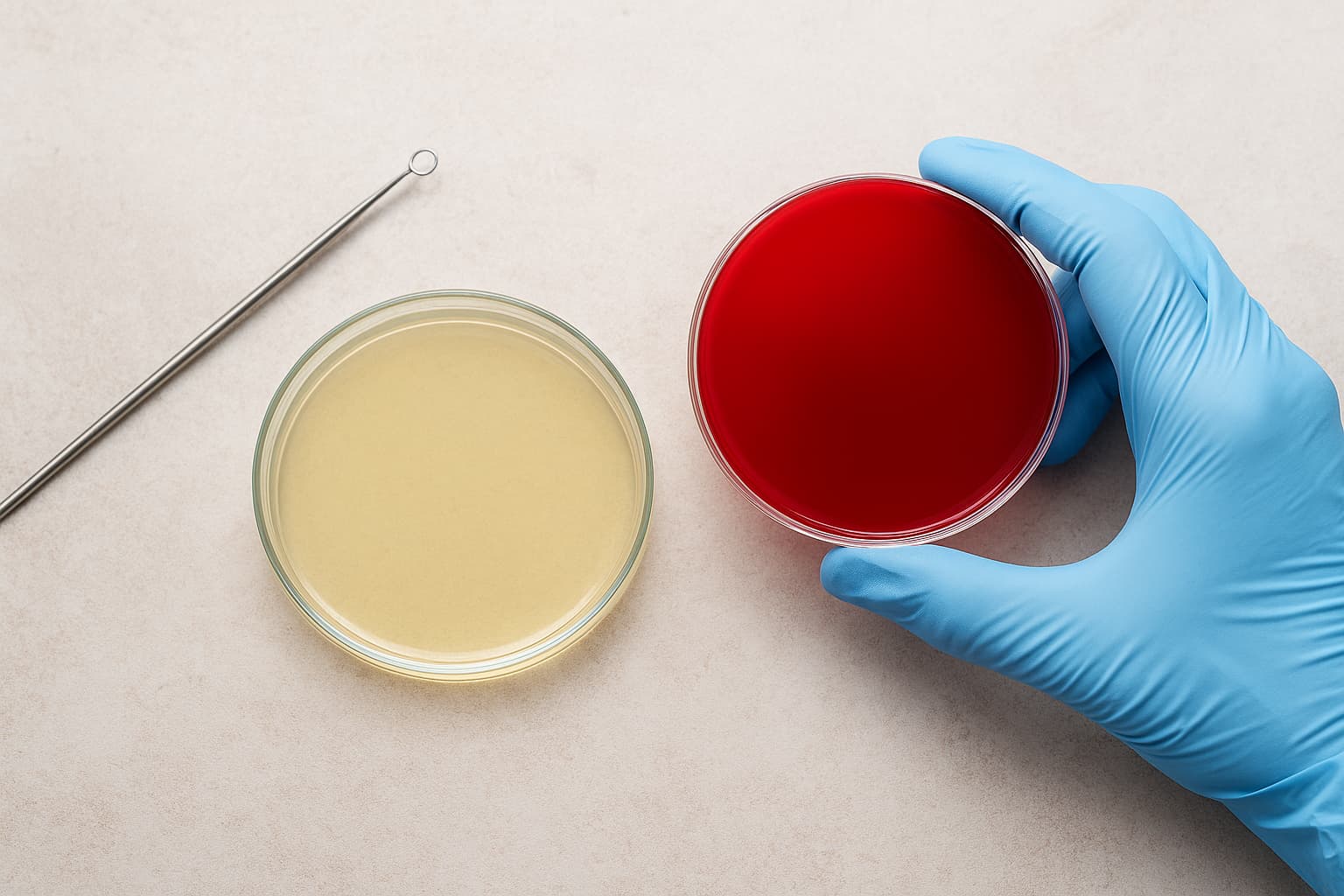
Agar plays a pivotal role in clinical and diagnostic microbiology. For pathologists and healthcare professionals, it serves as the foundational medium that supports microbial growth and identification. Derived from red algae, agar provides a stable, reproducible surface where microorganisms develop in a controlled environment. Its relevance extends from basic bacteriological studies to complex diagnostic assays used in clinical laboratories.
Uses of Agar in Microbiology
Agar is indispensable in microbiology because it provides a solid surface that allows isolated colonies of bacteria to grow. It facilitates differentiation between species and helps determine colony morphology, pigmentation, and hemolytic activity. Its ability to remain solid at incubation temperatures distinguishes it from other gelling agents.
In culture techniques, agar supports growth while maintaining a non-nutritive base unless supplemented with specific ingredients. Microorganisms do not metabolise agar. It ensures that the integrity of the medium remains constant during incubation. This consistency is imperative when isolating mixed bacterial populations from clinical samples, e.g., urine, sputum, or wound swabs.
For diagnostic microbiology, agar enables selective and differential culturing. Selective media inhibit unwanted microorganisms, while differential media reveal biochemical traits through colour changes or pH indicators. Such properties make agar the standard for clinical culture work.
Types of Agar in Microbiology
Microbiological research and clinical diagnostics use various agar types depending on the organism of interest and the diagnostic purpose. The following table summarises common types of agar used in microbiology and their applications.
| Type of Agar | Composition and Purpose | Primary Use in Microbiology |
|---|---|---|
| Nutrient Agar | Simple peptone and beef extract medium | Growth of non-fastidious organisms |
| Blood Agar | Enriched with 5% sheep or horse blood | Detection of hemolysis in Streptococcus species |
| MacConkey Agar | Contains bile salts, lactose, and crystal violet | Differentiation of Gram-negative enteric bacilli |
| Mannitol Salt Agar | High salt concentration with mannitol and phenol red | Isolation of Staphylococcus species |
| Chocolate Agar | Heated blood provides NAD (V factor) and hemin (X factor) | Cultivation of Haemophilus and Neisseria species |
| Sabouraud Dextrose Agar | Peptone, dextrose, and low pH | Fungal and yeast isolation |
| XLD Agar | Xylose, lysine, deoxycholate, and phenol red | Isolation of Salmonella and Shigella species |
| CLED Agar | Cystine, lactose, and bromothymol blue | Urinary tract pathogen isolation |
| Mueller-Hinton Agar | Non-selective, starch-based medium | Antibiotic susceptibility testing |
Each agar type provides specific nutrients, indicators, and inhibitory agents that guide diagnostic interpretation.
Properties of Agar in Microbiology
Melting and Solidification: Agar melts near 85°C but solidifies around 40°C, enabling the addition of heat-sensitive nutrients after sterilisation. Once solidified, it remains stable at incubation temperatures up to 45°C.
Transparency: The clear gel allows visual observation of colonies and pigment production, aiding accurate interpretation.
Inert Nature: Microbes cannot digest agar, maintaining structural stability through prolonged incubation.
Consistent Texture: Its smooth, firm surface supports even streaking and isolation of discrete colonies.
How is Agar Manufactured?
The production of agar has evolved significantly since its early extraction from Gelidium amansii. Heavy reliance on this algae once led to resource shortages, prompting researchers to identify new agarophyte sources. Gracilaria soon became a viable alternative, though early extracts produced a weak gel known as “agroids.”
Japanese scientist Yaganwa refined this by applying alkaline hydrolysis, transforming Gracilaria-based agar into a strong, uniform product suitable for microbiological media.
Two modern manufacturing processes are now used.
1. Freezing–Thawing Method
Extracted agar is frozen, then thawed and filtered to concentrate the gel. While effective, this process requires substantial energy and yields a lower dry weight extract—about 11%.
2. Syneresis Method
A more advanced and efficient process, syneresis involves enclosing the extracted agar in a fine mesh cloth and applying horizontal hydraulic pressure. This expels water and impurities, producing a higher-purity agar with a dry weight extract of around 20%. It is more energy-efficient and cost-effective than the freezing–thawing method.
Gel Temperatures of Agar from Different Algae
| Algae Source | Gel Temperature |
|---|---|
| Gelidiella | 42–45°C |
| Gracilaria | 40–42°C |
| Gelidium | 36–38°C |
| Pterocladia | 33–35°C |
The gel strength and gelling temperature vary depending on the algal species, which influences agar’s physical behaviour and suitability.
Agar in Culture Techniques
Agar is used in various microbiological culture methods.
1. Streak Plate Method
Used to isolate pure colonies from mixed samples. A sterile loop streaks the inoculum across the agar surface in decreasing concentrations. It yields discrete colonies for further identification and susceptibility testing.
2. Pour Plate Method
A liquid sample is mixed with molten agar before solidification. Colonies develop within and on the surface of the medium, allowing quantitative microbial estimation.
3. Spread Plate Method
A measured liquid inoculum is evenly spread on a solidified agar plate. This technique enables the enumeration of microbial colonies, particularly in water or food microbiology.
4. Slant Culture Method
Agar solidified at an angle within test tubes provides increased surface area for maintenance and biochemical testing of isolates.
5. Deep Tube Culture
Agar is allowed to solidify upright, permitting observation of motility and oxygen requirements among anaerobes and facultative organisms.
These culture methods, standardised worldwide, rely on agar’s versatility and non-reactive stability.
Role of Agar in Diagnostic Microbiology
In diagnostic laboratories, agar-based culture media provide essential data for infection management. Growth patterns, pigment production, and biochemical reactions guide pathogen identification. Blood agar, for example, differentiates streptococci through hemolysis types, while MacConkey agar reveals lactose fermentation, which is a major feature in differentiating E. coli from Salmonella.
In susceptibility testing, Mueller-Hinton agar ensures accurate diffusion of antibiotics, supporting standardised antimicrobial resistance profiling. For fungal diagnostics, Sabouraud agar supports the reliable culture of dermatophytes and systemic fungi.
Agar also aids in quantifying microbial load. It assesses sample contamination and monitors sterility in pharmaceutical and hospital environments.
Types of Agar Used in Microbiology Laboratories
Different departments within microbiology utilise agar differently:
- Bacteriology: Uses nutrient, blood, and MacConkey agars for routine cultures.
- Mycology: Employs Sabouraud agar for fungal isolation.
- Virology: Utilises agar overlays in plaque assays to restrict viral spread.
- Clinical Diagnostics: Relies on selective and differential agar for pathogen identification.
- Antimicrobial Testing: Depends on standardised media like Mueller-Hinton agar.
Quality and Preparation Considerations
For consistent performance, agar media require precise preparation. The powder must dissolve completely in distilled water before sterilisation at 121°C for 15 minutes. The pH and final gel firmness must be checked before pouring plates. Deviations may alter microbial growth and affect diagnostic accuracy.
Storage under controlled temperature and humidity prevents dehydration and contamination. In clinical settings, adherence to these practices maintains reproducibility and ensures reliable patient results.
Conclusion
Agar remains indispensable in microbiology for its ability to create reproducible, non-nutritive, and stable media surfaces. From general cultivation to selective and differential diagnostic tests, it provides the framework upon which microbial identification depends. For pathologists and healthcare professionals, its use underpins diagnostic precision and informs therapeutic direction.
Get Started at ₹1!
Try Flabs for a full month for just ₹1.
Follow us on