A growing number of clinicians are turning to Anti-Müllerian Hormone (AMH) measurements for clearer insight into ovarian physiology and fertility planning. As patient expectations rise and diagnostic timelines become tighter, laboratories play an essential role in delivering accurate AMH data to guide treatment choices.
The AMH assay is a stable biomarker that remains steady throughout the cycle, which gives clinicians a dependable signal in a field filled with fluctuating hormones.
What AMH Represents in Clinical Practice
Anti-Müllerian hormone is produced by granulosa cells of small antral and pre-antral follicles in females, and the testes in developing male infants. AMH levels in females rise near puberty, track with ovarian follicle activity, and gradually fall with age.
Since serum AMH reflects the pool of remaining follicles, it gives laboratories and fertility specialists a practical tool for assessing ovarian reserve.
Anti-Müllerian Hormone Function
- In female development, low fetal AMH allows Müllerian ducts to form the uterus, fallopian tubes, and upper vagina.
- In males, high fetal secretion causes Müllerian ducts to regress, shaping male reproductive anatomy.
- In adult females, AMH mirrors the number of available follicles, thereby informing decisions related to stimulation protocols, fertility preservation, and long-term reproductive planning.
What the AMH Test Measures
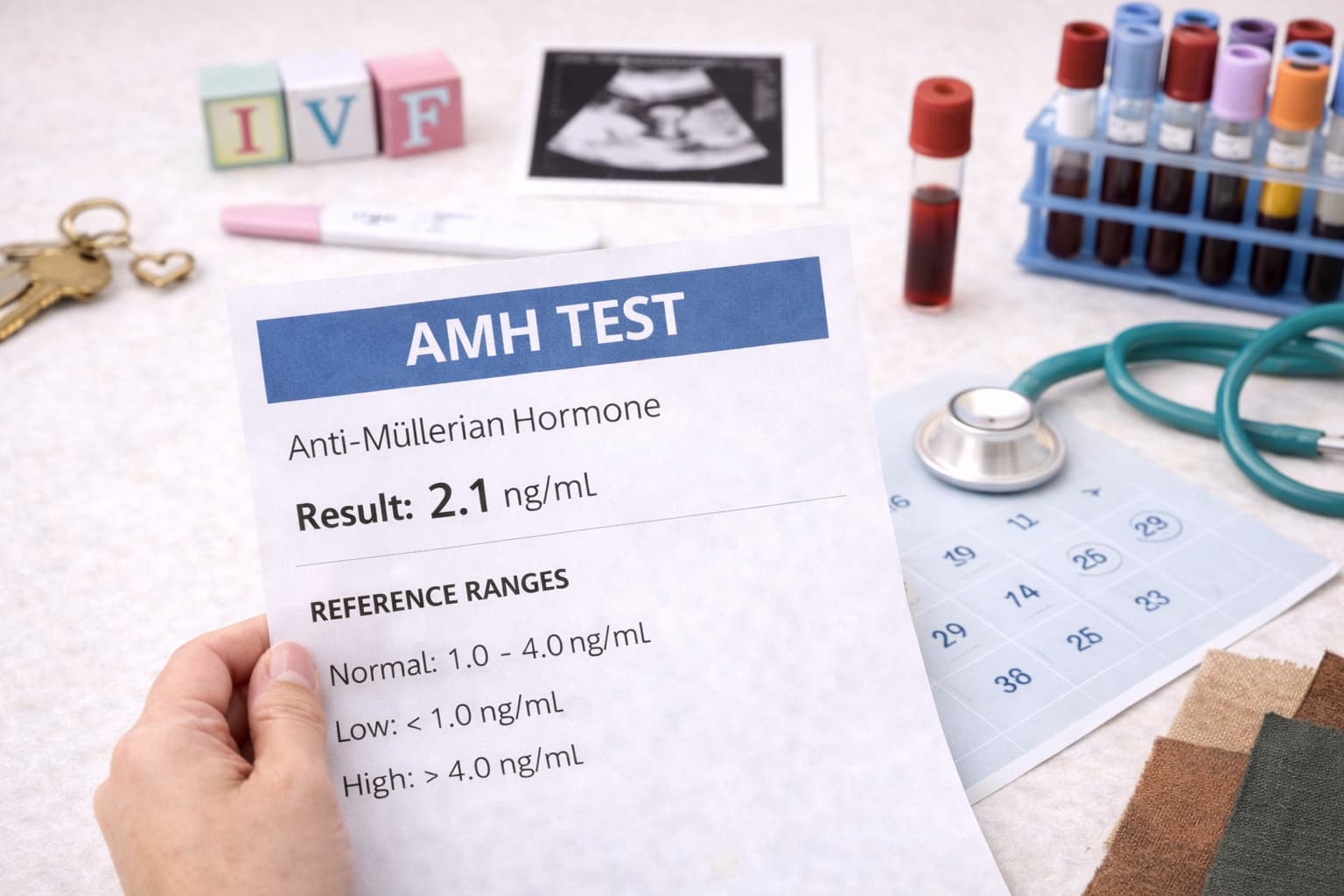
The AMH test full form is Anti-Müllerian Hormone assay. Accordingly, it is a serum-based immunoassay. It quantifies AMH levels and provides a window into ovarian reserve. Since AMH shows minimal cycle variation, sample collection can be scheduled at any point.
The measurement acts as a surrogate marker for antral follicle count, enabling fertility specialists to anticipate how patients might respond to pharmacologic stimulation.
How the AMH Test Is Done
A standard venous blood collection procedure is performed, followed by processing with ELISA or an equivalent immunoassay platform. The assay relies on AMH in the specimen binding to capture molecules, then generating a measurable signal. Results are released as nanograms per milliliter.
Preparing Patients
Patients rarely require advance preparation. Hydration can ease venous access. Clinicians may discuss medications if hormonal therapies are part of treatment. Relaxation techniques benefit individuals with phlebotomy anxiety.
AMH Levels in Females and Fertility
AMH levels in fertility workups serve multiple purposes. Laboratories issue AMH test reports to support:
- Ovarian reserve assessment.
- IVF protocol design.
- Egg-freezing considerations.
- Monitoring during controlled ovarian stimulation.
- Evaluation of early or premature menopause.
- PCOS-related pattern recognition.
- Surveillance of granulosa cell tumors.
- Assessment after ovarian surgery or gonadotoxic therapy.
While AMH alone cannot comment on egg quality, ovulation, tubal patency, or sperm factors, it remains a steady indicator of follicular quantity.
AMH Normal Value and Reference Ranges
Laboratories frequently field questions from clinicians regarding AMH normal value ranges for different age groups. Though reference intervals vary across platforms, the following table captures widely referenced estimates used in many fertility centers.
AMH Normal Range by Age
| Age Group | Approximate Values (ng/mL) |
|---|---|
| 20–29 | 3.0–5.0 |
| 30–39 | 1.5–3.5 |
| 40–44 | 0.5–1.5 |
| 45+ | Below 0.5 |
Interpretation patterns in routine reporting:
- Average levels tend to fall between 1.0 and 3.0 ng/mL.
- Low values appear below 1.0 ng/mL.
- Very low values fall below 0.4 ng/mL.
- Elevated readings may indicate PCOS, although high AMH levels alone are insufficient for a diagnosis.
Age-associated approximations reported in literature:
- Around 3.0 ng/mL at 25 years
- Around 2.5 ng/mL at 30 years
- Around 1.5 ng/mL at 35 years
- Around 1.0 ng/mL at 40 years
- Around 0.5 ng/mL by 45 years
These values inform the AMH level for pregnancy expectations during fertility evaluation, although no single AMH value for pregnancy guarantees conception.
More Clinical Applications
Menopause Evaluation: Lower serum AMH suggests diminished ovarian reserve. While AMH cannot pinpoint the exact menopause timeline, persistently low values support the diagnosis of premature ovarian insufficiency or a faster decline in follicular activity.
PCOS Evaluation: Due to increased follicle numbers, individuals with PCOS frequently show higher AMH levels. Measurement assists clinicians in forming a broader diagnostic picture in conjunction with ultrasound and hormone profiles.
Granulosa Cell Tumors: Rising AMH in follow-up appointments may indicate tumor recurrence. Laboratories that track trends longitudinally provide essential decision support to oncologists.
Pediatric and Neonatal Uses: In male infants, AMH can distinguish absent testes from undescended but functional ones.
In newborns with atypical genitalia, AMH complements chromosomal and imaging studies to determine the presence of functioning testicular tissue.
What AMH Can and Cannot Reveal
AMH Can
- Reflect ovarian reserve size.
- Indicate the likely response to stimulation medications.
- Offer a perspective on ovarian aging speed.
- Support granulosa tumor monitoring.
- Confirm functioning testes in infants.
AMH Cannot
- Predict natural conception capability.
- Determine egg quality.
- Confirm ovulation.
- Indicate tubal or uterine factors.
- Forecast the exact onset of menopause.
Factors Influencing AMH Levels
Several influences can shift serum AMH upward or downward. Age contributes the most consistent downward trajectory. PCOS elevates levels. Ovarian surgery reduces measured concentrations. Chemotherapy and radiation may suppress ovarian tissue function. Lifestyle factors such as smoking may reduce AMH over time, and hormonal medications can modulate readings slightly.
Interpreting Abnormal Results
Low AMH may correspond to reduced ovarian reserve, weaker response to stimulation medications, premature ovarian insufficiency, post-surgical reduction in ovarian tissue, and chemotherapy-associated decline.
High AMH may correspond to:
- PCOS
- Granulosa cell tumors in isolated situations
Interpretation must be contextual, since amh normal range values alone cannot determine treatment strategy.
Risks and Patient Considerations
The AMH test has minimal procedure-related risks outside minor bruising or transient discomfort. Rarely, a vasovagal response or small hematoma occurs. As fertility assessments carry emotional weight, laboratories can support clinicians by delivering consistent, well-structured AMH reports that reduce confusion and improve care conversations.
Integrating AMH Testing with Flabs LIS Software
As AMH becomes a regular part of fertility workups, laboratories face greater demand for rapid reporting, lower error rates, and consistent reference formatting.
Flabs Pathology Software supports these needs through an AI-powered LIS built for high-throughput environments, delivering serum AMH reports.
Flabs streamlines registration, automates workflow steps, and generates structured, QR-coded reports that clinicians access quickly.
AMH report retrieval becomes smoother through WhatsApp-integrated communication, which reduces manual follow-ups and keeps clinicians informed without delay.
Its patient portal enables individuals to access their AMH test report with their phone number, easing administrative load on the lab.
For laboratories scaling fertility services, Flabs offers:
- A user-friendly interface that technicians adapt to rapidly.
- Secure data backups and compliant data protection.
- Expansion capability for multi-site or multi-center operations.
- A fully digital workflow that fits seamlessly into AMH, hormone, and oncology panels
Laboratories exploring more efficient AMH workflows can start a free 5-day trial by entering basic details and receiving a hands-on demo of how Flabs elevates reporting accuracy and operational efficiency.
Final Thoughts
AMH testing has become a steady fixture in fertility and endocrine evaluation. While AMH normal value ranges contribute meaningful context, interpretation must remain multi-dimensional. Laboratories that adopt streamlined digital systems can deliver high-quality AMH assessments with speed and clarity, positioning clinical teams to make more informed decisions.
If your laboratory is expanding fertility diagnostics or refining AMH reporting standards, Flabs LIS Software is a modern infrastructure built for precision, scalability, and clinician-friendly output. You may begin a trial anytime and experience its workflow advantage firsthand.
Also check - DLC Test: Understanding White Blood Cell Distribution
Get Started at ₹1!
Try Flabs for a full month for just ₹1.
Follow us on