Hemostasis relies on a precise physiological balance between coagulation factors and inhibitors to prevent excessive bleeding or thrombosis. The APTT test serves as a primary screening assay to evaluate the functional integrity of the intrinsic and common pathways within the coagulation cascade.
Beyond basic screening, activated partial thromboplastin time (APTT) facilitates the monitoring of unfractionated heparin therapy and the identification of specific coagulation factor deficiencies. We will examine the procedural nuances, analytical variables, and interpretative strategies required for accurate diagnosis and patient management in a clinical setting.
The Clinical Scope of APTT
For pathologists and clinicians, the APTT full form in medical terminology, i.e., Activated Partial Thromboplastin Time, denotes its specific methodology. Unlike the standard PTT, an activator (e.g., silica, celite, or ellagic acid) speeds up the clotting time, providing a narrower, more sensitive reference range.
It specifically measures the efficacy of Factors XII, XI, IX, and VIII (intrinsic pathway) as well as Factors X, V, II (prothrombin), and I (fibrinogen) in the common pathway. It does not assess Factor VII or Factor XIII.
Consequently, the APTT test becomes essential when investigating:
- Unexplained Haemorrhage: Patients presenting with hematomas, hemarthrosis, or prolonged mucosal bleeding.
- Heparin Management: Monitoring unfractionated heparin (UFH) requires frequent assessment to maintain therapeutic levels, unlike Low Molecular Weight Heparin (LMWH).
- Pre-operative Screening: Identifying asymptomatic coagulopathies prior to major surgery.
- Liver Function: Since the liver synthesises most clotting factors, chronic hepatic disease often manifests as prolonged clotting times.
Pre-Analytical Variables and Procedure
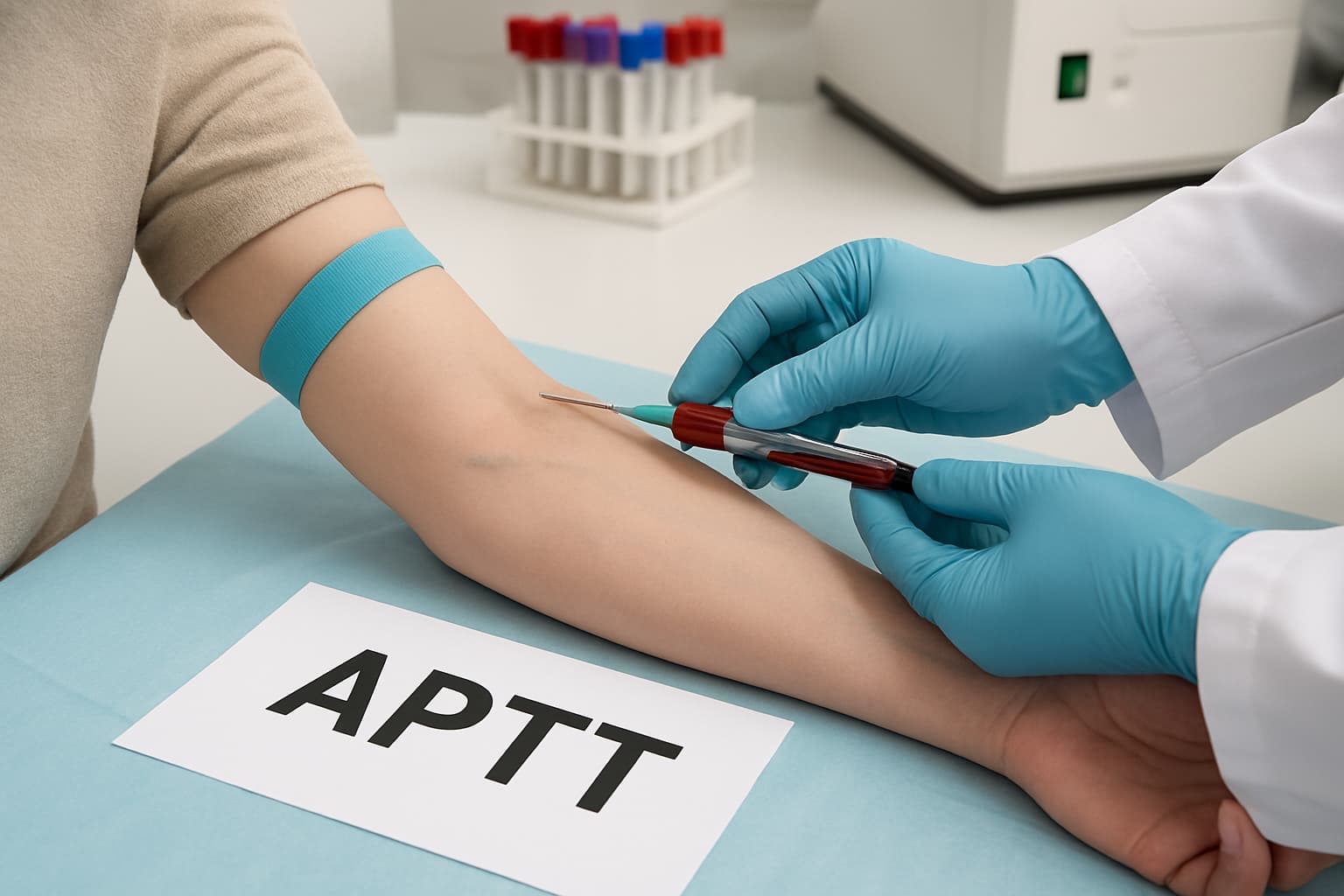
Accuracy begins before the sample reaches the analyser. Blood collection methods significantly influence the reliability of an APTT test report.
Sample Collection and Preparation
The standard specimen requirement involves whole blood collected in a 3.2% sodium citrate tube. A blue top collection tube is used. The ratio of blood to anticoagulant must remain strictly at 9:1. Under-filling the tube results in excess citrate, which binds calcium excessively and falsely prolongs the APTT time. Conversely, polycythemic patients (hematocrit >55%) require an adjustment in citrate volume to avoid erroneous results.
Processing and Turnaround Time
Once collected, the sample requires centrifugation to obtain platelet-poor plasma (PPP). Residual platelets can neutralise heparin or release platelet factor 4, skewing results. Most laboratories maintain a strict turnaround time, generally analysing the sample within four hours of collection to prevent the degradation of labile factors like Factor VIII.
The APTT Test Procedure
In the laboratory, the APTT test procedure involves two main steps:
- Activation: The platelet-poor plasma mixes with a phospholipid reagent and a contact activator (e.g., kaolin or silica). The mixture is incubated at 37°C for a set period to activate Factors XII and XI.
- Recalcification: Calcium chloride is added to initiate the clotting cascade. The analyser measures the time in seconds until a fibrin clot forms.
Interpretation: Normal vs. Abnormal
Interpreting the results requires knowledge of the APTT test normal range established by the specific laboratory. Reagent sensitivity varies, meaning "normal" differs slightly between institutions.
| Parameter | Patient State | Reference Range (Seconds) |
|---|---|---|
| aPTT | Healthy Adult | 30 – 40 (often ≤ 35) |
| PTT | Healthy Adult | 60 – 70 |
| aPTT | On Heparin Therapy | 60 – 80 |
| PTT | On Heparin Therapy | 120 – 140 |
Simultaneously, the lab runs an APTT control value using normal plasma to validate the reagent system and instrument performance.
Normal APTT Levels
Generally, the normal APTT levels fall between 30 and 40 seconds. However, in infants, the range may extend higher due to immature hepatic function. A result within this bracket suggests adequate concentrations (usually >30%) of the intrinsic and common pathway factors.
Therapeutic Ranges
For patients on unfractionated heparin, the target usually aims for 1.5 to 2.5 times the baseline control value. It translates to a desired range of nearly 60 to 80 seconds.
Analysing High and Low Values
When a high APTT test result appears (prolonged time), it indicates a delay in clot formation. Conversely, a shortened time has different clinical implications.
Causes of Prolonged APTT
- Factor Deficiencies: Haemophilia A (Factor VIII deficiency) and Haemophilia B (Factor IX deficiency) remain the classic congenital causes.
- von Willebrand Disease (vWD): Severe vWD can reduce Factor VIII levels, secondarily prolonging the APTT.
- Lupus Anticoagulant: Paradoxically, this antibody prolongs the partial thromboplastin time in vitro (in the test tube) but associates with a hypercoagulable state (thrombosis) in vivo.
- Vitamin K Deficiency: While primarily affecting the PT, severe deficiency impacts Factors IX, X, and II, eventually elongating the APTT.
- Liver Disease: Cirrhosis or severe hepatitis reduces factor synthesis.
Causes of Shortened APTT
While less discussed, an abnormally short APTT time reflects a hypercoagulable state. This may occur during acute inflammation (high Factor VIII or fibrinogen as acute phase reactants) or during difficult blood draws, triggering tissue factor release. It may suggest an increased risk of venous thromboembolism.
APTT Test in Pregnancy
Physiological hypercoagulability defines pregnancy. Clotting factors (specifically VIII, X, and fibrinogen) increase, while protein S decreases. Therefore, the APTT test in pregnancy reports can show values at the lower end of the reference range. A prolonged result in a pregnant patient warrants immediate investigation for underlying autoimmune conditions or carrier status for haemophilia.
Distinguishing PT and APTT
Clinicians rarely order the APTT in isolation. Comparing Prothrombin Time (PT) vs APTT provides a comprehensive view of the coagulation status. While the APTT covers the intrinsic pathway, the Prothrombin Time (PT) assesses the extrinsic pathway (Factor VII).
| Feature | APTT (Activated Partial Thromboplastin Time) | PT (Prothrombin Time) |
|---|---|---|
| Pathway Assessed | Intrinsic (XII, XI, IX, VIII) & Common (X, V, II, I) | Extrinsic (VII) & Common (X, V, II, I) |
| Primary Monitor For | Unfractionated Heparin (UFH) | Warfarin (Coumadin) |
| Reference Interval | APTT test normal range: 30–40 seconds | 11–13.5 seconds (INR 0.8–1.1) |
| Sensitivity | Detects Haemophilia A/B, vWD (severe) | Detects Vitamin K deficiency, Liver dysfunction |
| Specimen | Citrated Plasma (Blue Top) | Citrated Plasma (Blue Top) |
APTT Test Report Format
A standard APTT test report format includes the patient’s result, the laboratory’s reference interval, and the control value for that batch. Advanced reports may include historical data to track trends, specifically for patients on anticoagulation protocols.
Pathologists must verify that PT APTT normal values align with the specific reagent lot in use. Variations in phospholipid composition between reagent manufacturers mean that a result of 38 seconds might be normal in one facility but borderline high in another.
Closure
The APTT test is a fundamental tool in hematologic investigation. Its value lies not just in the number generated, but in the context of the patient's clinical presentation and concurrent PT and APTT test findings. By adhering to strict blood collection methods, minimising pre-analytical errors, and understanding the nuances of normal APTT levels versus pathological variance, healthcare professionals ensure precise diagnosis and safe therapeutic management.
From pre-operative assessment to managing complex coagulopathies, the Activated Partial Thromboplastin Time provides the data necessary to navigate the intricate physiology of human hemostasis.
Also check - Agar Plate: Uses in Microbiology and Lab Testing Basics
Get Started at ₹1!
Try Flabs for a full month for just ₹1.
Follow us on