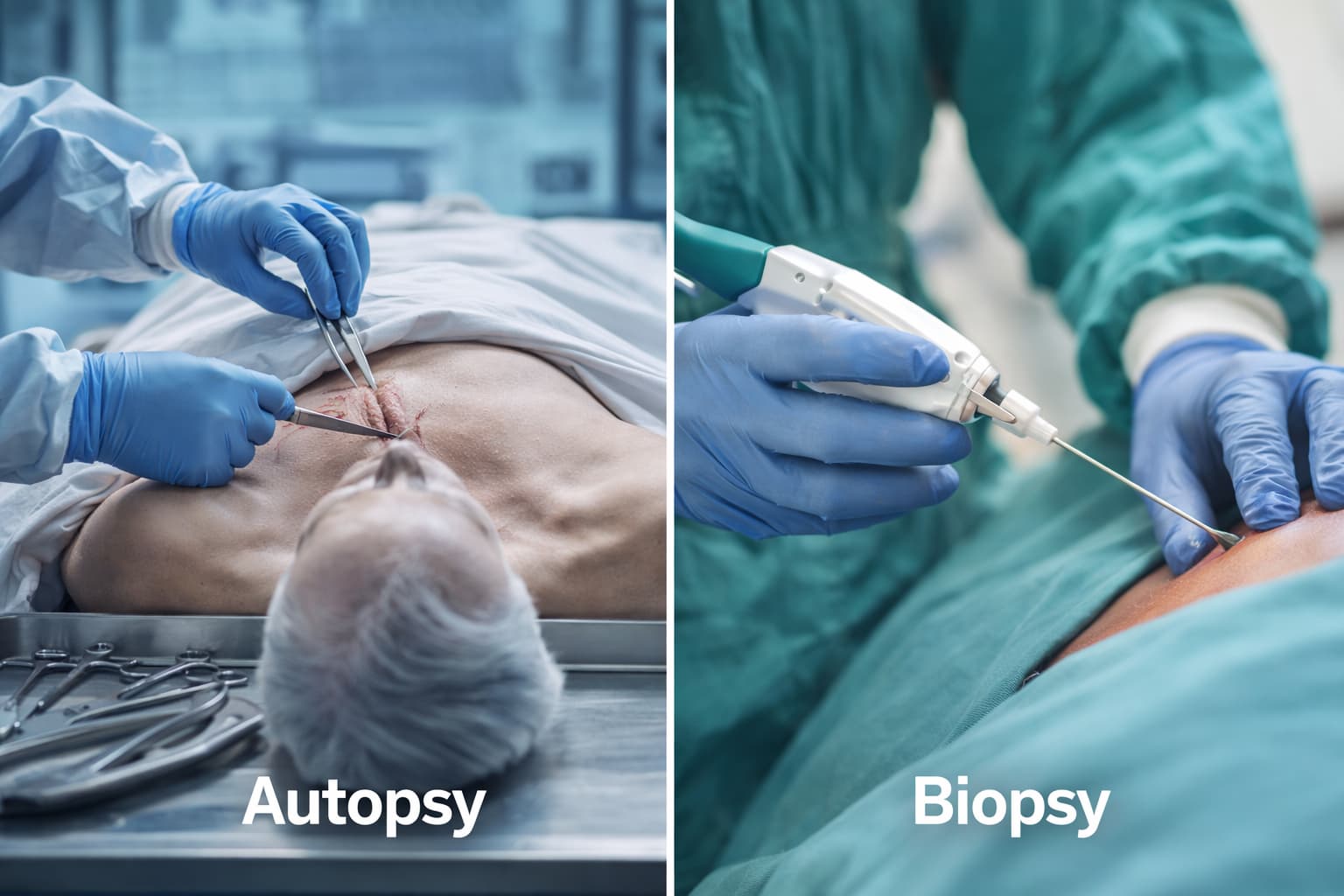
“Autopsy and biopsy” appears in countless clinical conversations, yet the two procedures sit on opposite ends of a patient-care timeline. One unfolds in the quiet of a post-mortem suite. The other occurs in procedure rooms, operating theatres, and interventional radiology units. Pathologists navigate both worlds, though the intent, workflow, urgency, and instrumentation diverge in striking ways.
The following exploration looks at the difference between autopsy and biopsy, how each contributes to diagnostic clarity, and why both remain indispensable to modern pathology services. Sentence rhythms may shift, and phrasing may wander a little, because the practice of pathology rarely moves in straight lines.
Why Autopsies Still Matter
Autopsy work continues to reveal disease patterns that imaging or pre-mortem testing nearly missed. Families seek answers. Clinicians want correlation. Institutions depend on accurate mortality reviews.
Yet the territory has changed. Requests fluctuate, clinical expectations shift, and regulatory pressures remain tight. Pathologists familiar with these dynamics know that an autopsy carries a unique responsibility.
Types of Autopsy
Different indications call for different approaches. Pathology teams usually encounter three broad categories.
| Type of Autopsy | Primary Aim | Common Triggers |
|---|---|---|
| Clinical (Hospital) Autopsy | Assess disease processes and correlate with clinical records | Unexpected deterioration, complex comorbidities, quality-assurance reviews |
| Forensic Autopsy | Determine cause and manner of death for legal or investigative purposes | Unexplained deaths, suspected foul play, sudden death in custody |
| Anatomical/Academic Autopsy | Support teaching and long-term research | Donor programs, training needs, and pathology education |
The workflow for each type of autopsy demands precise tissue handling, disciplined documentation, and thoughtful use of pathology lab equipment. While imaging adjuncts like post-mortem CT add new layers of information, the hands-on procedure continues to anchor final diagnoses.
Biopsies in Medicine
Biopsy procedures sit closer to everyday clinical throughput. A lesion emerges on imaging, or a patient reports a new symptom. A clinician needs histologic information with enough speed to influence management.
The biopsy procedure allows targeted sampling of tissue in a controlled, minimally invasive way. The pace is faster than an autopsy review. The communication loop is tighter. Decisions ride on turnaround times, clear margins, and precise cellular detail.
Common Biopsy Procedure
Instead of laying them out as a dry list, imagine a week in a busy pathology service.
On Monday, a breast surgeon phones down because the core needle sample requires expedited processing due to intraoperative uncertainty. On Tuesday, an interventional radiologist sends ultrasound-guided liver cores—thin, fragile, and prone to crush artefact.
By mid-week, dermatology delivers a flurry of tangential shaves and punch biopsies from patients with inflammatory eruptions. Later, a hematologist calls ahead for bone marrow aspirate and trephine interpretation to clarify a new cytopenia.
Each of these scenarios reflects one of the major biopsy approaches:
- Core needle sampling,
- Fine-needle aspiration,
- Excisional or incisional tissue removal,
- Endoscopic or image-guided targeted retrieval,
- Bone marrow procedures.
Autopsy and biopsy and their types intersect in only one place: both demand clean technique, anatomic orientation, and careful triage to culture bottles, molecular tubes, or routine histology.
Autopsy and Biopsy Difference: Purpose, Timing, and Strategy
Although both procedures examine tissue microscopically, the motivations diverge dramatically. The difference between autopsy and biopsy can be distilled across several dimensions.
Diagnostic Intent
A biopsy aims to direct immediate clinical care. Autopsy work reconstructs what happened after care concluded. One guides the next decision. The other assesses the arc of disease and intervention across an entire clinical episode.
Timing and Setting
Biopsy procedures occur everywhere, from bedside FNAs to operating theatres. Autopsies take place in dedicated suites equipped for safety, documentation, and extended examination times.
Specimen Characteristics
Biopsy material arrives small, precise, usually fresh or fixed quickly. Autopsy specimens involve entire organs or large tissue sections that reveal spatial relationships impossible to appreciate through small cores.
Use of Equipment
Biopsies rely on microtomes, automated processors, cryostats, and staining platforms tuned for rapid cycles. Autopsies demand saws, large dissection surfaces, containment systems, and high-capacity photographic documentation setups. The type of pathology lab equipment shapes the pace and depth of each process.
Turn-Around Expectations
Biopsies may require same-day adequacy assessments or intraoperative consultations. Autopsies allow a slower, reflective pace, particularly when ancillary studies extend the timeline, i.e., molecular, microbiologic, or toxicologic studies.
Autopsy and Biopsy: How They Complement
The two procedures function like different lenses aimed at the same subject. A biopsy provides a narrow field with high resolution. An autopsy opens a panoramic view with the ability to trace disease from organ to organ.
Take infiltrative cardiac disease. A biopsy might show vague interstitial fibrosis or subtle granulomas that leave clinicians uncertain. An autopsy can map fibrosis patterns through ventricular walls or reveal conduction-system involvement that had never surfaced in imaging. Conversely, biopsy-driven molecular assays may uncover mutations that later refine autopsy interpretation.
The interplay strengthens diagnostic confidence across clinical services.
Autopsy Decline and the Consequences
Many institutions face decreasing autopsy rates. Consent barriers, operational constraints, and time pressures contribute. The downstream effect can be subtle. Diagnostic discrepancies rise. Mortality reviews lose granularity. Educational opportunities shrink for trainees who rarely see whole-organ pathology.
Yet whenever programmes invest in strong communication between clinicians and pathology departments, interest tends to revive. Families may appreciate the clarity provided. Hospitals gain sharper data for performance metrics. Pathologists regain a window into disease evolution that biopsy material alone cannot provide.
The Future
Biopsy material now feeds sequencing pipelines, multiplex immunohistochemistry, and digital image analysis. Autopsy samples increasingly contribute to research in genomics, infectious disease surveillance, and long-term cohort studies.
A lung autopsy series can reveal variant patterns in viral injury long before imaging criteria settle. A biopsy workflow can integrate AI-supported quantitative scoring to refine treatment decisions. While the day-to-day routines differ, both procedures adapt as molecular diagnostics mature.
Autopsy vs Biopsy: What to Choose
Clinicians weigh several factors—patient status, diagnostic ambiguity, procedural risk, research needs, and medico-legal frameworks.
A biopsy becomes the tool of choice when live-tissue evaluation informs treatment. Unexplained lymphadenopathy, new masses, and organ dysfunction without a clear etiology.
Autopsy becomes the procedure of record when a patient dies without a clear cause, when disease behaviour seems discordant with imaging, when legal authorities mandate review, or when educational programmes require full examinations. In many cases, the final explanation emerges only when both procedures tell parts of the same story.
What Pathology Teams Gain
Proficiency in autopsy technique reinforces spatial reasoning. Familiarity with biopsy procedure nuances refines micro-level diagnostic precision. Together, they shape a more intuitive understanding of disease progression.
Unexpected emboli discovered at autopsy can reshape how a clinician interprets subtle changes in biopsy vascular patterns. Conversely, biopsy-driven molecular results can explain autopsy findings that at first glance appear contradictory.
Closing Thoughts
Autopsy and biopsy continue to anchor modern pathology: one focused on immediate clinical decisions, the other on retrospective clarity and institutional learning. Pathologists who balance both gain an edge in diagnostic insight that no single procedure can provide alone.
While technology accelerates diagnostic speed, the core purpose stays steady: extracting truth from tissue, whether drawn from a patient on an operating table or from someone whose story concludes in the post-mortem suite. Both pathways, different as they seem, feed the same mission.
Also read
Difference Between Autopsy and Post Mortem Explained
Biopsy Procedure: Step-by-Step Guide for Patients
Get Started at ₹1!
Try Flabs for a full month for just ₹1.
Follow us on