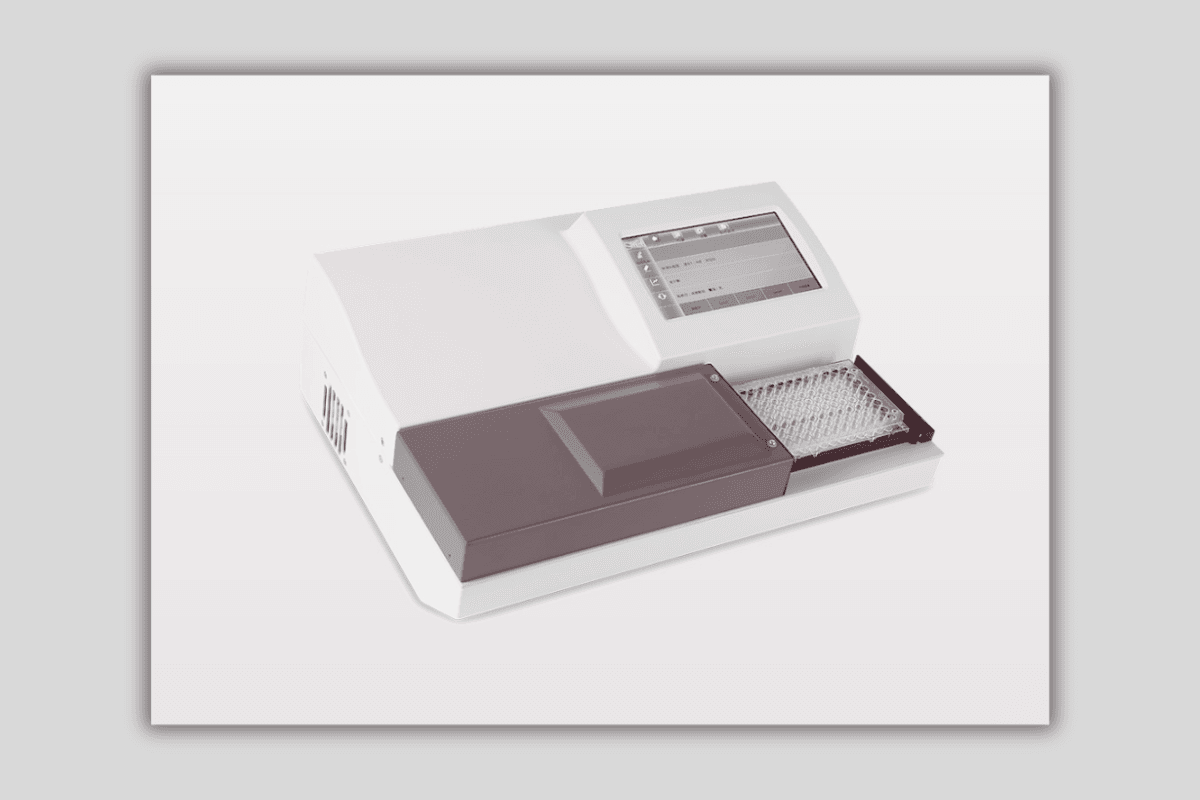
An ELISA Reader is a pathology lab equipment used to measure the absorbance of samples in microplate wells, usually during an enzyme-linked immunosorbent assay (ELISA). Indeed, the ELISA reader's full form is Enzyme-Linked Immunosorbent Assay reader, which precisely describes its function.
Known as a microplate reader or microplate photometer, it can detect and quantify biomolecules like hormones, proteins, and antibodies with precision. But as diagnostic demands increase and sample volumes grow, relying on manual interpretation risks compromising results.
The consequences of inconsistent data in clinical diagnostics, vaccine development, or pharmaceutical research are significant. Let’s explore how ELISA readers step in here to support high-throughput testing and improve result reliability across healthcare and research settings.
What Does an ELISA Reader Do?
The ELISA reader principle is based on spectrophotometry, where light of a specific wavelength passes through samples within microtiter plate wells. The machine measures how much light is absorbed rather than transmitted. Each well contains a chemical reaction that changes colour in the presence of specific biomolecules. The depth of that colour correlates with how much of the analyte is present.
Most ELISA readers are designed for 96-well or 384-well plates and operate by directing light through each well. Based on the absorbance reading (commonly at 450 nm for colourimetric assays), the concentration of the target substance is calculated using standard curves.
Components of an ELISA Workflow
Though the reader itself is only one part of the assay, its effectiveness depends on the integrity of the entire process. A standard ELISA includes:
Sample Coating: Antibodies or antigens are adsorbed onto the plate surface.
Blocking: Proteins like BSA are used to cover unbound surfaces, reducing false signals.
Incubation with Samples: The target analyte binds to the capture molecule.
Detection Phase: An enzyme-tagged antibody binds to the target.
Substrate Reaction: A chemical substrate reacts with the enzyme to produce a measurable signal.
Absorbance Measurement: The ELISA reader quantifies the reaction intensity.
Assay Formats Supported by ELISA Readers
| Assay Format | Key Features | Best Used For |
|---|---|---|
| Direct ELISA | Enzyme-linked detection antibody; simple and fast | Purified samples; quick screening |
| Indirect ELISA | Uses a secondary enzyme-conjugated antibody; signal amplification | Serological testing; improved sensitivity |
| Sandwich ELISA | Two antibodies bind different epitopes on the same target | Low-abundance proteins in serum or cell lysates |
| Competitive ELISA | Sample competes with labelled antigen; generates inverse signal | Small molecules like hormones or drug monitoring |
Using an ELISA Reader: A Step-by-Step Process
- Prepare samples according to established protocols to ensure correct dilution within the assay’s measurable range.
- Load samples, standards, and controls into the plate to maintain consistency.
- Incubate the plate under recommended conditions for proper antigen-antibody binding.
- Wash the plate thoroughly to remove unbound materials and reduce background noise.
- Add detection reagents using specified concentrations and timing for consistent signal development.
- Insert the ELISA plate reader into a stable surface, ensuring it's connected to power and any necessary computing systems for data acquisition.
- Insert the plate into the ELISA Reader, select the appropriate wavelength (generally 450 nm), and ensure correct alignment.
- Analyse the absorbance values using a standard curve.
- Validate results with appropriate statistical methods.
Before reading plates, regularly verify that the instrument's optical system is clean and aligned. Dust, fingerprints, or residue can impact readings. Many laboratories establish a pre-reading checklist. They use optical system inspection to prevent erroneous results.
Why ELISA Readers Are Standard Equipment
ELISA microplate readers can deliver reproducible results while supporting high-throughput workflows. They can process hundreds of samples in a single run. These instruments also integrate smoothly with automation systems and laboratory information management software, reducing manual intervention.
Unlike subjective visual interpretations, ELISA readers provide consistent, objective data through absorbance measurements. Most models also have built-in software to calculate standard curves and generate detailed reports and exportable data.
However, Rregular maintenance of the ELISA reader instrumentation is imperative for preserving this reliability. Implementing a scheduled cleaning regimen ensures consistent performance over time. Especially for optical components. Laboratories should also maintain a dedicated instrument logbook for it.
Considerations When Using ELISA Readers
Despite their strengths, ELISA readers are not foolproof. Their accuracy depends on:
- Proper Calibration: Optical misalignment or faulty filters can skew results.
- Environmental Conditions: Enzymatic reactions may vary with temperature or pH changes.
- Cross-Reactivity: Poor antibody specificity can lead to misleading signals.
- Plate Uniformity: Uneven coating or evaporation in wells affects consistency.
ELISA Training and Institutional Support
Training institutions like the Indian Biological Sciences and Research Institute (IBRI) in Noida have played a major role in familiarising students and early-career professionals with ELISA and its instrumentation.
They conduct hands-on workshops that focus on:
- Plate handling and coating techniques
- Pipetting precision
- Reader operation and calibration
- Result interpretation and documentation
These initiatives contribute to a more skilled diagnostics workforce, especially in resource-constrained regions.
Innovation in ELISA Technology
Recent advancements in ELISA reader technology have focused on improving speed, portability, and data accessibility. Newer models are designed with dual-beam optics that reduce scanning time.
Miniaturised versions have also been introduced. They enable ELISA testing in mobile units and remote settings.
Cloud-enabled ELISA readers now provide data sharing and remote access to results, supporting centralised reporting.
Some advanced systems feature multiplexing capabilities for the simultaneous measurement of multiple analytes within a single well.
Despite these enhancements, absorbance-based ELISA remains the backbone of immunoassay analysis.
More Areas of Application
- ELISA readers can screen for infectious diseases like HIV and Hepatitis B by detecting viral antigens or antibodies.
- They are used to measure hormone levels such as insulin and cortisol, and identify IgE antibodies involved in allergy testing.
- ELISA is commonly used in cancer and autoimmune disease diagnosis, detecting markers like ANA and anti-dsDNA antibodies.
- In pharmaceutical research and development, ELISA Readers track antibody responses, drug levels, and immune reactions to new treatments.
- Food and environmental labs use ELISA to detect toxins like aflatoxins, pesticide residues, and allergens.
Conclusion
ELISA Readers stand at the junction of precision and practicality, enabling laboratories to detect and quantify biomolecules with confidence. As the demands of immunodiagnostics grow, so does the importance of mastering the technology.
From setup to data analysis, every step with an ELISA Reader contributes to the reliability of your results. For those in immunology, diagnostics, or biopharma, fluency in ELISA techniques is foundational.
Also check - How the HbA1c Machine Improves Diabetes Monitoring in Labs
Get Started at ₹1!
Try Flabs for a full month for just ₹1.
Follow us on