Nearly half of India's diagnostics market still runs on standalone, unbranded labs. A huge slice of patient volume is with independent operators who have not yet shifted to a networked model. It is actually a runway to convert your single lab into a multi-branch brand
You already have the hard part. A working lab, a referral base, and trust in your catchment area. What you do not yet have is reach.
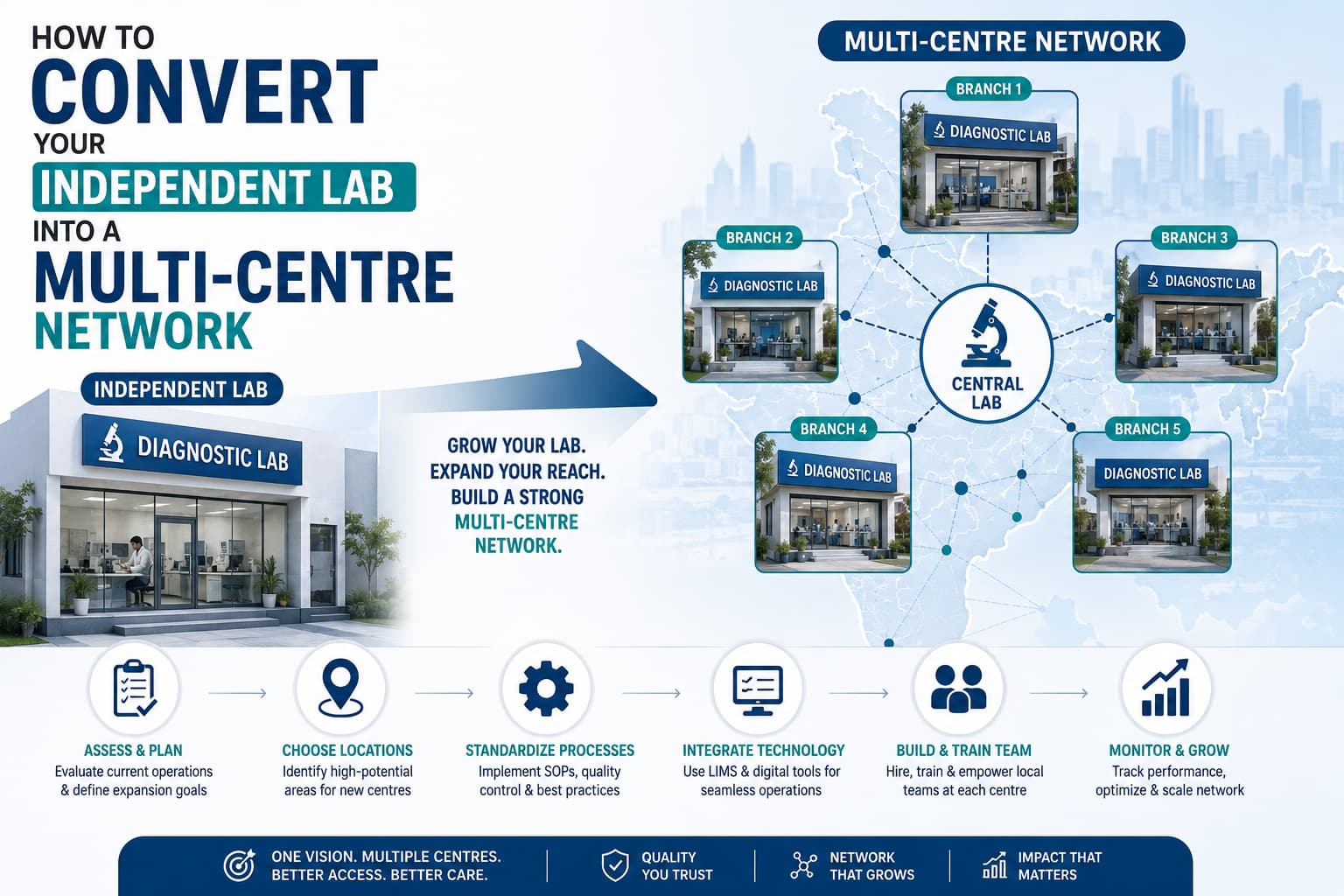
Going multi-centre is the next move. The shift sounds intimidating, yet the core mechanics are simpler than most owners assume. You do not need to build five new labs. You need spokes that feed one strong hub.
What is Building a Lab Network in India?
A lab network in India is a hub-and-spoke model. Your existing lab becomes the central processing centre. Around it, you set up smaller satellite collection centres that draw samples, log them digitally, and send them to the hub for testing. Reports flow back to patients and referring doctors through a single connected system.
The patient experience stays local. The testing capacity stays centralised. You scale revenue without duplicating expensive analysers at every site.
That is the entire model. Everything else including staffing, software, branding, and logistics, supports those two ideas.
Decide Your Hub Capacity
Before you expand a diagnostic lab into a wider footprint, audit the hub. A spoke is only as fast as the centre that processes its samples. If your current turnaround time (TAT) for routine biochemistry sits at six hours, adding three new collection sites will push it to ten. Patients notice. Doctors notice faster.
Run a stress test. Calculate your current daily sample load, then model what happens at 2x and 3x volumes. Audit every piece of lab equipment for uptime, service contract status, and remaining useful life. Add technician hours and reagent stock cycles to the same view. Where do bottlenecks appear first? Fix those before signing the first satellite lease.
Most pathology labs in India underestimate the pre-analytical stage. Sample pickup timing, temperature control during transit, and barcode integrity at receipt are where multi-site operations break down. Solve these on paper before you solve them with rented vans.
First Three Spoke Locations
You do not pick locations by gut feel. You pick them by data.
Pull six months of patient address data from your LIS. Plot the postcodes. Wherever you see clusters that sit more than four kilometres from your hub, you have a candidate zone. Cross-reference with referring doctors who send samples your way but practise far from your current centre. Their patients are your easiest early adopters at a new site.
Aim for three spokes in year one. More than that splits your attention. Fewer leaves your fixed costs underused.
The same answer shows up when you run the math at a national scale. A supply-chain analysis modelled lab placement across eleven Indian cities using the P-median method, balancing transport cost (₹6.64 per kg per km) against operating cost (₹83 lakh divided by the square root of the number of labs).
One lab leaves the south and east stranded. Two labs still leave Guwahati and Bhubaneswar far from a hub. Three labs (Delhi, Chennai, Bhubaneswar) cover all three demand clusters at the lowest total cost, around ₹47.9 lakh in operating cost. A fourth lab barely moves the needle.
| No. of Labs | Coverage | Total Cost Outcome |
|---|---|---|
| 1 | Single national hub, long hauls everywhere | Transport cost dominates, not viable |
| 2 | North + South, east still stranded | Still expensive |
| 3 | North + South + East clusters covered | Lowest total cost, best trade-off |
| 4 | Marginal transport savings | Diminishing returns |
| Decision Factor | What to Look For | Why It Matters |
|---|---|---|
| Patient density | 8,000+ residents within 2 km | Walk-in volume sustains overheads |
| Doctor proximity | 5+ referring clinicians within 1 km | Steady prescription-led footfall |
| Hub distance | Under 25 km road travel | Sample integrity during transit |
| Rent vs revenue | Monthly rent under 12% of projected revenue | Protects unit economics |
| Competing labs | No major chain within 500 m | Reduces price pressure early on |
Standardise Operations Across Every Site
Patients should not feel a difference between your hub and your newest spoke. The phlebotomy chair, the receipt format, the SMS confirmation, and the report template all of it stays identical. Your pathology test list, prices, and reference ranges should match across every site too.
Write a one-page SOP for each routine task. Sample collection. Centrifuge timing. Cold-chain handover. Front-desk scripts for common patient questions. Train every new hire on the same material so a patient walking into spoke three gets the same five minutes they would get at the hub.
Branding consistency matters as much as clinical consistency. Your lab network in India needs to feel like one operation. A patient who notices small differences across two visits to your lab network in India will try the chain across the road on visit three.
Pick Suitable Software
A standalone LIS designed for one location will buckle the moment you add a second. To run a real lab network in India, you need software that treats branches as first-class entities from day one.
Look for these features specifically. Centralised sample accession with barcodes generated the moment a patient is registered at any spoke. Real-time tracking from collection to report dispatch. Branch-level revenue and TAT dashboards. Role-based access so a phlebotomist at spoke two cannot accidentally edit a report dictated at the hub. Automated home-collection scheduling tied to the nearest available centre.
Without these, you will run your lab network in India on WhatsApp groups and Excel sheets. That works for a month. It collapses by month four.
Build a Sample Logistics Routine
Sample transport is where new operators bleed money and trust. A delayed pickup means a delayed report, which means an angry doctor, which means a lost referral source.
Fix a pickup schedule and stick to it. Two pickups a day from each spoke during ramp-up. Three or four once volumes justify the cost. Use validated transport boxes with temperature loggers for any sample that needs a cold chain. Audit the loggers weekly. Most pathology labs in India skip the audit step and only discover transport failures when results start drifting from clinical expectations.
A simple driver app that scans samples in and out at every handover removes nearly all the disputes about lost specimens. Once that app is live, your lab network in India starts behaving like one connected unit instead of three loosely linked addresses.
Measure the Right Numbers
You cannot manage what you do not track. As your lab network in India grows past three sites, weekly numbers become your dashboard.
Track these. Samples per spoke. TAT for top ten test panels at each site. Re-collection rate. Walk-in to home-collection ratio. Revenue per branch versus break-even. Referring-doctor count per spoke and how it has moved month on month. If a spoke is below break-even after six months, dig into the data before you panic. Sometimes the fix is two more billboards near a clinic. Sometimes it is honest to accept that the location will not work.
Regulatory and Accreditation Layer
NABL accreditation does not automatically extend to every new site. Each spoke that performs any testing on its own needs to be added to your scope. Pure collection centres have lighter requirements but still need state-level registrations and biomedical waste authorisation.
Build a compliance calendar before you open the first spoke. Renewals creep up fast when you go from one set of papers to four. A lab network in India that loses NABL status because a paper expired loses doctor confidence overnight, and that confidence takes years to rebuild.
Your Realistic Timeline
A clean conversion from a single lab to a three-spoke lab network in India takes nine to twelve months. Rush it and you will spend year two fixing avoidable mistakes. Pace it correctly, and you will end year one with a lab network in India that throws off real cash, serves more patients, and still feels like the lab you started.
The owners who build durable diagnostic networks treat the conversion as an operations project, not a real estate project. Get the hub strong, pick spokes with data, and let the lab network in India you are building grow at the optimal speed.
Also check - Multi-Branch Lab Management: How to Scale Without Losing Control
Get Started at ₹1!
Try Flabs for a full month for just ₹1.
Follow us on