![Principles of NABL Accreditation [2026 Guide]](/_next/image?url=https%3A%2F%2Fcdn.flabs.in%2Fwebassets%2F65818f377fe99dccdebf.png&w=1920&q=75&dpl=dpl_C7KEtbvCHPcmS98LGJd567X1pJAV)
The gamut of healthcare facilities is reliant on laboratory testing and diagnosis. It goes without saying that medical laboratories are trusted for their competence, testing procedures, and diagnostic accuracy. The reason is adherence to various local and international regulations regarding testing procedures and calibration equipment. In particular, medical laboratories can only function with receiving NABL accreditation in India.
NABL (National Accreditation Board for Testing and Calibration Laboratories) is India's accreditation authority for various testing, calibration, and clinical laboratories. It is done using the principles of NABL accreditation following national and international standards.
Clinical laboratories seeking NABL accreditation must understand the NABL accreditation principles and procedures to receive certification successfully. That is the scope of the discussion today.
NABL Full Form & Abbreviations
NABL full form is National Accreditation Board for Testing and Calibration Laboratories.
NABL is an autonomous body under the Department of Science & Technology, Government of India, responsible for accrediting testing, calibration, and medical laboratories.
Common NABL Abbreviations
- NABL – National Accreditation Board for Testing and Calibration Laboratories
- CAB – Conformity Assessment Body (laboratories eligible for NABL accreditation)
- ISO 15189 – International standard for quality and competence of medical laboratories
- EQAS – External Quality Assessment Scheme
- IQC – Internal Quality Control
- QMS – Quality Management System
What is NABL Accreditation
NABL full form is: National Accreditation Board for Testing and Calibration Laboratories
The National Accreditation Board for Testing and Calibration Laboratories (NABL) is an autonomous body under the Dept. of Science & Technology, Govt. of India. It is registered under the Societies Act.
NABLE accreditation refers to the attestation of a conformity assessment body (CAB) recognising the competence of the CAB to perform specific conformity assessment tasks. The conformity assessment body can be a clinical laboratory, food inspection laboratory or any other lab as defined by the NABL. NABL was established to accredit testing & calibration laboratories. It now also carries out accreditation of clinical laboratories.
Medical Laboratories Eligible for NABL Accreditation
- Clinical Biochemistry
- Haematology
- Clinical Pathology
- Microbiology & Infectious Disease Serology
- Histopathology
- Cytopathology
- Flow Cytometry
- Cytogenetics
- Molecular Testing
Principles of NABL Accreditation
- Contact the NABL secretariat to obtain relevant NABL documents related to accreditation.
- Learn about all the relevant documents, the NABL accreditation procedure, and the process of creating an application.
- Train a person on Quality management systems and internal audit through the 4-day residential training courses conducted by NABL.
- Prepare a QUALITY MANUAL in accordance with ISO 15189 standards.
- Prepare a standard operating procedure for every investigation performed in the lab, ensuring adherence to effective environmental conditions like temperature, humidity, storage placement, etc.
- Laboratories seeking NABL accreditation must ensure all their instruments/equipment are calibrated. Moreover, such laboratories must ensure the calibration of instruments/equipment only through NABL-accredited calibration labs.
- Laboratories must give training on the process of documentation. It should cover proper formatting, document authorisation, issuance and withdrawal processes, and process of document review and changes. Each document should include an ID No., the name of the controlling authority, the period of retention, etc.
- Laboratories must know that a quality manual is only a policy document. It must be supplemented by a set of next-level documents, which also need proper preparation.
- Ensure that processes mentioned in the quality manual are effectively being implemented.
- Document the internal quality control (IQC) measures followed during patient analysis along with the uncertainty of measurements in accordance with Levy Jennings charts.
- Participate in External Quality Assessment Schemes (EQAS) and inter-laboratory comparison for unavailable analytes.
- Document corrective actions on deviations in IQC/EQA.
- Conduct an internal audit and management review.
- Apply to NABL accreditation by paying applicable fees.
Procedure of NABL Accreditation
Every laboratory seeking NABL accreditation must prepare a plan and appoint a quality manager to coordinate during the NABL accreditation process. The principles of NABL accreditation involve the following tasks.
Making Application
- The Conformity Assessment Body (CAB) or laboratory seeking NABL accreditation must submit a corresponding application form (NABL 153 for Medical Labs).
- NABL accreditation is location-specific. CABs with multiple locations must apply for separate NABL accreditation. Those located outside India should submit scanned copies of the application.
- They should implement a quality management system according to relevant ISO standards.
- CABs must submit an application form along with a quality manual, application fees and requisite information.
Document Review
- An NABL assessment team will review the documents submitted by the laboratory, providing feedback and indicating inadequacies.
- At this stage, CABs/laboratories can raise any objections to NABL regarding points of conflict. Otherwise, they must make suggested corrections within seven days to complete the document review.
Assessment
- The appointed NABL assessment team will assess the implementation of quality management systems and the technical competence of the laboratory. The duration varies based on the scope of accreditation.
- If there is any non-conformity, laboratories must take corrective action and submit a report within 30 days.
- The assessment team will submit the report for NABL review.
Surveillance Assessment
- NABL conducts annual surveillance to ensure compliance with prescribed standards and laboratory policies.
- Newly accredited CABs will undergo on-site surveillance for the first year.
- In the subsequent cycles, NABL conducts desktop surveillance to assess submitted records and their compliance.
- Unannounced assessments may also happen to evaluate compliance in a natural state or to investigate complaints.
Approval for Accreditation
- The accreditation committee reviews the assessment report and makes recommendations to NABL for a grant or withdrawal of accreditation. The same process happens for renewal, reduction or suspension of NABL accreditation for laboratories.
- The involved laboratories receive decisions regarding the NABL accreditation.
Issue of Accreditation Certificate
- For approved laboratories, NABL issues an accreditation certificate containing a unique number and QR code. It is valid for two years.
- The certificate will detail the scope of accreditation, including specific disciplines and site or mobile facilities.
- However, the NABL certificate issue requires clearance of all related fee payments.
Check detailed guid on NABL Accreditation Procedure
NABL Accreditation Process Chart
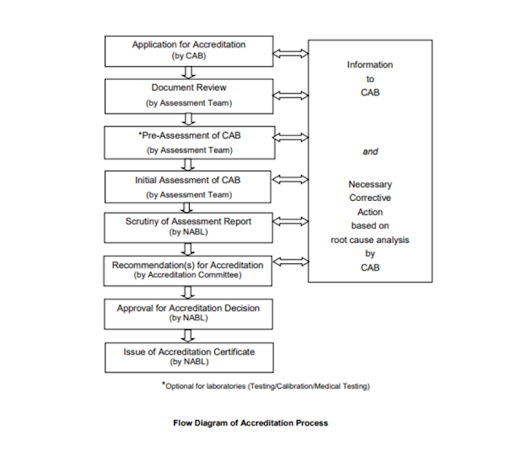
Source: NABL Official
NABL Accreditation Fees for Medical Labs
Clinical laboratories must pay the below-mentioned fees as part of the application for NABL accreditation.
NABL Accreditation Fees
| Laboratory Type | Patient Capacity (per day) | Base Fee (₹) | Additional Fee per SCF (₹) |
|---|---|---|---|
| Micro Laboratories | Up to 25 | 6,000 | 200 |
| Mini Laboratories | 26 - 50 | 10,000 | 200 |
| Small Laboratories | 51 - 100 | 18,700 | 200 |
| Medium Laboratories | 101 - 400 | 44,000 | 200 |
| Large Laboratories | 401 - 1,000 | 110,000 | 200 |
| Very Large Laboratories | Above 1,000 | 220,000 | 200 |
Benefits of NABL Accreditation
NABL accreditation procedure follows international criteria for medical laboratories. The benefits of NABL accreditation are as follows:
- NABL accreditation is a measure of confidence in the lab tests, test reports, and calibration methods to produce accurate and reliable results.
- People in need can readily identify laboratories, reliable tests, and calibration services that meet their requirements.
- Regulators pick test results from the NABL-accredited laboratories to promote good practices in the public interest regarding new diseases and the importance of lab testing for healthcare.
- NABL accreditation earns medical laboratories global recognition and acceptance in international markets.
- NABL-accredited laboratories are included in the NABL directory so people can seek the most reliable laboratories for specific tests. For example, medical laboratories seeking instrument calibration can check for registered calibration labs.
- Medical laboratories can maintain a strict quality management system and operational control in their testing processes, calibration methods, and report formats.
- The NABL accreditation process is time and money-efficient.
Sample NABL Accreditation Certificate
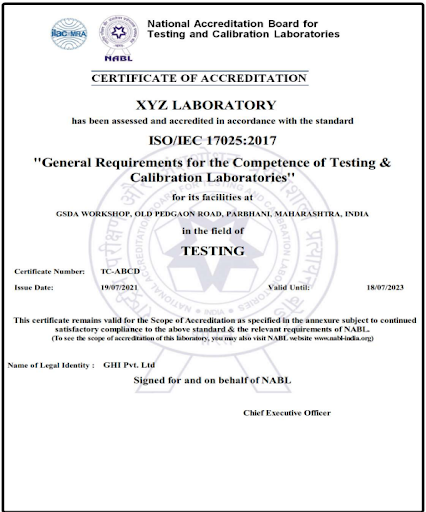
Source: NABL Official
Conclusion
Understanding the principles of NABL accreditation is the first step for various testing, clinical and calibration laboratories in India. Receiving NABL certification establishes trust in their testing procedures, lab equipment calibration, and medical reports. Such laboratories will gain access to international markets as NABL accreditation follows international criteria. Moreover, laboratories with NABL status will be listed in the NABL directory for patients and concerned medical facilities to check information.
Ultimately, getting NABL accreditation conveys the commitment of clinical laboratories to providing accurate diagnosis and quality patient care.
Suggested - [NABL Standards](NABL standards.)
Get Started at ₹1!
Try Flabs for a full month for just ₹1.
Follow us on