Pathology labs must take utmost care in preparing their pathology lab reports by adhering to medical standards for accurate diagnosis. The same goes for lipid profile test report format as well when it has to go through multiple physicians and healthcare professionals. First and foremost, a standardised lipid profile test report format prevents miscommunication, which is crucial for a patient’s healing journey. Imagine suggesting an incorrect diagnosis that may change a treatment plan completely? No pathology laboratory can afford to make such a mistake.
Data organisation, inclusion of all essential data, consistent formatting elements, high readability and simple skeletal structure of a lipid profile test report sample are some of the aspects of lipid profile test report formatting. Let’s analyse the details more closely.
What is Lipid Profile Test
The Lipid Profile Test, or just lipid panel, checks for fats in your blood, including cholesterol levels. Your body uses these lipids for energy and stores them in tissues. You can find out the cost of this group of tests to check your cholesterol at your local HOD centre.
Components of a Normal Lipid Profile Test Report Sample
A lipid profile test report format must have the following components in the least for ensuring seamless communication and adherence to medical standards.
Report Heading and Title
- Name and logo of your pathology laboratory or medical facility.
- Label the report with “Lipid Profile Test”.
- Clearly mention the unique report ID.
Patient Information
- Include the name, gender and DOB/Age of the patient.
- Include the patient's mobile number.
- Mention who referred them. Mention “Self” referral if it's not the case.
LP Report Components
Mention all the parameters measured in the lipid profile test:
- Total Cholesterol
- Triglyceride
- HDL Cholesterol
- LDL Cholesterol
- VLDL Cholesterol
- LDL / HDL Ratio
- TC / HDL Ratio
Reference Ranges
- Mention the normal ranges for each parameter tested.
- Indicate units of measurements.
- Mention possible variations of reference ranges based on age/gender.
Test Results
- Give numerical values of each test parameter of the lipid profile– use decimal round numbers round off to 2 digits at the most.
- Organise the information with headings and subheadings.
- Highlight any deviations or abnormal values from reference ranges.
Interpretation
- Interpret each parameter of the lipid profile test sample for desirable levels, borderline high, and High levels.
- Explain the clinical inferences of various parameter levels.
- Deduce the patient's condition with the results if necessary.
Contact Information
Mention the email, phone number and website of your lab or medical facility.
- Include emergency contact details if possible.
- Include the official signature along with their position.
- Mention the report date.
- Include any QR codes for easy accession of information about your lab.
Lipid Profile Test Report Sample
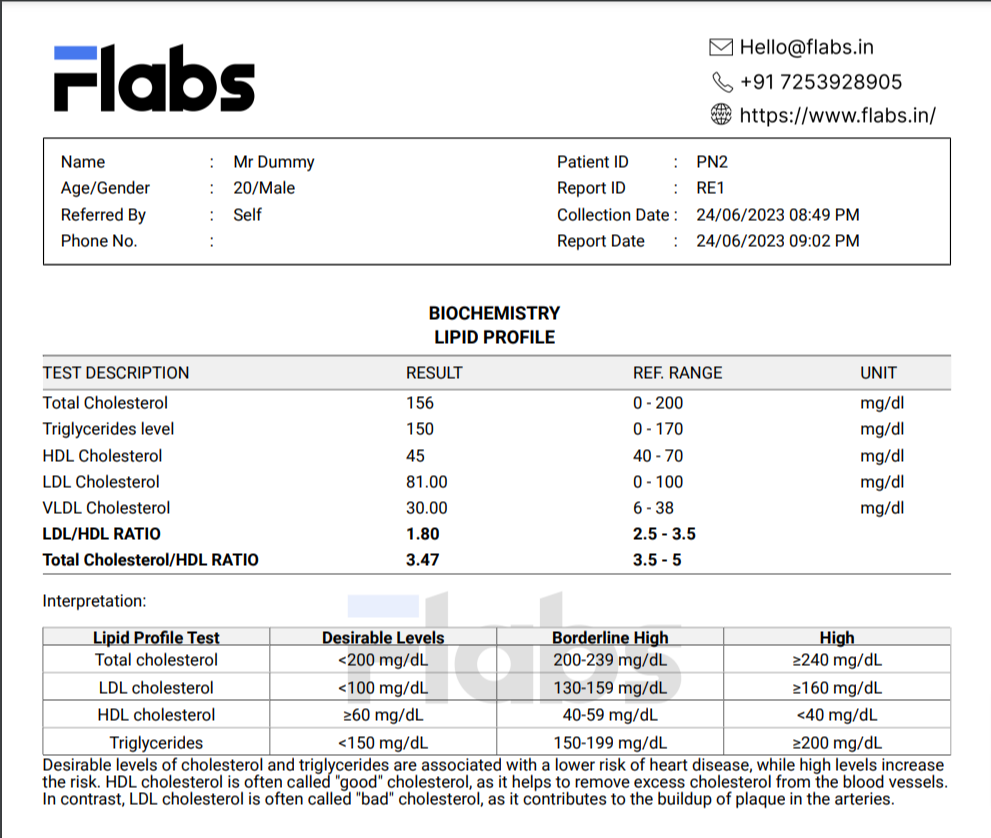
Lipid Profile Test Report PDF Format
You can download the lipid profile test sample report in PDF format from the link below. It gives an overview of lipid profile test report formatting.

Interpreting Lipid Profile Test Sample Components
A lipid profile test report format includes the following parameters:
- Total Cholesterol: Includes all cholesterol types– LDL, VLDL, and HDL.
- LDL cholesterol: The LDL (Low-density lipoprotein) is the "bad" cholesterol that can build up in arteries and raise the chance of heart problems.
- VLDL cholesterol: VLDL (Very low-density lipoprotein) doesn't show up much if you haven't eaten before the test since it comes from recent meals. Higher levels during fasting may point to a fat processing issue in the body.
- HDL cholesterol: The "good" HDL (High-density lipoprotein) cholesterol that helps get rid of LDL in your arteries.
- Triglycerides: General fats from food and too much of them can lead to heart disease or pancreas swelling.
Who Should Undergo a Lipid Profile Test
Health experts advise that adults, even those without heart disease risk factors, should have their cholesterol checked every 4 to 6 years. If you have additional risks like a family history of heart problems, weight issues, regular drinking or smoking habits, a sedentary routine, or conditions like diabetes, kidney issues, polycystic ovary syndrome, or low thyroid function, testing should be done more often.
Conclusion
The way in which a lipid profile test report is formatted can greatly impact patient care and treatment outcomes. It is not a mere document, but as a critical communication tool between the laboratory and the medical professionals who depend upon its accuracy. A standardised lipid profile test report format ensures consistency by eliminating the risk of errors, and conveying crucial information in the clearest possible manner.
As healthcare paths are often navigated through such reports, any deviation from excellence is simply not an option. Pathology labs must, therefore, prioritise creating reports that are as meticulous and detailed as the tests they describe. A well-structured lipid profile test report format is not just a best practice—it's a responsibility to patient health that can have lasting implications.
Get Started at ₹1!
Try Flabs for a full month for just ₹1.
Follow us on