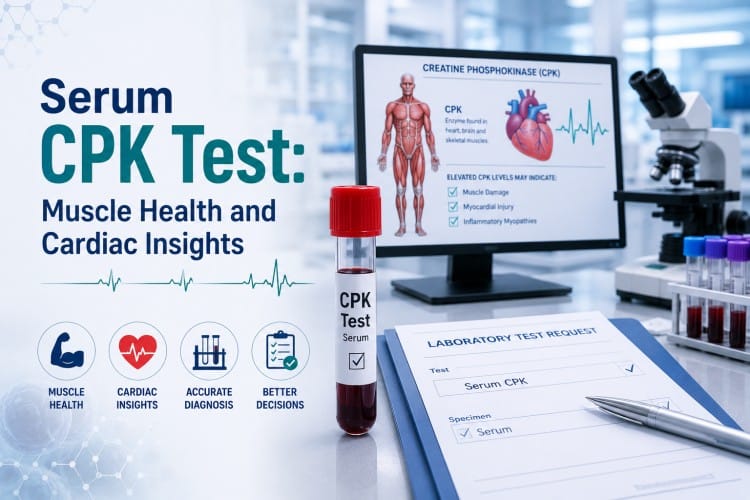
The serum CPK test measures the level of creatine phosphokinase in the blood, an enzyme released when muscle tissues are damaged. For pathologists and healthcare professionals, it provides essential biochemical insight into muscular, cardiac, and neurological conditions. This test is especially useful for identifying myocardial infarctions, muscle disorders, and trauma-related injuries.
What Is the Serum CPK Test?
Also known as the CPK total serum test, this diagnostic procedure evaluates the concentration of creatine phosphokinase (also referred to as creatine kinase or CK) in the bloodstream. CPK is an energy-associated enzyme found in three main isoenzyme forms.
- CPK-1 (CK-BB): Located in the brain and lungs
- CPK-2 (CK-MB): Found in cardiac muscle tissue
- CPK-3 (CK-MM): Predominantly in skeletal muscles
When muscle fibres are injured or stressed, these isoenzymes are released into circulation, elevating total serum CPK levels.
Clinical Applications of the Serum CPK Test
The serum CPK blood test is ordered in multiple diagnostic and monitoring contexts:
- Cardiac Assessment: Elevated CK-MB levels are consistent with myocardial infarction or myocarditis.
- Muscle Damage: Helps identify conditions like rhabdomyolysis, muscular dystrophy, and polymyositis.
- Neurological Conditions: CK-BB may be elevated in brain injuries or stroke.
- Drug Reactions: Monitors muscle enzyme response to medications like statins.
How the Test Is Performed
The procedure involves drawing blood from a vein, typically from the arm. No special preparation is required unless instructed by a physician:
- Fasting: Not usually necessary.
- Exercise: Avoid strenuous activity 24-48 hours prior.
- Medication Disclosure: Notify if taking statins, corticosteroids, or antipsychotics.
The sample is then analysed in a laboratory to determine CPK enzyme levels and potentially differentiate isoenzymes, depending on the clinical suspicion.
The CPK test results are usually available after 4 hours of the test, depending on the time of the day.
CPK Normal Range (General Reference)
| Sex | Normal CPK Range (U/L) |
|---|---|
| Males | 39 to 308 U/L |
| Females | 26 to 192 U/L |
Note: Labs may present values slightly differently depending on methodology.
Elevated Levels Indicate
- CK-MM (Skeletal Muscle): Trauma, intense physical activity, myositis, or muscle degeneration
- CK-MB (Heart Muscle): Myocardial infarction or myocarditis
- CK-BB (Brain Tissue): Stroke, brain injury, or cerebral trauma
Lowered Levels
Less commonly discussed, but could be associated with reduced muscle mass, inactivity, or late-stage muscular diseases.
Factors Affecting the Test
Several external and physiological factors influence enzyme levels:
- Physical Strain: Temporary elevations can result from workouts or muscle overuse.
- Medications: Statins, steroids, and certain psychotropics may raise CPK.
- Medical Conditions: Hypothyroidism, viral infections, or renal impairment can affect results.
- Sampling Time: CPK levels usually peak 12-24 hours after injury and decline over several days.
CPK Test Price and Availability
The CPK test price can vary depending on geographic location, healthcare facility, and whether isoenzyme differentiation is required. On average, the serum CPK test price in India ranges from ₹500 to ₹1,500.
Clinical Decision-Making
Once results are available, the next step depends on the underlying findings.
Elevated CPK Without Cardiac Symptoms
- Investigate for muscular disorders or trauma
- Consider medication-induced elevation
- Recommend rest and repeat testing if transient causes are suspected
Elevated CK-MB
- Initiate cardiac evaluation (e.g., ECG, troponins, echocardiography)
- Consider hospitalisation if a myocardial infarction is likely
Persistent Elevation
- Refer to neurology or internal medicine
- Electromyography or muscle biopsy may be advised
When Should the CPK Test Be Repeated?
- Monitoring the progression or resolution of muscle damage.
- Evaluating post-myocardial infarction recovery.
- Adjusting medications that impact muscle metabolism.
Serum CPK Test vs Other Muscle Enzyme Tests
| Test | Measures | Best Used For |
|---|---|---|
| Serum CPK | Creatine phosphokinase | General muscle, cardiac, and neurological injury |
| Troponin | Cardiac-specific proteins | Acute coronary syndrome detection |
| Aldolase | Muscle enzyme | Rarely used, but can detect myopathies |
Final Notes
The CPK test full form (Creatine Phosphokinase Test) may appear under different names in lab reports, such as CK total or CK-MB panel. Regardless, its relevance in emergency, internal medicine, and neurology settings remains consistent.
Awareness of CPK normal range, patient history, and timing of events is key to accurate diagnosis. For interpretation and treatment, CPK should be correlated with symptoms, imaging, and other biochemical markers.
Related test
Get Started at ₹1!
Try Flabs for a full month for just ₹1.
Follow us on