
Thanks to advancements in medical diagnostics, malaria tests have become critical in identifying the fever and initiating early treatment. Pathology laboratories across the world follow a standard procedure to identify the presence of malaria parasites. After diagnosis, when publishing results, following a standardised format ensures accurate interpretation and quality healthcare.
That is where the Malaria Parasite Report Format comes forth. Medical laboratories aiming to stand ahead must understand the guidelines followed when designing the Malaria test report formats.
Malaria Parasite Test Report Sample PDF
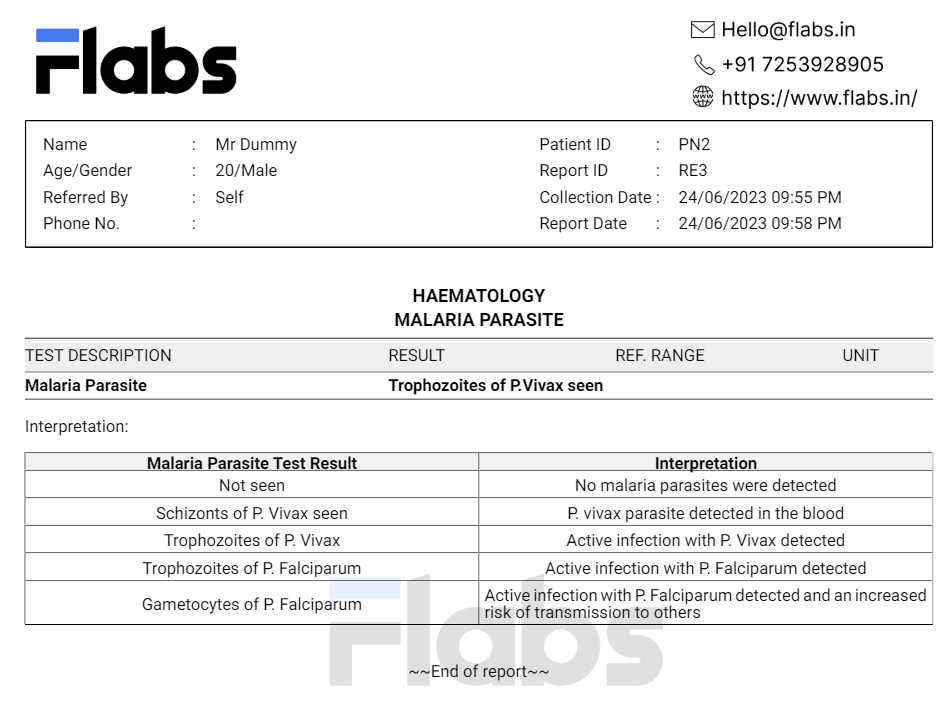
When preparing Malaria reports of test, templates or samples become crucial to maintaining consistent formatting. For reference, a sample of a malaria parasite report is given below.

Guidelines for Malaria Parasite Report Format
The above sample of the malaria lab report PDF follows the formatting guidelines mentioned below. However, it can vary slightly for different laboratories and countries based on local medical regulations.
Identity
Patient Identification: Provides detailed patient information such as name, age, gender, and patient ID, ensuring the malaria parasite report is correctly associated with the right individual.
Test Details
Collection and Report Dates/Times: This section lists the specific dates and times when the sample was collected and when the malaria parasite report was issued, giving a clear timeline of the malaria parasite test procedure.
Referred By: Indicates that the patient self-referred for the test.
Test Results
Test Name and Description: The test clearly identifies a malaria parasite and mentions the specific parasite type observed (e.g., Trophozoites of P. Vivax).
Result and Reference Range: This section shows the result (e.g., "Trophozoites of P. Vivax seen") alongside the interpretations for various potential findings, such as not seen, schizonts seen, and gametocytes seen, explaining the significance of each.
Malaria Parasite Count Interpretation: This section offers a detailed section that categorises the findings (e.g., no malaria parasites, active infection with P. Vivax, increased risk of transmission) and provides guidelines for understanding the results.
Signatory Authority: The report is signed by Dr. Dummy, MD in Pathology, which certifies the professional scrutiny and validity of the findings.
Note: The use of "Dummy" in the report is a placeholder. It's commonly used in sample documents for training or demonstrations to avoid using real names and to focus on the report's format and structure. When preparing actual reports, include the real names in the place of "Dummy".
Additional Guidelines for Malaria Parasite Report Format
- Ensure consistent formatting across the Malaria parasite test report.
- Use bold, underline or such stylisation to highlight key sections of the report.
- Use barcodes, QR codes and other data encryptions to protect data privacy.
- Give important contact details related to the laboratory to encourage open communication between patients and medical professionals.
- Provide glossary.
Conclusion
The malaria parasite report format is not just a design principle or structured arrangement. It is an insightful guideline for making the reports accessible, traceable, and interoperable between different healthcare facilities. Moreover, it includes information about patients, laboratories, and other key details. The format ensures that data privacy is upheld for the safety and security of the stakeholders involved.
Get Started at ₹1!
Try Flabs for a full month for just ₹1.
Follow us on