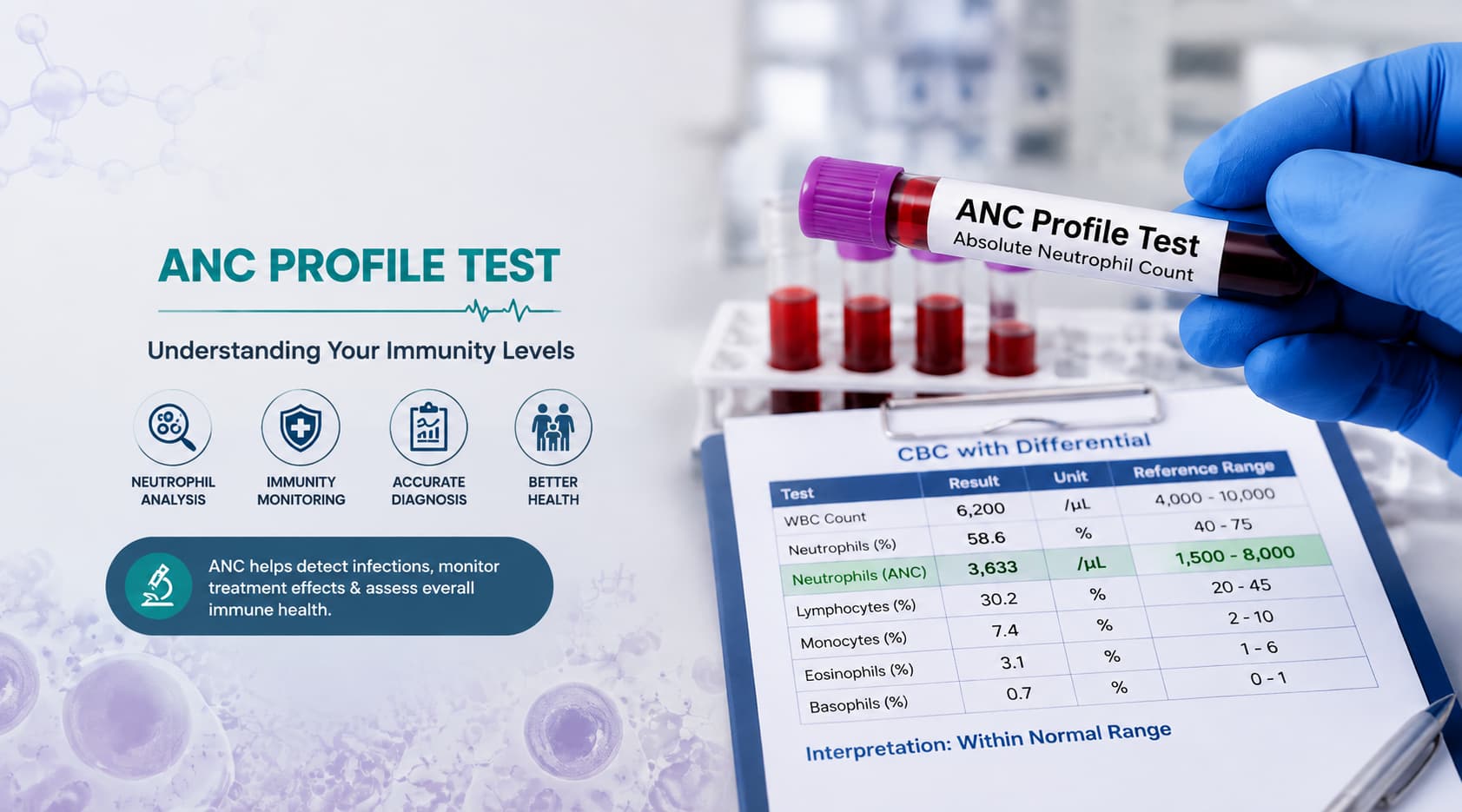
Most patients collect their CBC report, check the platelet count and move on. The P-LCR blood test result sitting a few rows below often gets less attention. P-LCR, or Platelet-Large Cell Ratio, shows what proportion of circulating platelets fall into the large-platelet size range. Larger platelets are often associated with increased platelet turnover and greater metabolic activity, so the value can add context that the platelet count alone does not provide.
That distinction matters, but P-LCR is not a direct measure of platelet age or activity. It is a size-based index interpreted alongside platelet count, MPV, PDW and the clinical picture.
What Is the P-LCR Blood Test
The P-LCR blood test measures the percentage of platelets larger than about 12 femtolitres (fL) in the circulating platelet pool. It is one of several platelet indices that may be generated during a routine complete blood count, alongside mean platelet volume (MPV), platelet distribution width (PDW) and plateletcrit (PCT).
Platelets, also called thrombocytes, are the small blood cells involved in clot formation. Platelets vary in size, and larger platelets can be more reactive and granule-rich. A higher P-LCR may therefore appear when platelet turnover increases, but the result does not identify the cause on its own.
Many automated haematology analysers can calculate P-LCR during routine CBC analysis. No separate blood sample is usually needed. Whether the value appears on the final report depends on the analyser and the laboratory's reporting setup.
P-LCR Blood Test Normal Range
The P-LCR blood test normal range falls between approximately 13% and 43% in most laboratory settings, though some references cite a narrower range of 13% to 35%. The variation reflects differences across analysers, calibration standards, and the populations used to establish reference intervals.
One practical point: the reference interval printed on your specific lab's report is the one that applies to your result. A value that looks high against one lab's range may fall within another lab's normal band entirely.
| P-LCR Value | Interpretation | Common Associations |
|---|---|---|
| Below 13% | Low | May occur with reduced or altered platelet production |
| 13% to 43% | Normal (example range) | Falls within the laboratory's example reference interval |
| Above 43% | High | May occur with increased platelet turnover or altered platelet production |
Example reference interval. Ranges vary by instrument and population. Use the range printed by your testing laboratory.
A result within range does not automatically rule out every health issue. A result outside range does not automatically confirm one. The clinical picture, other CBC parameters, and the patient's history all shape how a P-LCR result should be interpreted.
What a High P-LCR Blood Test Means
A high P-LCR means a greater proportion of circulating platelets fall into the large-platelet range. This can happen with increased platelet turnover and in several inflammatory, haematological or thrombotic conditions. The value does not, by itself, prove that bone marrow production has increased.
Inflammation and infection are among the conditions associated with increased P-LCR. During an inflammatory response, platelet production and activation can change, which may shift platelet size indices. These changes are non-specific and need to be read with the rest of the CBC.
P-LCR has also been studied in cardiovascular disease, but it is not an independent cardiovascular risk test. A prospective study published in PMC on non-STEMI patients examined changes in MPV, PDW and P-LCR after clopidogrel treatment. In that study, changes in P-LCR did not independently predict major adverse cardiovascular events. The stronger prognostic signal came from PDW.
Abnormal platelet size and distribution can also occur in myeloproliferative disorders, usually alongside changes in platelet count and other CBC findings. Inflammatory bowel disease, rheumatoid arthritis and some cancers have also been associated with altered platelet indices, although P-LCR is not diagnostic for any of them.
P-LCR can rise during recovery from some forms of thrombocytopenia. As platelet production responds, a larger proportion of newly released platelets may enter circulation. The pattern should still be interpreted with platelet count, MPV and the reason for the thrombocytopenia.
A Medicine journal study of 1,992 hospitalised COVID-19 patients found higher P-LCR levels among patients who died than among survivors. ICU and intubated patients also showed higher values. The findings suggest a possible prognostic role for P-LCR in COVID-19, but they should not be generalised to every critically ill patient.
A high P-LCR result alone is rarely an emergency. It calls for interpretation alongside MPV, PDW, platelet count and the clinical picture.
What a Low P-LCR Blood Test Means
A low P-LCR means fewer circulating platelets fall into the analyser's large-platelet range. On its own, this is a non-specific finding. It is best interpreted alongside platelet count, MPV, PDW and the rest of the CBC rather than as a direct measure of reduced production of young platelets.
Low P-LCR may be seen in some conditions associated with reduced or altered platelet production, including bone marrow failure states such as aplastic anaemia. However, P-LCR alone cannot diagnose marrow suppression, and abnormalities in the platelet count and other blood cell lines carry much more weight.
Immune thrombocytopenia (ITP) follows a different pattern. Because platelets are destroyed in the circulation and the marrow responds by releasing larger platelets, MPV and P-LCR may be increased rather than low. These indices can support interpretation, but they do not diagnose ITP on their own.
Some viral infections and marrow-suppressive states can alter platelet production and size distribution. A low P-LCR in isolation, without thrombocytopenia or other CBC abnormalities, is usually of limited clinical significance.
P-LCR in Pregnancy: What Indian Labs Should Know
Platelet indices including P-LCR are being studied in antenatal care. A comparative study conducted at LNJP Hospital, New Delhi, published in the Annals of Pathology and Laboratory Medicine examined P-LCR alongside other platelet indices in 180 pregnant women with preeclampsia, gestational diabetes mellitus (GDM) or healthy pregnancies.
The study found significant differences in P-LCR values between the preeclampsia group and healthy controls. This aligns with other research suggesting that changes in platelet indices may appear in preeclampsia even when platelet count alone provides limited information. These indices remain supportive markers rather than diagnostic criteria.
For diagnostic labs running antenatal profiles, P-LCR can add useful context alongside MPV, PDW, platelet count and the broader clinical assessment when preeclampsia or GDM is being evaluated. It does not replace established diagnostic criteria.
Pregnancy itself can affect platelet indices, so P-LCR should be interpreted alongside gestational stage, other platelet parameters and the clinical picture. Laboratories should use their own validated reference intervals rather than assuming one pregnancy-specific range applies everywhere.
What Is the Cost of a P-LCR Test in India
P-LCR is usually generated as part of an automated complete blood count with ESR package or CBC workflow rather than ordered as a standalone test. Where the analyser and reporting format include P-LCR, it generally does not require a separate blood sample. CBC pricing in India varies widely by provider, city and whether the test is part of a health package.
At-home collection services may charge more when CBC testing is bundled with other investigations or home-visit fees. Whether P-LCR appears on the report depends on the analyser and the laboratory's reporting format, so patients should check the test details if they specifically need this index.
Patients with insurance should confirm whether routine CBC testing is covered. For others, CBC remains a relatively affordable laboratory investigation.
How Flabs Supports Platelet Index Reporting
Over 2,000 NABL-accredited diagnostic labs across India run on Flabs LIS, a cloud-based laboratory information system built for pathology workflows. For labs reporting CBC results including P-LCR, MPV and PDW, structured reporting helps keep platelet indices visible and easy to interpret alongside reference ranges.
- Structured CBC report templates capturing all platelet indices including P-LCR, MPV, PDW, and PCT
- AI Smart Reports presenting platelet index results in patient-friendly language alongside reference ranges
- Automated TAT tracking ensuring results reach clinicians within agreed turnaround windows
- Digital report delivery via WhatsApp, SMS, and email for referring doctors
- NABL-ready audit trails for every result entered and authorised
- Role-based access ensuring only qualified staff verify and release haematology reports
The pathology reporting software at Flabs supports structured, complete reporting so platelet indices such as P-LCR appear with the context clinicians need.
The Bottom Line
The P-LCR blood test is not a standalone diagnostic. Its value comes from being read alongside the platelet count, MPV, PDW, the patient's symptoms and other relevant findings.
P-LCR has been studied in cardiovascular disease, haematological disorders, COVID-19 and pregnancy. It remains an adjunct marker rather than a test that confirms disease or predicts outcomes by itself.
A P-LCR result outside the laboratory's reference range is a prompt for context, not a diagnosis. Discuss it with a healthcare professional alongside the rest of the CBC and the clinical picture.
Also check - PT INR Test Report Format - Download Free PDF Sample
Get Started at ₹1!
Try Flabs for a full month for just ₹1.
Follow us on