A PT/INR test report records how long a plasma sample takes to clot and presents the result as both Prothrombin Time, measured in seconds, and the International Normalized Ratio.
PT evaluates the extrinsic and common coagulation pathways. INR standardizes the PT result so it can be interpreted more consistently when laboratories use different thromboplastin reagents or testing methods. The test is commonly used to monitor warfarin therapy and may also support the investigation of unusual bleeding, clotting disorders or impaired liver synthesis.
A complete PT/INR report should show the patient result, laboratory reference interval, specimen and method information, collection and reporting timestamps, abnormal-result flags and the authorized signatory.
Important: The reference range printed by the testing laboratory should be used instead of treating one online range as universal.
What is PT-INR Test ?
The full form of PT INR test is Prothrombin Time International Normalized Ratio, a crucial test for measuring blood clotting time.
A PT (Prothrombin Time) is a blood test to determine the blood clotting time in a person. INR (International Normalised Ratio) is an assay for calculating the extrinsic pathway and common pathway of coagulation. Prothrombin is a protein made by the liver that helps in blood clotting. A physician may request the PT test report results for symptoms such as unexplained heavy bleeding, nose bleeding, menstrual bleeding in women, bruising, etc. It is sometimes done along with a PTT test (Partial Thromboplastin Time).
A clotting disorder may manifest in terms of leg pain or tenderness, leg swelling, redness or red streaks on the legs, breathing difficulty, cough, chest pains, and rapid heartbeat. Blood sampling is done through venipuncture. PT INR test report format ensures precise interpretation of the results. Also,it is one of the most affordable pathology tests in India– PT INR test price varies from ₹190-₹300 depending on the city.
Guidelines for PT INR Test Report Format
Title
Start the PT INR test report with the title field “PT INR Test Report”.
Patient and request details
- Patient name
- Age or date of birth
- Sex, where relevant
- Patient ID or UHID
- Referring doctor
- Registration date and time
- Sample collection date and time
- Sample receipt time
- Report release date and time
Specimen Info
Mention the name, volume and collection techniques used for blood sampling. A PT INR test report can also speak about relevant test conditions, prompt collection, and assure the integrity of the sample.
The report or laboratory record should identify:
- Specimen: citrated plasma or platelet-poor plasma
- Collection tube: light-blue-top tube
- Anticoagulant: 3.2% sodium citrate
- Sample condition or rejection comment, where applicable
- Collection location or phlebotomist, if part of the laboratory workflow
PT/INR testing uses plasma collected in a light-blue-top sodium-citrate tube. Accurate tube filling is important because excess citrate from an underfilled tube can falsely prolong the clotting time.
Sampling Techniques
Include a section on describing the methodology used in Prothrombin Time Test along with the factors that might impact the results and testing protocols used.
Test Results
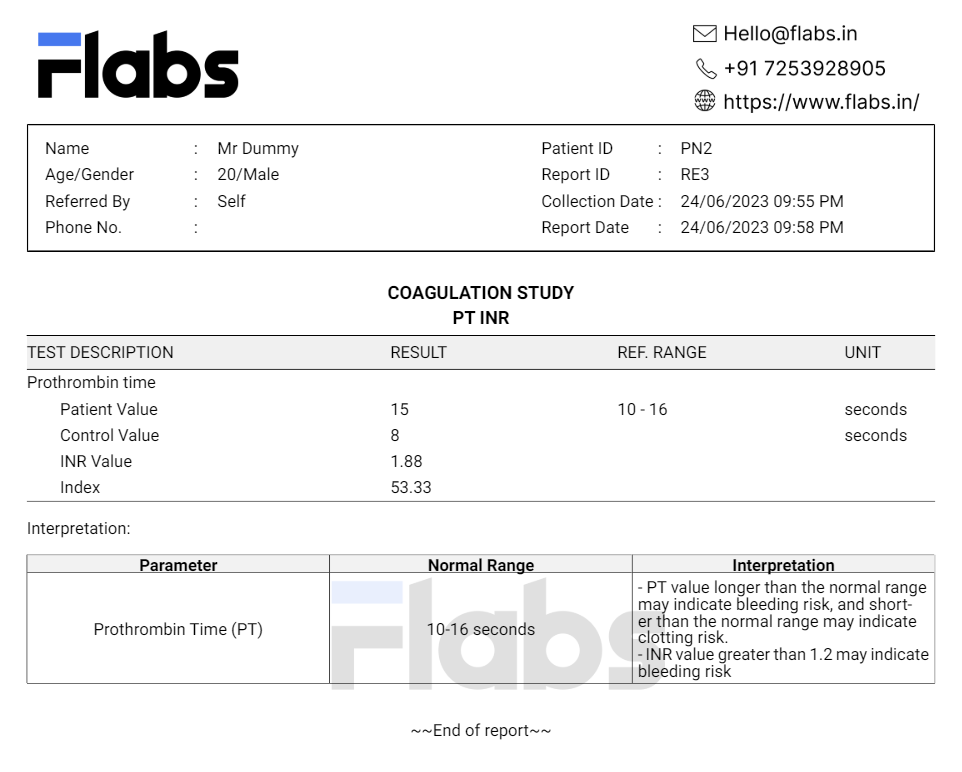
Prominently display the test results in the PT INR test report. Remember to include units of measurement for a standardised PT INR test report format. Indicate the abnormal findings in the same section along with follow-up suggestions.
The main result table should contain:
- Prothrombin Time—patient value
- PT unit in seconds
- Laboratory PT reference interval
- Mean normal or control PT, when used by the laboratory
- International Normalized Ratio
- Laboratory INR reference interval
- Abnormal-result flag
- Prescribed therapeutic target, only when clinically supplied
- Test method or clot-detection method
- Analyzer and reagent information where required by laboratory policy
Reference Values
Include normal reference values for the PT INR test results to enable comparison. It also helps other healthcare professionals easily diagnose a patient’s health condition. Indicate what might influence the PT test normal values such as age, gender, test conditions, etc in the report.
Interpretation
Present concise interpretation of the test results along with instruments used and calibration methods to promise trustworthiness and standardisation of the PT INR test report format.
Signatory
Properly attest the PT INR test report with signatories of authorities to ensure adherence to PT INR test report format guidelines, as set by local regulatory bodies.
Data Encryption
- Name and qualification of the authorized signatory
- Electronic or digital signature
- Laboratory name, address and contact details
- Accreditation information only when applicable
- Page number
- Report version or amended-report identifier
- QR code or verification link when securely implemented
Do not describe a QR code or barcode as encryption. State that it supports report authentication, identification or traceability.
Laboratory Info
Provide laboratory details like email, contact numbers, FAX numbers, etc., to encourage open communication between patients and healthcare professionals.
PT/INR Sample Report Format
| Report Field | Illustrative Entry |
|---|---|
| Test name | Prothrombin Time with INR |
| Specimen | Platelet-poor citrated plasma |
| Collection tube | Light-blue top, 3.2% sodium citrate |
| Prothrombin Time—patient | XX.X seconds |
| PT reference interval | Laboratory-specific interval |
| Mean normal/control PT | XX.X seconds |
| INR | X.XX |
| INR reference interval | Laboratory-specific interval |
| Method | Optical or mechanical clot detection |
| Result flag | Normal, High or Low according to laboratory rules |
| Clinical note | Interpret using the patient’s medication and prescribed target |
| Authorized by | Name and qualification |
| Report status | Final or amended |
This is an illustrative template. Each laboratory should use its validated method, analyzer, reagent-specific reference interval, report authorization process and applicable quality-management requirements.
PT INR Test Report PDF Sample
To understand the guidelines of the PT INR test report format, download the below given PT INR test report sample.

PT and INR Normal Range
PT reference intervals vary according to the analyzer, reagent and laboratory method. For example, Mayo Clinic Laboratories publishes a PT reference interval of 9.4–12.5 seconds and an INR interval of 0.9–1.1, while MedlinePlus describes commonly used values of approximately 11–13.5 seconds and INR 0.8–1.1 for people not taking anticoagulants
| Clinical Context | Commonly Used Range | Reporting Note |
|---|---|---|
| Person not taking a vitamin K antagonist | PT: laboratory-specific; INR commonly around 0.8–1.1 | Always display the testing laboratory’s validated interval |
| Standard-intensity warfarin treatment | INR commonly 2.0–3.0 | Use only when this target has been prescribed |
| Higher-intensity anticoagulation | INR may be 2.5–3.5 | Applies only to selected indications under clinician supervision |
| Result outside the laboratory or prescribed range | Do not diagnose from the number alone | Correlate with medication, symptoms, history and other tests |
- Below prescribed target: INR is below the patient-specific anticoagulation target. This label is relevant only when a therapeutic target has been provided.
- Within prescribed target: INR is within the range specified by the treating clinician.
- Above prescribed target: INR is above the specified therapeutic range and should be reviewed in the patient’s clinical context.
Not taking warfarin: Compare the result with the laboratory’s reference interval rather than a therapeutic anticoagulation target.
Patients should not stop, start or change anticoagulant medication based solely on an online range.
How to Read a PT/INR Report
Read the report in the following order:
- Confirm the patient name and collection date.
- Check whether the result is PT in seconds or INR as a ratio.
- Compare PT with the laboratory’s printed reference interval.
- Compare INR with either the healthy reference interval or the clinician-prescribed therapeutic target.
- Check abnormal-result flags and laboratory comments.
- Review whether the patient is taking warfarin or another anticoagulant.
- Discuss unexpected results with the treating clinician.
A prolonged PT or raised INR may occur with vitamin K antagonist treatment, vitamin K deficiency, liver dysfunction, coagulation-factor deficiency or other clinical conditions. A PT/INR result alone does not establish the diagnosis.
Related read - Coagulometer for PT and INR testing
PT/INR Specimen Requirements and Common Rejection Reasons
Accurate PT/INR reporting begins before the sample reaches the analyzer.
Recommended specimen information
- Platelet-poor plasma
- Light-blue-top tube
- 3.2% sodium citrate
- Tube filled to the manufacturer’s mark
- Blood-to-citrate ratio approximately 9:1
- Sample gently inverted rather than shaken
Common reasons to reject or recollect a sample
- Underfilled citrate tube
- Visible clot in the sample
- Incorrect collection tube
- Hemolysed or severely lipaemic sample according to laboratory policy
- Heparin or saline contamination
- Delayed processing outside the laboratory’s validated stability period
- Unlabelled or incorrectly labelled specimen
- Citrate volume not adjusted when required for very high haematocrit
An underfilled citrate tube leaves too much anticoagulant relative to plasma and can produce an artificially prolonged result. Clotted samples, improper citrate ratios and contamination are recognized pre-analytical causes of unreliable coagulation results.
You may also like to check Machine Interfacing for Diagnostic Labs
Important Notes for Laboratories
- Use reagent- and analyzer-specific PT reference intervals.
- Do not publish the warfarin therapeutic range as the “normal range.”
- Display INR without a time unit.
- Show PT in seconds.
- State the specimen type and method.
- Flag results using laboratory-approved rules.
- Maintain an audit trail when a report is amended.
- Ensure an authorized person reviews results before release.
- Keep interpretations concise and avoid making a diagnosis from PT/INR alone.
- Validate calculations, reference intervals and automated report rules before use.
NABL assessment documentation specifically checks whether laboratories have procedures for authorized result review, automated selection and release, report content and amended or revised reports.
Standardize PT/INR Test Reporting
A well-structured PT/INR report improves result interpretation and ensures consistent diagnostic documentation. Explore our Pathology Report Format for professionally designed templates used across a wide range of laboratory tests. If you want to streamline report generation, our Pathology Reporting Software helps diagnostic laboratories create accurate, standardized reports with greater speed and efficiency.
Conclusion
A useful PT/INR test report does more than display a clotting-time number. It clearly separates the patient’s PT result, laboratory reference interval, INR value and any clinician-prescribed therapeutic target.
For reliable reporting, laboratories should use correctly collected citrated plasma, validated analyzer and reagent settings, appropriate abnormal-result flags and an authorized review process. The downloadable format on this page is a sample template and should be adapted to the laboratory’s validated workflow before clinical use.
Also check APTT test and coagulation report format
Get Started at ₹1!
Try Flabs for a full month for just ₹1.
Follow us on