Syphilis continues to challenge diagnostic workflows because early symptoms drift into misleading clinical patterns. Pathologists face pressure to deliver clarity while working with samples that demand precise interpretation. Those tensions grow when faster turnaround times are needed and patient loads rise.
A treponemal test enables a confident syphilis diagnosis, yet many labs juggle scattered processes from blood collection to final reporting. When testing feels fragmented, accuracy and efficiency slip at the edges. A structured approach, paired with dependable laboratory software, steadies the entire journey from specimen to report.
The Role of the Treponemal Test
A treponemal test detects antibodies that target Treponema pallidum, the organism responsible for syphilis. Since these antibodies persist for years, the test confirms exposure and supports stage-appropriate management. Clinicians value treponemal assays for their sensitivity during later stages.
Several Treponema pallidum tests exist, each aligned with distinct parts of the diagnosis. Compared with non-treponemal assays that assess disease activity, treponemal tests are about specificity. For labs trying to refine syphilis diagnosis, this difference shapes interpretation and workflows.
Common treponemal assays include,
- FTA-ABS
- TP-PA
- EIA and CIA assays
- Rapid treponemal tests suited for decentralized settings
Each reflects a different balance of sensitivity and operational complexity. For pathologists, these nuances influence reagent selection, staffing needs, and interpretation.
Syphilis Test Name and Its Use
Naming conventions can create confusion across systems, especially when EHRs list assays in inconsistent ways. The phrase syphilis test name may refer to treponemal or non-treponemal assays, but the distinction matters.
Treponemal tests are confirmatory. Non-treponemal tests provide quantitative titers.
To streamline ordering, many labs embed reflex rules. An EIA treponemal screening test can trigger an automatic non-treponemal test if the initial result turns reactive. This “reverse algorithm” minimises uncertainty.
How a Treponemal Test for Syphilis Works
A treponemal test for syphilis measures IgG and, in some formats, IgM antibodies. Because antibodies remain in circulation for an extended period, they serve as historical markers of exposure even once a patient receives treatment.
- Antigens attached to a solid phase interact with patient antibodies.
- Binding triggers a detection signal via fluorescent, agglutination, or enzyme-linked methods.
- The assay platform quantifies or qualifies the response.
- The report flows into the LIS for verification and final release.
Test Procedure: Blood Sampling
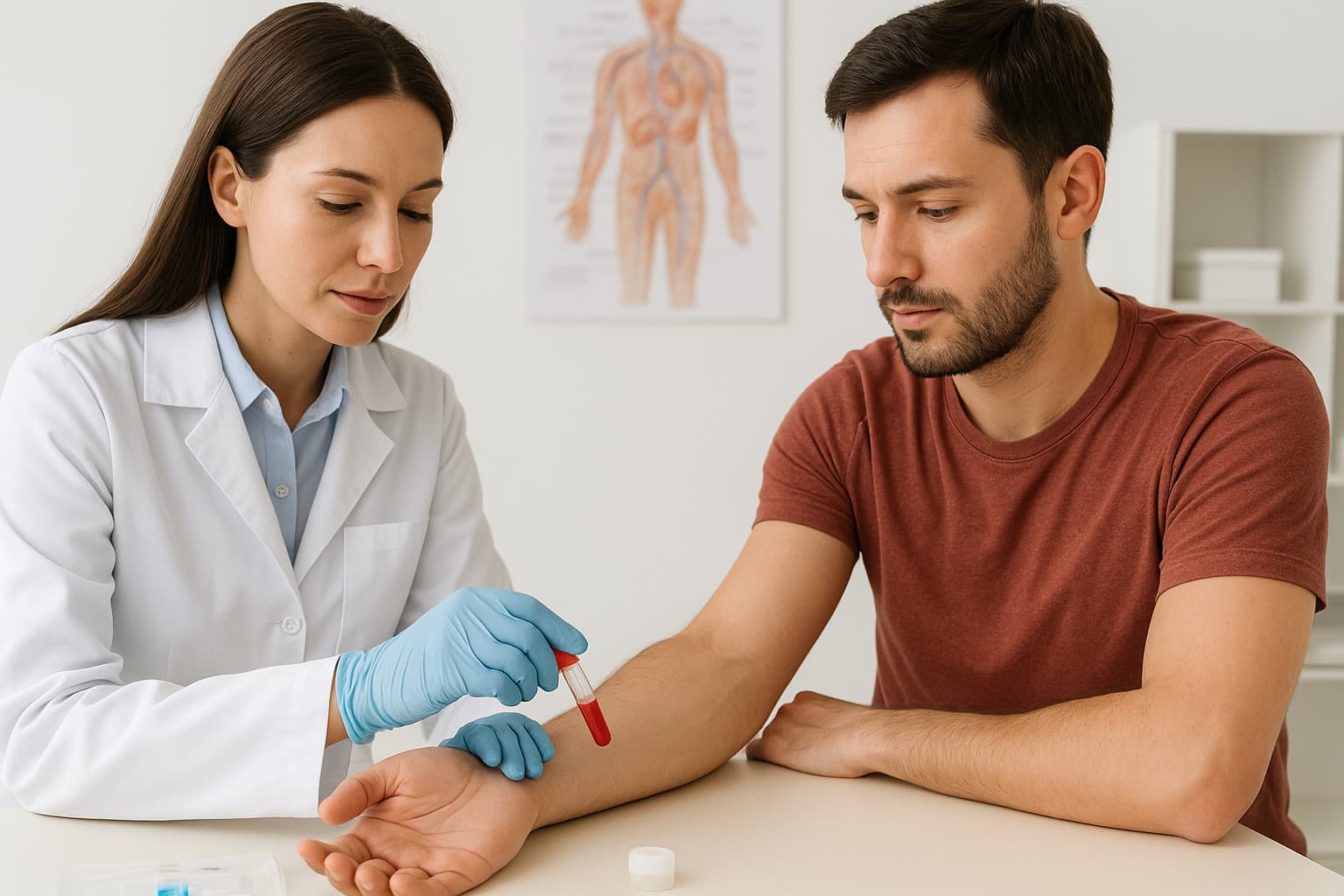
Even minor deviations in the blood collection procedure influence assay consistency. Syphilis testing has relatively stable pre-analytical requirements, although hemolysis and improper storage can introduce noise.
| Step | Aspects |
|---|---|
| Venipuncture | Use serum separator or EDTA tubes according to the assay’s needs. |
| Sample handling | Maintain temperature stability; avoid prolonged exposure to heat |
| Centrifugation | Process samples promptly to preserve antibody integrity |
| Transport | Use sealed, labeled containers with traceable identifiers |
| Pre-analysis | Verify patient identity and test order in the LIS |
How to Test for Syphilis
The test for syphilis varies by region, lab capacity, and practitioner preference. Two overarching ways dominate clinical practice.
Traditional Algorithm
- Non-treponemal test (RPR or VDRL)
- Confirmation with a treponemal test
It suits labs where rapid titers guide treatment and follow-up.
Reverse Algorithm
- Treponemal EIA or CIA test
- Reflex non-treponemal test
- Secondary treponemal test if discordant
This structure integrates smoothly with automated analysers. Many pathology labs lean toward the approach.
Turnaround Time
Syphilis testing introduces variable timing due to platform diversity. Still, most immunoassay-based treponemal tests demonstrate rapid analytical phases. The overall turnaround time (TAT) hinges on batching, workload peaks, reagent availability, and LIS efficiency.
Lean digital workflows reduce bottlenecks. Real-time dashboards, automated alerts, and structured approval chains prevent delays during report authorisation. As testing demand grows, labs with outdated systems struggle to sustain the TATs.
Syphilis Antibody Test Results
A syphilis antibody test requires a clear, structured reporting language. Ambiguity complicates provider decisions, especially when reflex testing occurs behind the scenes.
A concise pathology report format for treponemal testing should include,
- Assay method and platform
- Result interpretation (reactive, non-reactive, equivocal)
- Reflex tests performed
- Correlation advice
- Notes on prior reactivity if historical data exist
Strengthening Lab Workflows with Flabs LIS
Treponemal tests rely on tight coordination across pre-analytical, analytical, and post-analytical stages. Fragmented systems contribute to mislabeled samples, delayed approvals, and inconsistent communication with clinicians. This is where modern digital infrastructure becomes vital.
Flabs Pathology Software brings structure to routine testing, including treponemal assays. Its design supports fluid registration, sample tracking, and result delivery without forcing labs into rigid workflows.
Streamlined Lab Operations
Flabs automates patient registration, lab analysis routing, and report generation. For syphilis diagnosis workflows, this means the treponemal test, non-treponemal reflex test, and downstream confirmations move without unnecessary manual input.
QR-coded reports provide fast retrieval, while WhatsApp integration eases communication on both the patient and provider sides. By trimming manual tasks, labs gain accuracy and productivity.
Patient Experience
Patients can log in using their phone number to access results instantly. This reduces repeated calls to lab staff and shortens the communication chain when follow-up care is time-sensitive.
User-Friendly Interface
Flabs favors an intuitive interface that supports technicians, lab owners, and pathologists without requiring extensive training. Navigation remains clear even during high-volume testing days, a factor that improves consistency across shifts.
Affordable and Scalable
Small labs and large diagnostic centers can adopt Flabs without technical strain. As testing demand expands, new collection centers link into the same ecosystem. That stability matters when syphilis testing requirements rise during community outbreaks.
Security and Data Protection
Flabs safeguards patient data through strong backup systems, disaster recovery readiness, and alignment with industry security standards. Patient identities remain linked only to the originating lab.
Labs exploring efficiency upgrades can start a 5-day free trial of Flabs by submitting basic details. There’s also a demo request that supports teams comparing LIS platforms.
Conclusion
The treponemal test remains a central anchor in syphilis diagnosis. As testing volumes shift and expectations tighten, reliable workflows depend on accurate assays supported by efficient digital systems.
Modern LIS platforms like Flabs bring structure and clarity to each stage, reducing strain on staff and smoothing patient communication. For laboratories searching for steadier operational control, digital reinforcement becomes as essential as the assay itself.
Also check - SFLC Blood Test: Role in Diagnosing Plasma Cell Disorders
Get Started at ₹1!
Try Flabs for a full month for just ₹1.
Follow us on