Enzyme-Linked Immunosorbent Assay (ELISA) is one of the most widely used immunoassays in diagnostic laboratories. Pathologists and laboratory professionals rely on ELISA to detect antigens, antibodies, hormones, and proteins in infectious diagnostics, autoimmune screening, and biomarker research.
You encounter ELISA daily in serology sections, research labs, and diagnostic centres. Reliable antigen-antibody interaction, measurable enzyme reactions, and scalable microplate formats allow laboratories to process large sample volumes with high specificity.
Laboratory professionals frequently ask a simple question: how many types of ELISA exist and when should each method be used? Because the selection of the correct assay format influences sensitivity, specificity, reagent cost, and turnaround time.
Types of ELISA: At a Glance
| ELISA Method | Target Detected | Antibody Requirement | Sensitivity | Common Uses |
|---|---|---|---|---|
| Direct ELISA | Antigen | One labeled antibody | Moderate | Protein detection, antigen screening |
| Indirect ELISA | Antibody | Primary + secondary antibody | High | Serology testing, infection screening |
| Sandwich ELISA | Antigen | Capture + detection antibody | Very high | Cytokines, hormones, clinical biomarkers |
| Competitive ELISA | Small antigen | Antibody competition system | High | Hormones, drugs, toxins |
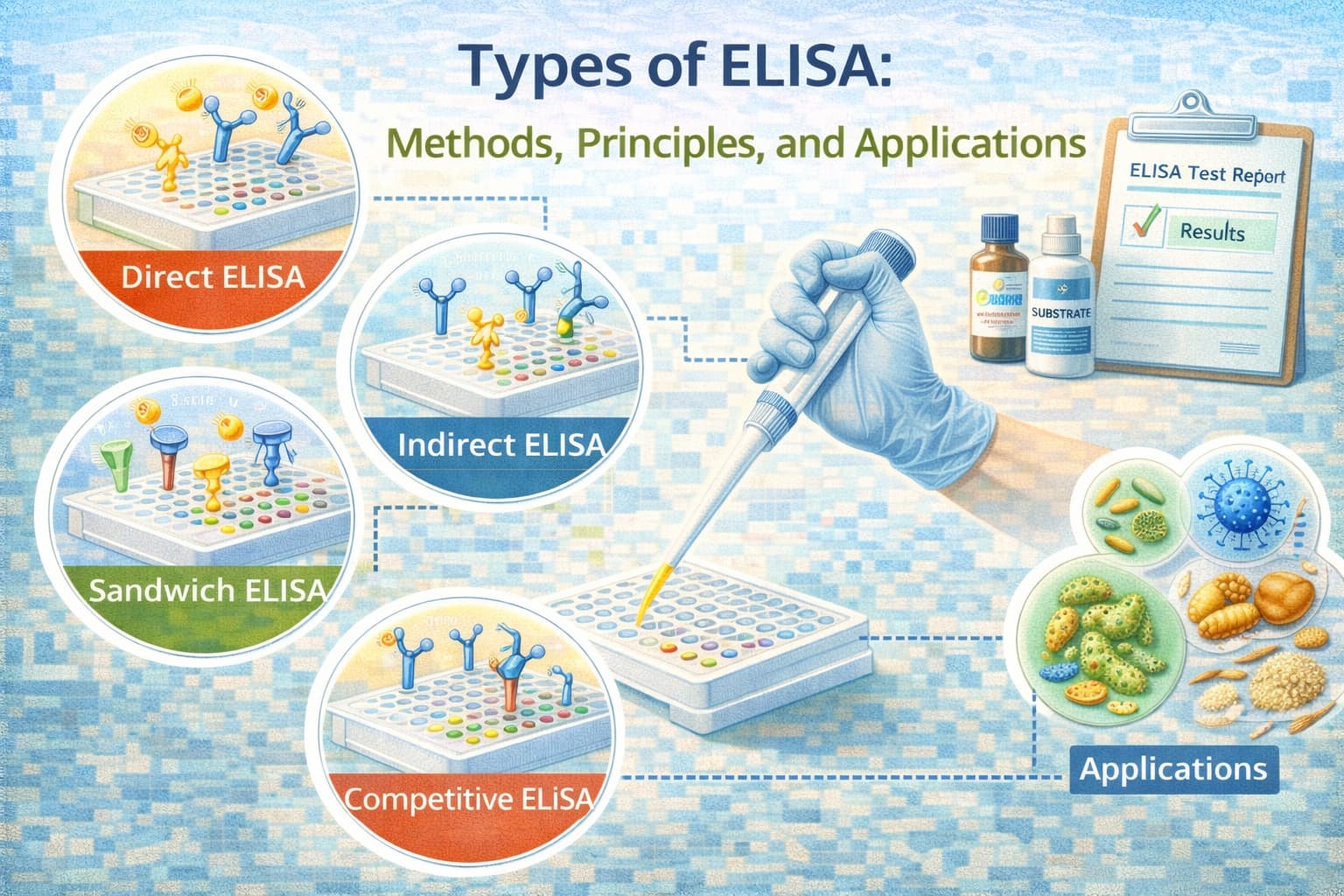
Diagnostic labs use 4 main types of ELISA based on assay design and antigen-antibody arrangement. Each format detects analytes in a slightly different way.
- Direct ELISA
- Indirect ELISA
- Sandwich ELISA
- Competitive ELISA
Every method relies on the same fundamental immunological principle: antigen-antibody binding detected through an enzyme-mediated colour change.
However, assay structure determines sensitivity, complexity, and diagnostic use.
Among the types of ELISA, sandwich assays dominate clinical diagnostics, while indirect assays appear widely in serology testing. Competitive ELISA becomes useful for small molecules or low-molecular-weight antigens.
Laboratory professionals who understand the difference between assay designs can select reagents, kits, and calibration methods with greater accuracy.
Principle of ELISA Techniques
ELISA operates through antigen-antibody specificity combined with enzyme-mediated signal detection.
The process begins with immobilisation of either antigen or antibody on a microplate surface. A patient sample enters the well, allowing target molecules to bind with coated reagents. After washing steps remove unbound material, an enzyme-linked antibody attaches to the immune complex.
A substrate is then added. The enzyme converts substrate into a detectable signal, usually a colour change measurable through an ELISA reader.
There are 6 basic stages.
- Plate coating with antigen or antibody.
- Sample incubation.
- Binding of enzyme-linked antibody.
- Washing to remove unbound material.
- Substrate reaction producing a measurable signal.
- Optical density measurement using an ELISA reader.
Signal intensity correlates with analyte concentration.
Laboratories use spectrophotometric absorbance values to quantify results. Calibration curves generated from standards convert optical density into concentration values.
However, the reliability of an ELISA technique depends on reagent quality, incubation timing, and instrument calibration.
1. Direct ELISA
Direct ELISA represents the simplest assay format among laboratory immunoassays.
In direct ELISA, an antigen attaches directly to the microplate surface. A single enzyme-conjugated antibody binds to that antigen. After substrate addition, signal intensity reflects antigen concentration.
Characteristics of direct ELISA:
- Uses one antibody
- Fewer incubation steps
- Shorter assay time
- Lower risk of cross-reactivity from secondary antibodies
Limitations include reduced signal amplification and lower sensitivity compared with other formats.
Direct ELISA suits antigen detection in controlled laboratory settings, especially during assay development or protein quantification experiments.
2. Indirect ELISA
Indirect ELISA detects antibodies rather than antigens. Many serology assays use indirect formats for infectious disease screening.
In indirect ELISA, the antigen coats the microplate. Patient serum enters the well, allowing antibodies within the sample to bind the antigen. A secondary enzyme-linked antibody then binds the patient antibody.
Signal amplification occurs because multiple secondary antibodies may bind each primary antibody.
Advantages include:
- High sensitivity
- Cost-efficient secondary antibodies
- Flexible detection systems
Indirect ELISA appears widely in antibody screening for viral infections and autoimmune markers.
Serology laboratories also apply indirect formats in vaccine response studies and epidemiological research.
3. Sandwich ELISA
Sandwich ELISA detects antigens using two antibodies that bind different epitopes.
The microplate contains a capture antibody attached to the surface. When a sample enters the well, target antigen binds the capture antibody. A second enzyme-linked detection antibody attaches to another site on the antigen.
The antigen becomes “sandwiched” between antibodies.
Sandwich assays provide high specificity and sensitivity because two antibodies confirm antigen identity.
Diagnostic laboratories favour sandwich assays for:
- Cytokine measurement
- Hormone quantification
- Biomarker detection
- Infectious disease antigen tests
Many automated immunodiagnostic platforms rely on sandwich formats due to strong signal amplification and reduced background noise.
4. Competitive ELISA
Competitive ELISA measures antigen concentration through signal inhibition.
During incubation, the sample antigen competes with the labelled antigen for antibody binding sites. When the sample antigen concentration increases, fewer labelled antigens bind antibodies.
Signal intensity, therefore, decreases as antigen concentration rises.
Competitive assays work well for:
- Small molecules
- Hormones
- Drug monitoring
- Toxin detection
Large antigens with multiple epitopes generally perform better with sandwich assays, while small molecules require competitive formats.
Laboratory scientists select competitive assays when antigen size prevents the simultaneous binding of two antibodies.
Among laboratory immunoassays, these four types of ELISA form the foundation of most diagnostic test kits.
A pathologist selecting among types of ELISA evaluates antigen structure, expected concentration range, and reagent availability.
ELISA Applications in Clinical Diagnostics
Clinical laboratories rely on ELISA across many diagnostic areas. The flexibility of assay formats expands the list of detectable targets.
Common ELISA applications include:
- Viral infection screening
- Hormone testing
- Allergy diagnostics
- Autoimmune disease markers
- Tumour biomarker detection
- Vaccine response
One widely recognised use involves the ELISA test for dengue. Detection of dengue relies on antigen detection (NS1 antigen) and antibody detection (IgM and IgG). ELISA assays detect dengue virus infection during both acute and convalescent stages.
Other infectious diseases diagnosed using ELISA include HIV, Hepatitis B and C, Zika virus, and COVID-19 antibody detection.
Public health laboratories also employ ELISA in surveillance studies and outbreak investigations.
Researchers exploring types of ELISA and its applications in biomarker discovery also apply the method to detect inflammatory proteins, growth factors, and cytokines.
ELISA Reader and Detection Systems
Signal measurement requires a microplate spectrophotometer, commonly called an ELISA reader.
An ELISA reader measures optical density at specific wavelengths, usually between 405 nm and 450 nm.
Modern readers support:
- Dual wavelength measurement
- Automated plate shaking
- Kinetic assays
- Data export to laboratory information systems
Laboratories processing large volumes integrate plate washers and automated readers for improved reproducibility.
As with other pathology lab equipment, accurate calibration ensures consistent absorbance readings and reliable quantitative results when using the device.
Types of ELISA and Their Advantages
| ELISA Method | Key Features / Advantages |
|---|---|
| Direct ELISA | Simple assay design, Short incubation time, Reduced reagent cost |
| Indirect ELISA | Strong signal amplification, Greater flexibility with secondary antibodies, Widely used in antibody detection assays |
| Sandwich ELISA | High specificity from dual antibody binding, Strong sensitivity for low-abundance antigens, Ideal for complex biological samples |
| Competitive ELISA | Suitable for small molecules, Useful when antigen contains only one epitope, Accurate measurement of hormones and toxins |
Types of ELISA Kits Used in Laboratories
Commercial manufacturers provide several types of ELISA kits designed for diagnostic or research use.
Kit formats include:
- Pre-coated microplates
- Ready-to-use reagents
- Calibrators and controls
- Substrate and stop solutions
Manufacturers also design different types of ELISA tests targeting specific diseases or biomarkers.
- Dengue IgM ELISA kit
- HIV antibody ELISA kit
- Cytokine sandwich ELISA kit
- Hormone competitive ELISA kit
Kit design aligns with different types of ELISA techniques to ensure assay performance matches antigen structure and expected concentration.
Laboratories have to verify kit performance using positive and negative controls before patient testing.
Choosing Between ELISA Methods
Laboratory professionals evaluating types of ELISA consider several analytical factors.
- Nature of target molecule.
- Expected analyte concentration.
- Required sensitivity.
- Cross-reactivity risk.
- Available antibodies.
Small molecules with limited epitopes generally require competitive assays. Large proteins with multiple epitopes work better with sandwich assays.
Indirect ELISA suits antibody detection in serology labs, while direct ELISA works well in protein quantification research.
Instrument compatibility also matters. Microplate readers and automated washers support high-throughput diagnostic laboratories processing hundreds of samples per day.
Knowledge of types of ELISA methods enables accurate assay selection and reliable laboratory reporting.
Conclusion
ELISA is a foundational immunoassay across clinical diagnostics, biomedical research, and public health laboratories.
The four types of ELISA provide flexible solutions for detecting antigens, antibodies, hormones, and proteins. Each format follows the same immunological principle. But they differ in assay structure, sensitivity, and diagnostic application.
As diagnostic laboratories expand molecular and immunological testing, ELISA is a reliable, scalable platform for protein and antibody measurement.
Familiarity with types of ELISA and their applications supports accurate assay selection, optimised reagent use, and consistent laboratory results.
Also check - Types of Chromatography: Complete Guide for Beginners
Get Started at ₹1!
Try Flabs for a full month for just ₹1.
Follow us on