The bile solubility test is a diagnostic test in microbiology labs, specifically for identifying Streptococcus pneumoniae among alpha-hemolytic streptococci. The test not only enables rapid and reliable differentiation of S. pneumoniae through unique autolytic properties but also underscores the importance of technique and handling. While procedural details are critical, the test's sensitivity and accuracy can be influenced by factors such as reagent freshness, pH balance, and sample age.
Additionally, precise interpretation is vital in preventing false positives or negatives, especially in mixed cultures, emphasising that lab expertise and confirmatory tests strengthen the reliability of bile solubility results.
Principle of Bile Solubility Test
The bile solubility test principle relies on the autolytic enzyme amidase, present in Streptococcus pneumoniae. In an incubated broth culture, this enzyme leads to natural cell lysis: at 24 hours, the culture appears turbid, but after several days, the medium clears as cells break down.
When exposed to bile or bile salts, like sodium deoxycholate, S. pneumoniae rapidly lyses.
Bile salts reduce surface tension between the bacterial cell membrane and medium, accelerating autolysis by activating amidase and inducing culture clearing within minutes. This specific reaction differentiates S. pneumoniae from other alpha-hemolytic streptococci.
Bile Solubility Test Reagent
The bile solubility reagent is Sodium Deoxycholate (C₂₄H₄₀O₄). It is used in different concentrations for preparing two types of reagents.
| Reagent | Concentration | Preparation |
|---|---|---|
| Sodium Deoxycholate | 2% | 2 g in 100 ml sterile distilled water |
| 10% | 10 g in 100 ml sterile distilled water |
Bile Solubility Test Procedure
The bile solubility test procedure can be performed using either the tube or plate method.
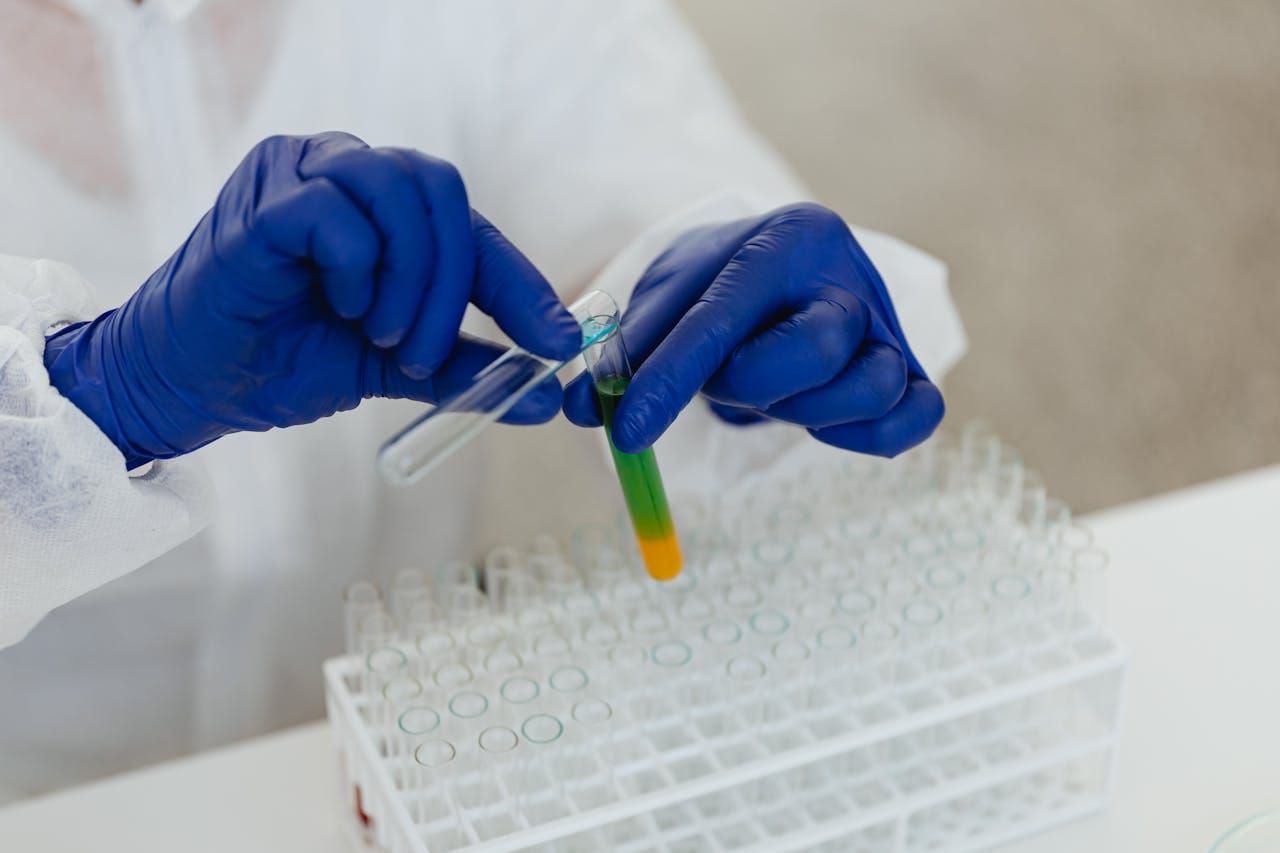
For the tube method, begin by preparing a suspension of the test organism in a small test tube containing a saline solution or an unbuffered broth. Adjust the pH of the suspension to neutral to ensure accuracy, as an incorrect pH can lead to false-negative results. Next, add a small amount of bile salts or sodium deoxycholate reagent to the tube. Incubate the tube at 35–37°C for 10–15 minutes, observing for lysis. A clear solution after incubation indicates a positive result, while a turbid solution suggests a negative result.
In the plate method, add a drop of bile salt reagent directly onto a colony of the test organism on a blood agar plate. Incubate the plate at room temperature for a few minutes, being careful not to disturb the colony, as dislodging it may cause a false-positive result. Observe for any lysis or flattening of the colony, which would indicate a positive result. If no lysis occurs, the test is considered negative.
Modified Bile Solubility Test (AKA Rapid Test)
There is another Bile solubility test procedure that quickly identifies Streptococcus pneumoniae in blood samples by comparing bacterial lysis in bile-treated and untreated smears, aiding fast diagnosis. It is known as the Rapid test.
Rapid tests are essential for understanding the infection source and aiding in precise treatment for septic patients.
In this, a 10% blood sample (by volume) was introduced into two separate bottles containing tryptic soy broth and Thiol broth, under vacuum with CO₂ and 0.025% sodium polyanetholsulfonate (C₁₀H₁₂NaO₄S).
For slide preparation, one half received a drop of blood mixed with 2% sodium deoxycholate, while the other half received blood mixed with water to serve as a control. The slide was air-dried at room temperature, Gram-stained, and examined for cocci.
Finally, organism counts in the deoxycholate-treated sample were compared with the untreated control to evaluate the bacterial concentration and presence.
Bile Solubility Test Results & Interpretation
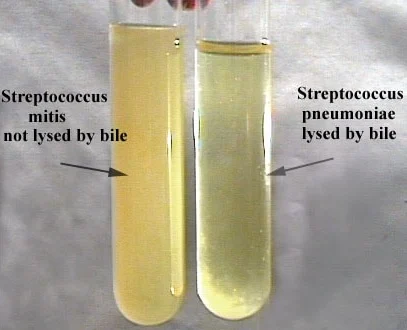
| Observation | Result | Interpretation |
|---|---|---|
| Clear solution (tube) | Positive | Streptococcus pneumoniae likely present |
| Turbid solution (tube) | Negative | Streptococcus pneumoniae unlikely |
| Colony lysis or flattening (plate) | Positive | Streptococcus pneumoniae likely present |
| No colony lysis (plate) | Negative | Streptococcus pneumoniae unlikely |
| Modified Test | Positive | No cocci in the test smear; cocci were present in the control smear. |
| Modified Test | Negative | Cocci is present in both smears. |
Factors Influencing Bile Solubility Test Interpretation
- Reagent freshness and concentration
- pH balance of the suspension
- Age of the bacterial culture
- Accurate incubation times
- Proper handling to avoid dislodging colonies (in plate method)
- Presence of contaminants or mixed cultures
- High concentrations of bile salts
- Temperature consistency
Challenges in the Bile Solubility Test
- For high specificity, tube test-positive but spot test-negative strains should be confirmed using an optochin disk, DNA probe, or MALDI-TOF.
- Non-lysing S. pneumoniae strains may still be S. pneumoniae due to a possible loss of virulence factors or capsule.
- Bile-insoluble colonies resembling S. pneumoniae should be further tested with optochin susceptibility, DNA probes, or MALDI-TOF for accurate identification.
- High bile salt concentrations may inhibit S. pneumoniae autolysis, and reagent evaporation can increase concentration, potentially affecting results.
- Older cultures with autolysed cells are unsuitable for reliable bile solubility testing.
- In the tube test, when using saline or unbuffered broth, adjust pH to neutral to prevent false-negative outcomes.
- Handle colonies carefully in the plate method to avoid dislodging, which can cause false positives; if the plate method is unclear, switch to the tube or slide method.
- Contaminants or non-target organisms may cause partial lysis, leading to potential false positives.
- Cold-stored reagent may thicken, so warm it to 37°C before use for proper consistency.
- Incubation time beyond recommended durations can lead to autolysis, resulting in inaccurate readings.
What’s Beyond
Beyond understanding the bile solubility test’s procedures and challenges, consistent lab practices are crucial for reliability. Labs should implement routine checks on reagent concentration and storage conditions for accurate results. Additionally, laboratory personnel must receive proper training on interpreting subtle differences in test outcomes.
By maintaining these standards, labs can improve diagnostic precision, reinforcing the bile solubility test's effectiveness in identifying Streptococcus pneumoniae accurately.
Relared read: Bile Esculin Test
Get Started at ₹1!
Try Flabs for a full month for just ₹1.
Follow us on