PCR Machine: Uses, Instrumentation, Types and Price in India
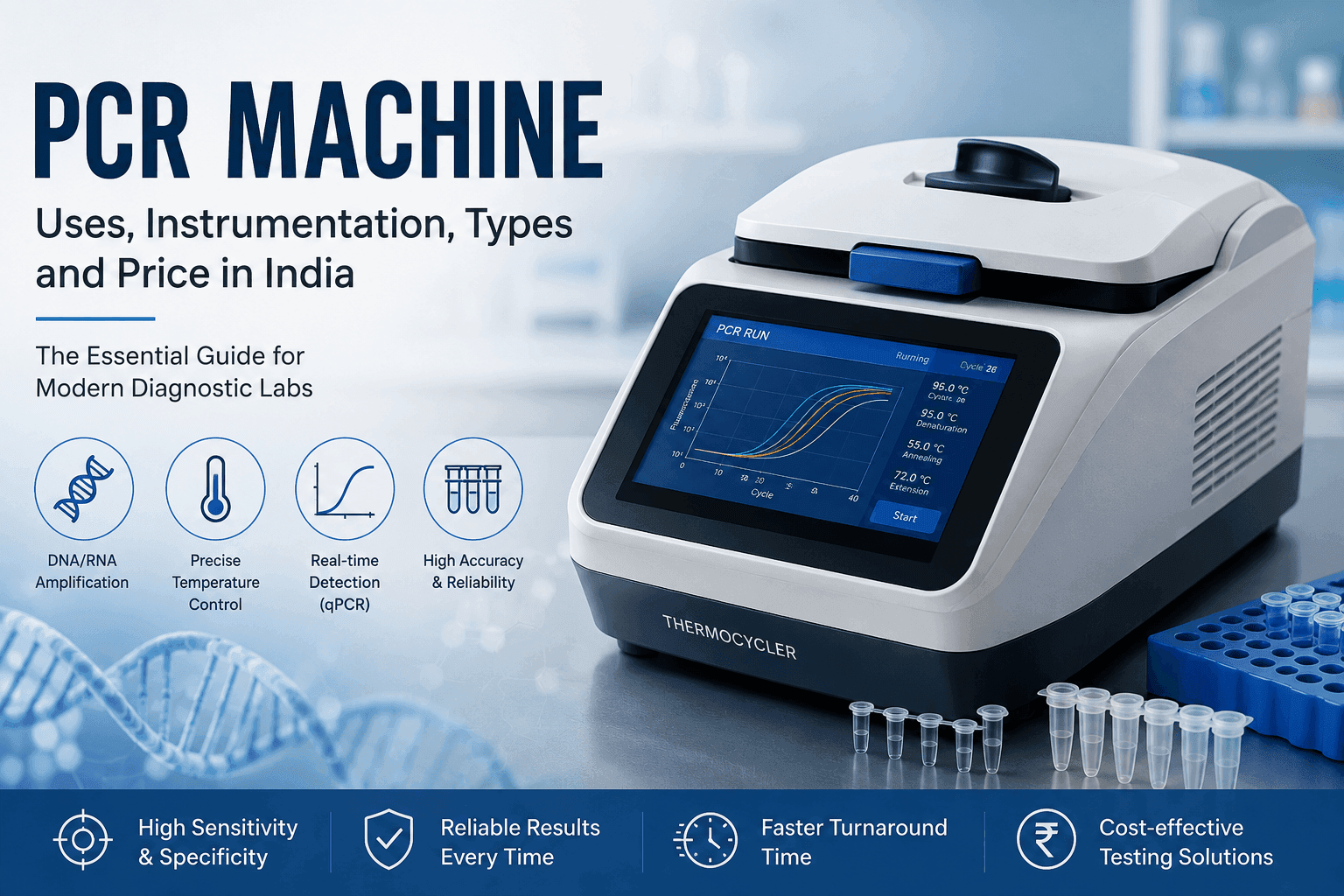
If you run a pathology or molecular diagnostic lab, a PCR machine can be an important part of your laboratory's molecular-testing setup. Also called a thermal cycler or thermocycler, the instrument repeatedly heats and cools nucleic-acid reaction mixtures so selected DNA sequences can be amplified for further detection or analysis.
PCR is used across infectious-disease testing, selected genetic tests, molecular oncology, research and other nucleic-acid applications. However, not every PCR method uses exactly the same type of instrument. Conventional PCR uses thermal cycling followed by endpoint detection, while real-time PCR (qPCR) adds optical detection so fluorescence can be monitored during amplification.
Understanding PCR instrumentation, different PCR methods, laboratory workflow and purchasing factors can help laboratories choose equipment that matches their test menu, sample volume and quality requirements rather than simply choosing the highest-specification platform available.
How Does a PCR Machine Work?
A PCR machine amplifies selected DNA sequences through repeated temperature-controlled cycles.
The reaction begins with DNA extracted or prepared from an appropriate specimen. If the original target is RNA, as in many RNA-virus or gene-expression assays, the RNA is first converted into complementary DNA (cDNA) through reverse transcription before PCR amplification.
A standard PCR cycle has three main stages:
Denaturation (~94–98°C): Double-stranded DNA separates into individual strands.
Annealing (~50–65°C): Short primers bind to complementary sequences on the target DNA.
Extension (~72°C): A thermostable DNA polymerase synthesizes new complementary DNA strands.
The cycle is repeated multiple times. Under suitable reaction conditions, the target sequence can increase exponentially during the earlier cycles, although amplification efficiency is not necessarily 100% in every cycle. After repeated cycling, many copies of the selected DNA segment can be available for detection or downstream analysis.
Actual run time depends on the PCR method, assay design, cycling conditions, number of samples and instrument. The complete laboratory turnaround time also includes specimen preparation, nucleic-acid extraction, reaction setup, amplification and result analysis.
Inside a PCR Instrument: Key Components
Understanding PCR instrument components is useful when evaluating equipment, troubleshooting temperature variation or planning laboratory throughput.
Thermal Block
The thermal or reaction block holds PCR tubes, strips or plates and moves the reactions through programmed temperature stages.
Temperature accuracy and uniformity across wells are important because variation between wells can affect amplification performance and assay reproducibility.
Heating and Cooling System
Many modern thermal cyclers use Peltier-based temperature control.
The heating and cooling system influences:
- Temperature accuracy
- Temperature uniformity
- Ramp rate
- Gradient capability
- Overall cycle time
A faster ramp rate can shorten a PCR run, but validated assay conditions and reproducible temperature control remain more important than speed alone.
Optical Detection System
An optical detection system is a defining component of real-time PCR (qPCR) equipment.
Fluorescent dyes or probes generate signals during amplification. The instrument detects these signals across PCR cycles, allowing the laboratory to monitor amplification and, for validated quantitative assays, estimate target concentration.
Conventional endpoint thermal cyclers generally do not require an integrated optical detection system.
Heated Lid
The heated lid helps reduce condensation on PCR tube or plate covers during high-temperature cycling and helps maintain consistent reaction conditions.
Instrument Software
PCR instrument software controls thermal protocols and records run information. In qPCR systems, it also processes fluorescence data and supports amplification-curve analysis.
Depending on the instrument, validated interface and laboratory setup, molecular results may also be transferred into a laboratory information system rather than being manually re-entered.
FLABS supports analyzer result integration for compatible laboratory instruments. Available integration methods depend on the analyzer model, communication protocol and laboratory requirements.
Types of PCR and Where Each Method Fits
PCR has developed into several methods for different molecular-testing applications.
Not every PCR term represents a completely different machine. Some terms describe the amplification or assay approach rather than a distinct instrument.
| PCR Method | Main Capability | Common Applications |
|---|---|---|
| Conventional PCR | End-point DNA amplification | Basic molecular testing, research and genotyping |
| Real-Time PCR (qPCR) | Monitors fluorescence during amplification | Pathogen detection, viral-load assays and selected gene-expression studies |
| Reverse Transcription PCR (RT-PCR) | Converts RNA to cDNA before PCR amplification | RNA-virus detection and gene-expression analysis |
| Multiplex PCR | Amplifies multiple targets in one reaction | Respiratory, STI and other multi-target molecular panels |
| Digital PCR (dPCR) | Partitions reactions for precise target quantification | Low-frequency variant detection, copy-number analysis and selected oncology/research applications |
| Nested PCR | Uses sequential amplification rounds | Selected specialised molecular assays |
Real-time PCR systems combine thermal cycling with optical detection and software that monitors fluorescent signals during amplification.
Digital PCR differs from conventional and real-time PCR by partitioning a sample into many individual reactions and estimating target concentration from positive and negative partitions.
For a deeper comparison, see Types of PCR: Different PCR Techniques and Applications.
PCR Machine Price in India
PCR machine price in India varies considerably depending on the instrument type, sample capacity, optical capabilities, automation, brand, software and intended application.
Indicative market prices can range from lower-cost conventional thermal cyclers to substantially more expensive real-time qPCR and digital PCR systems. Prices also vary between vendors and can change based on configuration, accessories, software licences, installation, warranty and service agreements.
For this reason, a quoted price should be treated as a planning reference rather than a fixed market price.
When requesting quotations, compare the total cost of ownership, not just the instrument price.
Ask vendors to separately specify:
- PCR instrument
- Computer or control workstation
- Analysis software and licences
- Installation
- Validation or verification support
- UPS or power backup
- Starter reagents and consumables
- Calibration or performance verification
- Training
- Warranty
- AMC/CMC
- Optical calibration for qPCR, where applicable
- Annual software or service charges
For broader equipment budgeting, see the FLABS Pathology Lab Equipment List and Price Guide.
PCR Machine Uses in Clinical and Molecular Laboratories
PCR machine uses extend across multiple areas of molecular testing. The actual application depends on the assay, specimen type, validated method and clinical purpose.
Infectious-Disease Testing
PCR and other nucleic-acid amplification methods are widely used to detect genetic material from infectious agents.
Applications include validated assays for respiratory viruses and selected bacterial, viral and fungal pathogens.
For example, molecular assays such as RT-PCR are widely used for detecting viral RNA in respiratory specimens. The ability to detect nucleic acid does not necessarily mean that viable organisms are present or that active replication is occurring.
Laboratories interested in the broader molecular-testing category can also review the FLABS guide to NAAT testing.
Oncology and Molecular Pathology
PCR-based methods can be used to detect or quantify selected molecular alterations relevant to oncology.
Examples include assays targeting:
- EGFR variants
- KRAS variants
- BRAF variants
- BCR-ABL1 transcripts
- Selected minimal-residual-disease targets
- Certain circulating tumour DNA targets
However, these biomarkers do not all depend exclusively on PCR. Depending on the clinical question, laboratories may use sequencing, next-generation sequencing (NGS), FISH, immunohistochemistry or other validated molecular methods.
For an example of a specific molecular target, see the FLABS guide to the BCR-ABL test.
Hereditary and Genetic Testing
PCR amplification can support selected tests for inherited variants, carrier screening and genotyping.
Depending on the disorder and testing objective, PCR may be one step within a larger workflow. Other techniques, such as sequencing, MLPA, fragment analysis or NGS, may be required.
The appropriate platform should therefore be selected according to the validated assay and clinical requirement, not simply because a condition is genetic.
Pharmacogenomics
PCR-based genotyping can identify selected variants in genes associated with drug metabolism or drug response.
Such information may contribute to personalised prescribing when an appropriately validated test and clinical interpretation framework are available.
PCR results should support clinical decision-making rather than independently determine medication selection or dosage.
Transplant and Post-Transplant Testing
Real-time PCR is used in selected post-transplant molecular monitoring workflows, including quantitative detection of viruses such as CMV, EBV and BK virus.
PCR-based methods may also be used in parts of histocompatibility testing, although other molecular approaches, including sequencing, are also widely used.
Results should be interpreted alongside the patient's clinical condition and other laboratory findings rather than being used independently to determine treatment.
Blood Banking and Transfusion Medicine
Nucleic-acid testing (NAT) can support screening for selected transfusion-transmissible infections and may help detect infections during periods when other markers may not yet be detectable.
However, NAT is a broader category than PCR. NAT platforms can use PCR-based or other nucleic-acid amplification technologies.
Therefore, it is not accurate to describe a PCR machine as universally mandatory equipment for every Indian blood centre. Blood centres should follow applicable regulatory, quality and testing requirements and use approved or validated methods within their testing scope.
What Determines Reliable PCR Results?
The PCR machine controls thermal cycling, but reliable molecular results depend on the entire testing process.
Sample Quality
Poor specimen collection, nucleic-acid degradation, extraction problems or amplification inhibitors can affect PCR performance.
For infectious-disease molecular testing, specimen type, collection timing, transport, storage and processing should follow the validated assay or manufacturer's instructions.
Primer and Probe Design
PCR specificity depends partly on whether primers and probes appropriately target the intended sequence.
Poor assay design can contribute to non-specific amplification, weak amplification or other performance problems.
Clinical laboratories should use validated assays and follow applicable kit instructions and laboratory procedures.
Controls and Quality Assurance
PCR quality-control requirements depend on the assay and workflow.
Positive, negative, extraction and/or internal controls may be used according to the test method, manufacturer instructions and laboratory validation.
There is no single identical control strategy that applies to every PCR assay.
Instrument Calibration and Verification
For medical laboratories working under ISO 15189:2022 and applicable NABL requirements, equipment used for testing must be appropriately managed, maintained and monitored for its intended use.
NABL's current molecular-diagnostics criteria specifically address PCR-based testing, equipment and contamination-control requirements.
Laboratories should maintain appropriate calibration, verification, maintenance and performance records according to the equipment manufacturer's specifications, laboratory procedures and applicable accreditation requirements.
Contamination Control
PCR is highly sensitive, so contamination can result in false-positive amplification.
Laboratories should establish workflow and contamination-control procedures appropriate to the assay. These may include:
- Separation of clean and amplified-material areas
- Dedicated equipment
- Controlled reagent preparation
- Appropriate surface and equipment decontamination
- Aerosol-resistant pipette tips
- Appropriate environmental monitoring where required
For PCR-based molecular testing, NABL guidance emphasizes physical separation and unidirectional workflow to reduce the risk of cross-contamination, with specific considerations for pre- and post-amplification areas.
The exact laboratory layout and controls should be determined by the validated method, risk assessment and applicable quality requirements.
Operator Training
Even highly automated PCR equipment cannot compensate for incorrect pipetting, poor sample preparation, reagent errors or inappropriate result interpretation.
Training, competency assessment and documented procedures remain important parts of a clinical molecular-testing workflow.
Choosing the Right PCR Instrument
When evaluating a PCR instrument, match the machine to the laboratory's actual test menu, projected workload and validated assay requirements.
Does It Support Your Required PCR Method?
Determine whether your laboratory needs:
- Conventional PCR
- Gradient PCR
- Real-time qPCR
- RT-qPCR
- Multiplex capability
- Digital PCR
The assay requirements should determine the instrument.
What Is the Throughput?
Check:
- Wells per run
- Expected daily sample volume
- Number of runs per shift
- Ability to run different protocols
- Expected future test-volume growth
A 96-well platform may be appropriate for a medium-volume laboratory but unnecessary for a low-volume setup.
What Is the Complete Run Time?
Review the complete assay workflow rather than relying only on the manufacturer's advertised thermal ramp rate.
Extraction, reaction preparation, amplification, analysis and reporting all contribute to laboratory turnaround time.
Open or Closed System?
An open PCR system may provide greater flexibility in assay and reagent selection.
A closed or proprietary system may provide more standardised workflows but can limit reagent and assay choices.
Consider:
- Test menu
- Validation requirements
- Consumable costs
- Vendor support
- Regulatory status of the assays
- Availability of reagents and consumables
Does It Support LIS Integration?
Ask whether the instrument can export or interface results with your laboratory information system.
Manual transcription creates an additional workflow step and can increase the risk of data-entry errors.
FLABS supports analyzer result integration for compatible instruments, but PCR machine compatibility should be confirmed for the exact model and communication interface before purchase or implementation.
What Infrastructure Is Required?
Before purchasing, check:
- Bench space
- Electrical requirements
- UPS requirements
- Air conditioning
- Sample-preparation areas
- Nucleic-acid extraction workflow
- Pre- and post-amplification separation where required
- Cold storage
- Biosafety requirements applicable to the specimens
The PCR machine is only one component of a molecular laboratory setup.
What Service and Calibration Support Is Available?
Confirm:
- Installation qualification
- Initial verification support
- Calibration availability
- Preventive maintenance
- Local engineer availability
- Spare-part availability
- AMC/CMC cost
- Response-time commitments
- Software support
For laboratories working toward or maintaining NABL accreditation, equipment-related records should align with applicable quality requirements.
PCR Machine vs Real-Time PCR Machine
One common purchasing mistake is treating a conventional PCR machine and a real-time PCR machine as interchangeable.
| Feature | Conventional PCR | Real-Time PCR (qPCR) |
|---|---|---|
| Amplification | Yes | Yes |
| Fluorescence monitoring during amplification | Usually no | Yes |
| Endpoint analysis | Yes | Yes, with additional real-time data |
| Quantitative applications | Limited | Yes, for validated quantitative assays |
| Typical complexity | Lower | Higher |
| Instrument cost | Generally lower | Generally higher |
| Common applications | Research, genotyping and endpoint assays | Pathogen detection, quantification and selected molecular diagnostics |
The appropriate system depends on the assay rather than simply on which instrument has more features.
Connecting PCR Testing With Your Laboratory Workflow
Installing a PCR machine solves the amplification part of molecular testing. Laboratories still need to manage:
Patient registration → sample identification → test assignment → processing → result capture → review → approval → billing → report delivery
Managing these steps across separate spreadsheets or disconnected systems can create additional manual work as molecular-testing volume grows.
FLABS Laboratory Information System brings patient registration, barcode-based sample tracking, analyzer result capture for supported instruments, report review, approval, billing and digital report delivery into one connected laboratory workflow.
For molecular laboratories, analyzer integration depends on the specific PCR instrument, interface and laboratory requirements. The FLABS team can review your machine model and workflow before confirming compatibility.
Running or expanding a molecular diagnostic lab?
Book a FLABS LIS demo to review your sample workflow, reporting requirements and available PCR/analyzer integration options.
The Bottom Line
A PCR machine is more than a device that repeatedly heats and cools samples. The right system depends on the type of molecular testing your laboratory performs, required detection method, throughput, assay compatibility, quality requirements and total operating cost.
Conventional thermal cyclers remain useful for endpoint amplification, while real-time qPCR machines add fluorescence detection for real-time monitoring and validated quantitative applications. Digital PCR adds reaction partitioning for specialised high-precision measurement.
Before purchasing polymerase chain reaction equipment, compare the complete laboratory workflow—not only the PCR machine price.
A well-planned molecular laboratory combines the right PCR instrument with validated assays, quality controls, trained staff, appropriate infrastructure and a laboratory information system capable of keeping samples and results organised.
Get Started at ₹1!
Try Flabs for a full month for just ₹1.
Follow us on