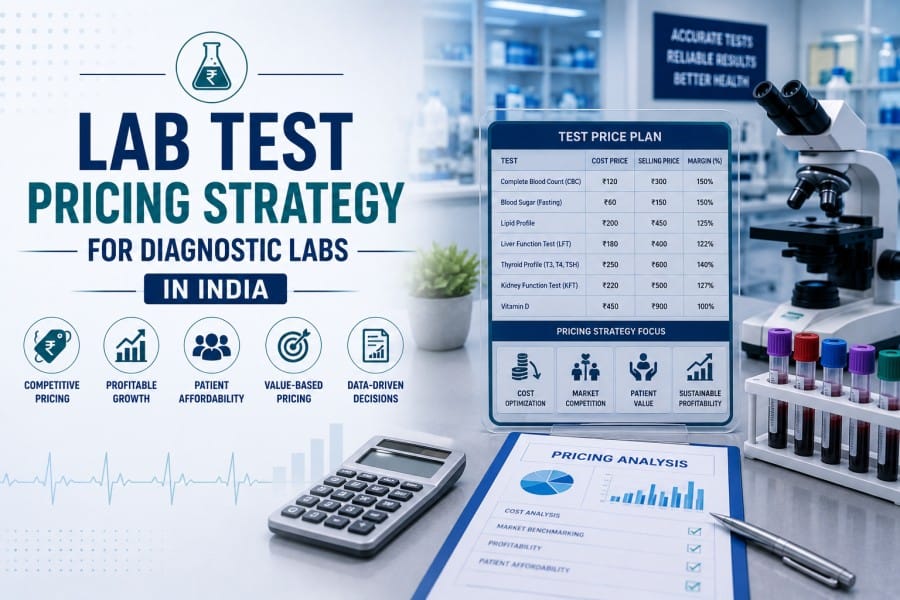
Lab test pricing can directly affect whether a diagnostic laboratory grows sustainably or struggles to maintain margins. Many labs simply compare their rates with nearby competitors and adjust prices accordingly. That approach ignores important factors such as reagent costs, staff expenses, test volume, payer agreements and operational efficiency.
A strong lab test pricing strategy turns pricing from guesswork into a repeatable system. It starts with understanding the actual cost of delivering each test, then considers market rates, payer requirements, expected volumes and the value your laboratory provides.
A rival may drop its CBC rate, but matching that price without knowing your own cost structure can reduce contribution margin even if test volume increases. Pricing should therefore start with your laboratory's economics rather than a competitor's rate card.
This guide explains how to price lab tests, calculate test costs, benchmark competitors, structure packages and build a sustainable diagnostic lab rate list for an Indian laboratory.
Lab Test Pricing Strategy: How It Works
A practical lab test pricing strategy should combine cost, market position, payer rules, test volume and service value.
Cost establishes what the test requires financially. Market data helps you understand the local price range. Payer rules determine whether you can freely set a rate or must follow a contracted or notified tariff. Test volume affects reagent utilisation and fixed-cost absorption, while service value influences where your laboratory can position itself.
| Pillar | Question It Answers | Data You Need |
|---|---|---|
| Cost | What does this test actually cost us? | Reagents, controls, calibrators, consumables, labour, lab equipment and overhead |
| Market | What do comparable labs charge? | Independently collected local rate cards and public online prices |
| Payer | Can we choose the rate? | Cash, corporate, B2B, insurance, TPA, CGHS or other scheme terms |
| Volume | How efficiently can we run this test? | Monthly volume, batch size, repeats, wastage and outsourcing |
| Value | Why might a patient or client choose us? | Turnaround time, accreditation, home collection and service availability |
These inputs should be reviewed together.
A high-volume test with low analytical cost may support a different pricing approach from a specialised, low-volume test with expensive reagents, calibration requirements or referral-lab charges.
When benchmarking competitors, use independently available public information. Competitor research should help you understand the market—not become coordinated price-setting with other laboratories.
Why Lab Test Prices Differ Between Labs
Two laboratories in the same city may charge different prices for the same investigation because their cost structures and service models are different.
Important factors include:
- Analyzer and reagent model: Closed systems, reagent-rental arrangements and open-channel systems can have different per-test economics.
- Test volume: Higher throughput can spread equipment, staffing and quality-control costs across more billable tests.
- Location: Rent, salaries, logistics and collection expenses differ across cities and localities.
- Accreditation and quality systems: Quality control, documentation and accreditation activities add operational costs.
- Turnaround time: Extended operating hours, urgent processing and additional staffing increase cost-to-serve.
- Home collection and logistics: Travel distance, phlebotomist time, sample transportation and cold-chain requirements affect cost.
- Payer mix: Cash patients, corporate clients, B2B partners and government schemes may use different approved rate cards.
- Outsourced testing: Referral-lab charges and sample logistics affect margins on low-volume specialised tests.
- Operational efficiency: Efficient reagent use, batching and analyzer utilisation can lower the cost per result.
For example, a laboratory operating an automated analyser near optimal capacity can spread fixed costs across more tests. Another laboratory running half-empty batches may incur a higher cost per report even when both laboratories use similar equipment.
There is no reliable national rule stating that a premium laboratory should always charge a fixed percentage more than a budget laboratory. The appropriate rate depends on cost, service level, local demand and positioning.
Know Your True Cost Per Test
You cannot price an investigation accurately without understanding what it actually costs to deliver.
A laboratory should distinguish between two metrics:
Blended Average Cost Per Test
Dividing the laboratory's total monthly expenditure by total monthly test volume provides an overall efficiency indicator.
For example:
₹4,00,000 monthly operating cost ÷ 5,000 billable tests = ₹80 blended average cost per test
This is useful for understanding overall laboratory economics.
However, it should not become the selling-price floor for every investigation.
A CBC, HbA1c, vitamin D test and molecular PCR test do not consume the same amount of reagents, equipment time or labour.
Fully Loaded Cost Per Test
For an individual test, start with the direct analytical cost:
Direct analytical cost = reagent + consumables + calibrator/QC allocation + expected repeat or wastage cost
Then allocate relevant operational costs such as:
- Sample collection consumables
- Technician time
- Analyzer lease or depreciation
- AMC or CMC
- Internal quality-control materials
- Calibration
- Electricity
- Sample transportation
- Referral-lab charges
- Reporting and billing
- Payment gateway charges where applicable
- Rent and administration overhead
The result provides a more realistic estimate of the fully loaded cost per test.
Consider two tests that both sell for ₹500:
| Pillar | Question It Answers | Data You Need |
|---|---|---|
| Cost | What does this test actually cost us? | Reagents, controls, calibrators, consumables, labour, lab equipment and overhead |
| Market | What do comparable labs charge? | Independently collected local rate cards and public online prices |
| Payer | Can we choose the rate? | Cash, corporate, B2B, insurance, TPA, CGHS or other scheme terms |
| Volume | How efficiently can we run this test? | Monthly volume, batch size, repeats, wastage and outsourcing |
| Value | Why might a patient or client choose us? | Turnaround time, accreditation, home collection and service availability |
Although the patient price is identical, the commercial outcome is completely different.
Pricing decisions should therefore be evaluated test by test and payer channel by payer channel.
Knowing how to reduce cost per test can create more room to compete without sacrificing quality.
Common cost-control opportunities include:
- Negotiating reagent contracts according to actual volume
- Batching samples where clinically appropriate
- Reducing unnecessary repeat runs
- Matching analyzer capacity to daily workload
- Monitoring reagent expiry and wastage
- Reviewing outsourced tests
- Improving billing and collection processes
- Lower costs create more flexibility in the final rate card.
How to Build a Diagnostic Lab Rate List
Once the cost structure is understood, create a structured master rate list rather than changing prices individually or maintaining separate uncontrolled spreadsheets.
A useful diagnostic lab rate list can include:
| Field | Example |
|---|---|
| Internal test code | CBC001 |
| Test name | Complete Blood Count |
| Department | Haematology |
| Direct analytical cost | ₹XX |
| Fully loaded cost | ₹XX |
| Standard patient rate | ₹XX |
| Corporate rate | ₹XX |
| B2B rate | ₹XX |
| Government/TPA rate | Contract or notified rate |
| Home-collection eligibility | Yes/No |
| Package eligibility | Yes/No |
| Processing | In-house/Outsourced |
| Effective date | DD/MM/YYYY |
| Last reviewed | DD/MM/YYYY |
Every rate change should have an effective date and version history.
This helps the laboratory identify which price was active when an invoice was generated and prevents different branches or staff members from accidentally using outdated rates.
For multi-branch laboratories, maintaining a controlled central test master with authorised branch or payer-specific variations can be more manageable than allowing each branch to maintain a separate spreadsheet.
Position Your Rates Against Competitors
Pricing in complete isolation is risky. Laboratory owners should understand what comparable facilities charge for commonly searched investigations.
Build a competitor rate tracker for the tests that matter most to your business.
Examples may include:
- CBC
- HbA1c
- Thyroid profile
- Lipid profile
- Liver function test
- Kidney function test
- Vitamin D
- Vitamin B12
- Ferritin
- Preventive health packages
Refresh the data periodically using publicly available prices and independent market research.
Once you understand the market, determine the role of each test.
Competitive or Footfall Tests
Common, highly visible investigations may be priced competitively because patients can easily compare them.
Margin-Supporting Tests
Specialised or lower-volume investigations may need stronger contribution because of expensive reagents, outsourcing or lower utilisation.
Hybrid Pricing
Many laboratories use competitive pricing on frequently searched tests while protecting margins on specialised investigations and value-added services.
A successful pricing strategy does not require every test to produce the same margin.
Some investigations drive patient acquisition, while others contribute more strongly to overall profitability.
Maintain Separate Rate Cards by Payer Channel
One investigation does not necessarily need one universal commercial rate.
Depending on the laboratory's business model, separate approved pricing may exist for:
- Walk-in patients
- Online bookings
- Corporate clients
- B2B laboratories
- Hospitals
- Referral partners
- TPA or insurance arrangements
- CGHS or other government schemes
- Government and contracted payer rates are different from open-market pricing.
For example, CGHS uses notified investigation rates for empanelled healthcare organisations. These should not be replaced with a laboratory's private patient rate.
Your pricing system should therefore identify:
Which test was performed + which payer rate card applies + which rate version was active
This becomes particularly important for laboratories handling a mix of retail, B2B, corporate and government business.
For more context, see the guide on CGHS vs private diagnostic rates.
Use Test Packages Carefully
Packages can improve patient convenience and increase average order value, but the discount should not be chosen using an arbitrary industry percentage.
Before setting a package price, calculate:
Package revenue – incremental cost of all included tests – collection/logistics cost = package contribution
A package can be priced below the combined individual list price when the remaining contribution is commercially sustainable.
Bundling can also create operational efficiencies when several tests share:
- One patient registration
- One blood draw
- Common collection consumables
- Shared sample transportation
The same analyzer workflow - One billing transaction
- Common package categories include:
- Diabetes monitoring packages
- Thyroid profiles
- Renal profiles
- Liver profiles
- Preventive health packages
Build packages around genuine clinical or consumer demand rather than simply bundling low-demand tests.
The patient should also be able to understand what is included in the package.
Price Home Collection Separately
Home collection introduces a separate cost structure.
The cost of one visit can depend on:
- Distance travelled
- Phlebotomist time
- Fuel or transport charges
- Collection consumables
- Cold-chain requirements
- Number of patients served on the route
- Failed or cancelled appointments
- Sample transportation back to the processing laboratory
- Do not assume one fixed home-collection charge works for every laboratory.
Once the true service cost is known, a laboratory can choose whether to:
- Charge separately
- Offer free collection above a minimum bill value
- Include it within selected packages
- Offer it as a premium convenience service
- The model should reflect the laboratory's actual logistics economics.
Review and Adjust Lab Test Prices
Rates should not remain unchanged indefinitely.
Review your rate card periodically when:
- Reagent prices change
- Supplier contracts are renewed
- Staff costs increase
- Equipment costs change
- Outsourcing rates are revised
- Logistics costs rise
- Government or corporate tariffs change
- New tests are introduced
- Test volumes materially increase or decrease
- Service levels change
A quarterly internal review is useful for active price monitoring, although a rate change does not necessarily need to happen every quarter.
Review investigations whose selling price no longer provides an acceptable contribution after direct and allocated costs.
Depending on the reason, the solution may involve:
- Revising the patient rate
- Renegotiating suppliers
- Improving reagent utilisation
- Redesigning packages
- Changing the test workflow
- Outsourcing low-volume investigations
- Moving tests in-house when volume justifies it
Pricing decisions should respond to meaningful trends rather than one unusual month.
The Role of an LIS in Lab Pricing
Pricing becomes harder to control when branches, billing teams and payer channels rely on separate spreadsheets or manually maintained rate cards.
A laboratory information system can support pricing operations by connecting test configuration with billing and financial workflows.
Flabs LIS supports laboratory workflows that can include:
- Test and rate configuration
- Patient invoicing
- Payment tracking
- Outstanding dues
- Corporate billing
- Branch-wise financial reporting
- Referral commission management
- Shared test catalogues across branches
- Standardised pricing and workflows across locations
- This can help laboratories maintain greater control over the rate applied to each patient or payer and improve visibility into billing activity.
Cost-per-test analysis should still use validated data for:
- Reagents
- Consumables
- Equipment
- Quality control
- Staffing
- Logistics
- Outsourcing
- Overheads
If a laboratory requires reagent-level costing or advanced inventory costing, the exact capabilities available within its software configuration should be confirmed before relying on the LIS as the sole costing source.
Laboratories can also improve pricing decisions by strengthening inventory and reagent management.
The Takeaway
Lab test pricing should be treated as a structured business process rather than a competitor-matching exercise.
Start by understanding the direct and fully loaded cost of each important test. Then assess local market rates, payer requirements, test volumes and the service value your laboratory provides.
Build a controlled diagnostic lab rate list with separate pricing where needed for cash patients, B2B clients, corporate accounts and government schemes.
Packages and home collection should also be priced according to their real economics rather than arbitrary discount percentages.
For laboratories that have never formally reviewed their rate card, start with the top 20–30 investigations by volume or revenue. Calculate the cost of each, compare public market prices and identify rates where the current contribution no longer makes sense.
Then extend the same process across the complete test menu.
A sustainable lab test pricing strategy is not about being the cheapest laboratory. It is about knowing exactly why each price exists.
Get Started at ₹1!
Try Flabs for a full month for just ₹1.
Follow us on