Upholding a diagnostic lab profitably has never been harder. Reagent prices continue to rise, skilled technicians are in short supply, and compliance requirements from bodies like NABL add operational overhead. At the same time, competitive pressure in high-density markets across pathology labs in India pushes pricing downward. The result is a shrinking margin.
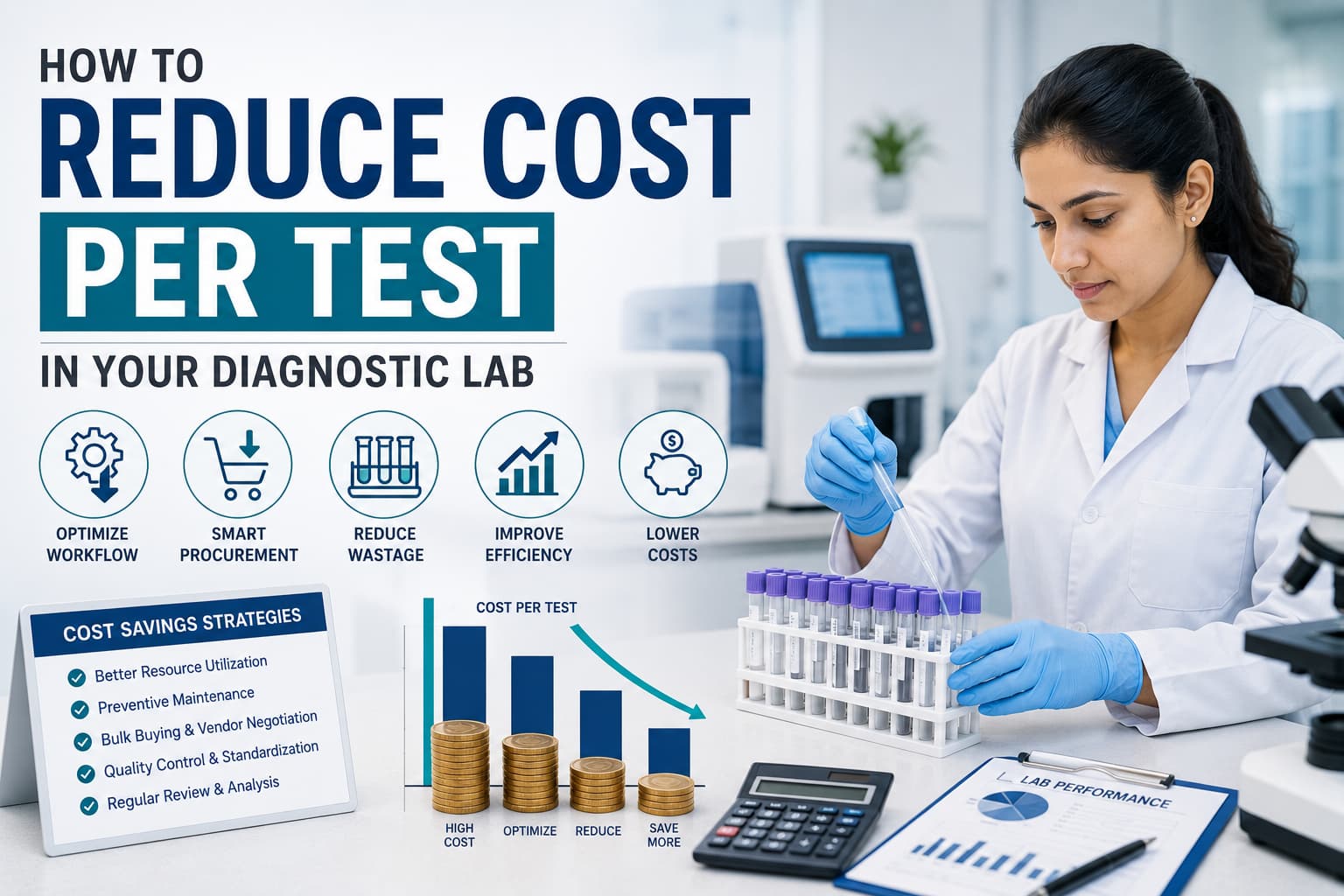
The single most actionable metric for reversing that trend is cost per test. Lower it, and you simultaneously improve margins, competitive pricing power, and long-term sustainability. Raise it or leave it unexamined, and every increase in test volume only amplifies losses.
10 Practical Strategies to Reduce Cost Per Test
Managing cost per test is essential for improving profitability and maintaining operational efficiency in diagnostic laboratories. By optimising processes, onboarding technology, and using data-driven decision-making, labs can realise it.
1. Consolidate Your Test Menu
Many labs accumulate a long tail of low-volume, low-margin tests that consume disproportionate resources: setup time, QC runs, staff training, and reagent minimum purchases. A focused test menu reduces complexity without reducing patient access.
Analyse your test volume data monthly. Identify tests below a minimum volume threshold. Retire them, refer them out, or package them into panels. Panel-based pricing raises perceived value while increasing revenue per patient interaction.
When done correctly, it will reduce cost per test across the panel by amortising fixed analytical costs over more billable units.
2. Automate with a Laboratory Information System
A laboratory information system (LIS) is the most direct digital investment for lab cost optimisation. It eliminates manual sample registration, automates result validation within pre-set reference ranges, and generates reports without technician intervention.
Labs using an integrated LIS see measurable reductions in repeat tests caused by data entry errors, faster turnaround times, and less administrative overhead per test. For NABL-approved labs, an LIS also auto-generates QC records and audit trails.
Total Laboratory Automation (TLA) takes it further. TLA is more capital-intensive, but for high-throughput labs, the reduction in manual handling errors and repeat tests can reduce cost per test by 20-35% on high-volume panels.
3. Improve Equipment Utilisation
Lab equipment depreciation is fixed regardless of how many tests run through it per day. A haematology analyser running at 40% capacity carries nearly the same ownership cost as one running at 90%. But the per-test burden is more than twice as high.
Track utilisation rates on each instrument daily. Schedule batching runs to consolidate samples and avoid single-sample runs where possible. For specialised equipment used infrequently, evaluate whether a referral arrangement is more affordable.
When your LIS provides real-time instrument load data, scheduling decisions become data-driven. That shift directly and measurably helps you reduce cost per test on capital-intensive equipment.
4. Cut Repeat Tests
Pre-analytical errors are one of the most overlooked cost drivers in diagnostic labs, e.g., haemolysed samples, mislabelled tubes, and incorrect volume. Each repeat test costs reagents, technician time, and delays the result.
Standardise sample collection rules and train phlebotomists on rejection criteria. Use barcode-based sample labelling connected to your LIS to eliminate transcription errors at the point of registration. A reduction in repeat rate from 5-2% on a lab processing 500 tests per day eliminates 15 unnecessary tests daily.
5. Tighten Inventory and Reagent Management
Reagent expiry, excess stock, and emergency procurement at premium prices are avoidable costs that accumulate quietly. Labs without automated inventory tracking routinely over-order buffers to avoid stockouts. Then write off expired reagents at the end of the month.
Implement a first-in-first-out (FIFO) reagent discipline enforced through your LIS. Set reorder points based on actual consumption rates. Track expiry dates digitally so nothing passes unnoticed. For high-volume reagents, negotiate volume-based contracts with suppliers using your consumption data. Reagent management alone can reduce cost per test on chemistry panels by 8-15% in labs.
6. Internalise High-Volume Outsourced Tests
Send-out tests represent both a direct cost, referral lab fees and a revenue leakage. Every test sent out is a test you paid for but did not earn.
Review your referral lab invoices quarterly. Identify tests sent out in volumes large enough to justify in-house processing. Calculate the break-even volume for adding the relevant equipment or reagent line, accounting for overhead absorption.
Internalising hormone panels, allergy testing, or molecular diagnostics reaches payback within 12-18 months. It permanently reduces the cost per test on that category.
7. Optimise Staffing
Personnel costs are fixed in perception but variable in practice. Most labs staff shifts by institutional habit rather than by actual sample load curves.
Pull LIS data on sample receipt by hour, day, and week. Identify whether your peak load is consistent or seasonal. Align shift scheduling to those patterns. For NABL-approved labs, staffing decisions must comply with personnel qualification requirements. But the ratio of administrative to technical staff is often where the inefficiency lives.
Cross-training technicians across departments reduces the need for siloed headcount. A technician trained in both haematology and biochemistry covers a wider workload without adding cost.
8. Standardise QC Processes
Poorly managed QC adds cost in two ways: failed runs waste reagents and delay reports, and undetected QC drift leads to repeat patient testing when results are questioned.
Use Westgard rules consistently. Set up your LIS to flag QC failures automatically before patient results are validated. Track Sigma metrics per analyte to identify which tests are running at high cost due to imprecision.
Labs that manage QC tightly reduce cost per test by eliminating unplanned reagent usage on failed runs and by building the internal credibility that supports NABL accreditation audits.
9. Streamline Billing and Collections
Revenue leakage is a cost. Unbilled tests, delayed claims, and rejected insurance reimbursements all reduce the effective revenue per test.
Integrate your LIS with billing software so every test ordered is captured automatically. Set up auto-flagging for tests ordered but not billed. For empanelled labs dealing with TPA or government schemes, build a pre-authorisation checklist that reduces claim rejection rates.
Reducing billing errors by even 2-3% across your monthly volume has a direct positive impact on diagnostic lab profitability without adding any test volume.
10. Use Data to Drive Continuous Cost Review
Cost management without data is guesswork. Most labs lack even basic visibility into cost per test by department, by shift, or by instrument.
A digital LIS platform gives you the data infrastructure to calculate actual cost per test on a rolling basis. Track reagent consumption against billable tests. Monitor rejection rates and repeat rates weekly. Compare cost per test across departments to identify outliers.
General State of Profit Margin in India
| Laboratory Category | Estimated Profit Margin |
|---|---|
| Small Standalone Laboratories | 15% – 25% |
| Mid-sized Diagnostic Centres | 20% – 30% |
| Large Diagnostic Chains | 25% – 40% |
Where Lab Costs Actually Come From
Before you can reduce cost per test, you need to know which cost categories to target. Lab expenditure falls into three primary buckets.
Analytical Costs: These are the direct costs tied to running each test: reagents, calibrators, controls, and consumables. Analytical costs fluctuate with test volume, batch efficiency, and reagent wastage. Open-channel analysers offer more flexibility here than closed, reagent-rental systems. But only if the lab manages batch sizing effectively.
Operational Costs: Operational costs cover everything required to keep the lab running: equipment lease or depreciation, utilities, quality control, IT systems, and compliance-related documentation. These costs are largely fixed in the short term, so increasing test throughput without adding infrastructure is one of the fastest routes to reducing operational cost per test.
Personnel Costs: Personnel costs include salaries, benefits, and the cost of errors. In labs where technicians spend significant time on administrative tasks, you are paying skilled labour for work that should be automated.
Final Note
The goal is not to cut costs arbitrarily. It is to align expenditure with test output. When you reduce cost per test with precision, you are not compromising quality. You are freeing capital for growth.
Flabs is built for labs that take cost intelligence seriously. From LIS-integrated test tracking to automated QC documentation for NABL-approved labs, every feature is designed to support the kind of operational discipline that makes diagnostic lab profitability sustainable.
Also check - Inventory & Reagent Management for Diagnostic Labs
Get Started at ₹1!
Try Flabs for a full month for just ₹1.
Follow us on