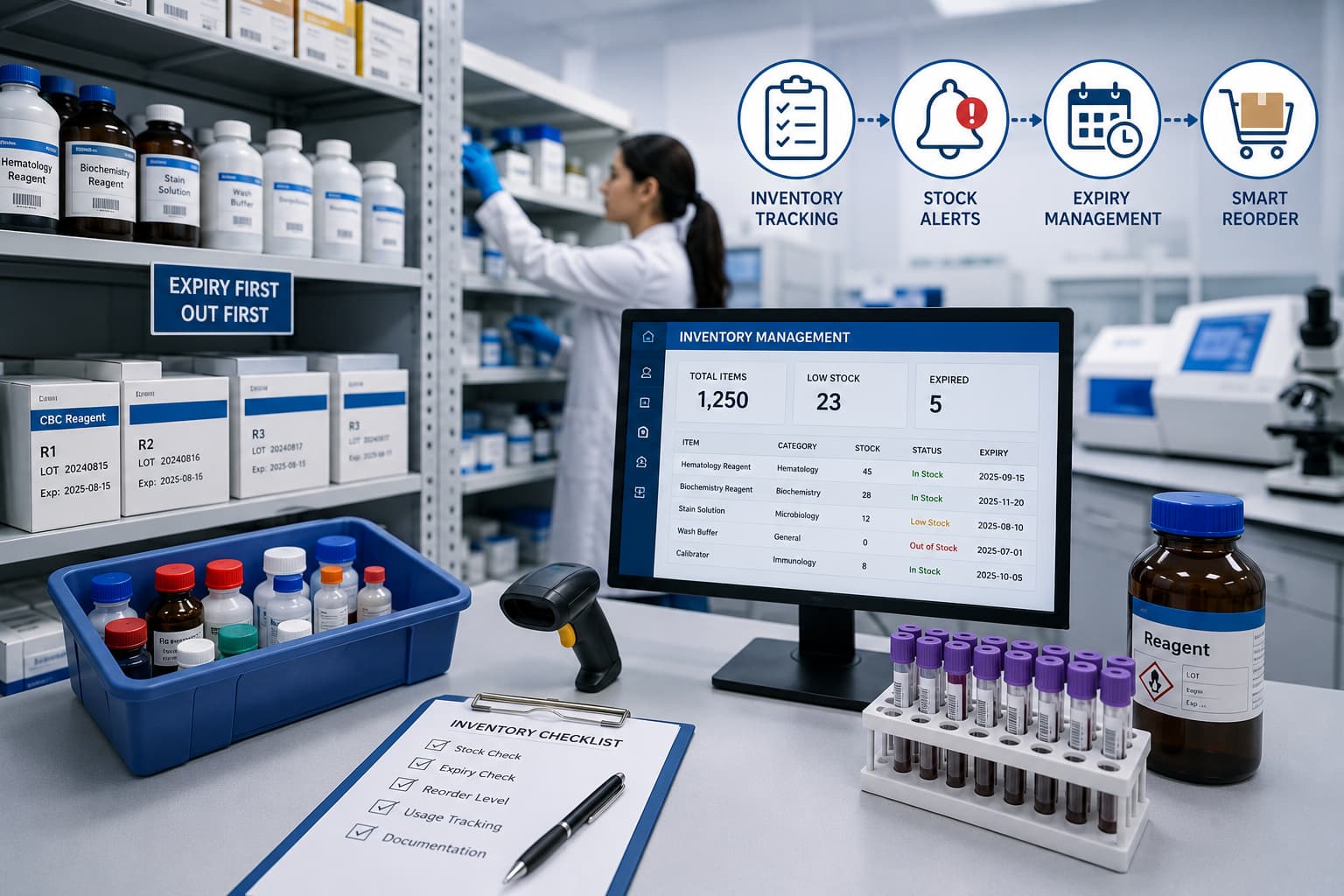
Running a diagnostic lab means you're responsible for thousands of moving parts. But somewhere in the middle of all that, inventory management quietly decides whether your lab runs like a machine or collapses under the weight of stockouts, expired reagents, and manual chaos.
If you've ever had a test delayed because a reagent ran out, or discovered expired kits only after using them, you already know the cost. And it's not just financial. It's patient trust, turnaround time, and your lab's reputation on the line.
Beyond operational disruption, poor inventory practices directly compromise research, staff safety, and the reproducibility of results.
Why Lab Inventory Management Breaks Down
Most labs don't fail at inventory because they don't care. They fail because they're managing it the wrong way, i.e., using spreadsheets, memory, and verbal updates.
Spreadsheets and paper logs are error-prone, hard to scale, and impossible to act on in real time. When your lab is running 500 tests a day, a static Excel sheet can't tell you that a reagent is two days from expiry or that tube stock just dropped below par. By the time someone notices, you're already scrambling.
What does a poor lab inventory management actually look like in practice?
A reagent expires on the shelf because it was reordered before the existing stock was used.
A high-volume test gets paused mid-day because nobody flagged low stock in time.
Consumables like tubes and slides are over-ordered, unnecessarily locking up the budget.
Audit time arrives and nobody can trace lot numbers, expiry dates, or vendor data
The fix starts with treating inventory as a live, real-time system. Not as a static list you update once a week.
The Anatomy of Diagnostic Lab Inventory
Lab inventory isn't one category. It has three distinct layers and each needs a different management approach.
| Category | Examples | Risk | Storage |
|---|---|---|---|
| Reagents | Immunoassay kits, stains, standards, controls | Expiry, cold chain breach, lot-to-lot variation | Temperature- and humidity-controlled |
| Consumables | Blood collection tubes, slides, cuvettes, pipette tips | Overuse, unauthorised consumption, and reorder delays | Dry storage, organised by department |
| Equipment supplies | Calibrators, QC materials, printer cartridges | Compatibility issues, delayed procurement, and equipment downtime | Ambient, but tracked for maintenance schedules |
Effective lab inventory management requires you to track all three. When one layer goes unmanaged, it creates a ripple effect across the others. For instance, lab equipment supply gaps are one of the quietest causes of instrument downtime in diagnostic labs.
What Lab Inventory Management Actually Involves
Before getting into best practices, it's worth being precise about scope. Lab inventory management covers four core functions.
1. Tracking Stock Levels in Real Time: Knowing what you have, where it is, and how much is left at any given moment.
2. Ordering and Reordering: Procurement triggered by actual usage data, not periodic guesswork.
3. Proper Storage: Temperature, humidity, and location assignment for every item
4. Recording Usage: A complete audit trail from receipt to disposal
In day-to-day terms, this translates to procurement and labelling at receipt, organised storage by category and condition requirements, active usage monitoring, and accurate records accessible to the right people.
Reagent Management: Where Labs Lose the Most
- Reagent management in a lab is high-stakes. Reagents are expensive, temperature-sensitive, and batch-specific. They are directly tied to the accuracy of results.
FEFO Over FIFO
- Most labs know FIFO (First In, First Out). But for reagent management lab environments, FIFO is not enough. You need FEFO (First Expired, First Out). Your team should always pull from the lot with the nearest expiry date, regardless of when it arrived.
- FIFO minimises waste for general consumables. FEFO protects the validity of results for reagents. Without an automatic system to enforce it, it won't happen consistently under pressure.
Lot Number Traceability
- When a QC failure happens, the first question is: which lot was used? If you can't answer that in under a minute, your lab inventory management system is failing you.
- Every reagent dispensed should be traceable to its lot number, vendor, receipt date, and expiry automatically. It is mandatory for NABL-ISO 15189 compliance and for protecting patients.
Open-Vial Stability
- Opened reagent kits have a different shelf life than unopened ones. A kit stable for 12 months unopened may only hold for 30 days once opened. Your lab inventory management process needs to track open-vial timelines separately.
Temperature and Humidity
- If a reagent stored at 2–8°C experiences refrigerator fluctuation overnight, that stock may be compromised. Proper storage is not just about putting things in the right place. It is about actively monitoring that conditions are within specification.
- Integrated temperature and humidity logging tied to your inventory system lets you flag deviations before those reagents reach patient samples.
Accurate Labeling
- Every reagent in your lab should be labelled with: name, lot number, receipt date, opened date (if applicable), in-use expiry, and storage location. Incomplete labelling is one of the most consistent findings in NABL audits.
Lab Consumables Tracking
Reagents get attention. Consumables don't until they run out.
Lab consumables tracking tends to be informal in most labs. Tubes, slides, swabs, and collection kits are consumed at high volume with little visibility. The result? Either you're over-stocking to compensate for uncertainty (which wastes budget) or you're under-stocking and scrambling during peak hours.
Good lab consumables tracking gives you the following.
Par-Level Alerts: Reorder triggers based on real usage rate, not guesswork.
Consumption by Department or Test type: So you know if haematology burns through more tubes on Mondays.
Wastage logs: To identify where consumables are being discarded unnecessarily.
Vendor Lead Times Factored Into Reorder Timing: Not just "we're low, order now"
Barcode-Based Processing: So every item entering and leaving your store is logged without manual entry.
When you link lab consumables tracking to your daily test volume, you can predict what you'll need next week with reasonable accuracy. That's the shift from reactive to planned inventory.
Cost of Poor Inventory Management
- Let's put numbers to it. Poor lab inventory management costs labs in ways that rarely get reported together:
Direct costs
- Expired reagent write-offs.
- Emergency procurement at premium pricing.
- Reruns due to QC failures from compromised reagents.
Indirect costs
- Increased turnaround time during stockouts.
- Staff time spent on manual stock counts.
- Compliance gaps during NABL or CAP audits.
Reputational costs
Delayed reports from referring physicians.
Reduced confidence from hospital partners.
A lab running 500–1000 tests a day can easily lose ₹2–5 lakhs annually to avoidable reagent wastage alone. That's before counting reruns, emergency purchases, or audit penalties.
5 Best Practices to Follow
1. Regular Stock Audits: Monthly full audits and weekly spot-checks on high-turnover items catch shortages and expiry risk before they become operational problems. Schedule them.
2. Labelling & Documentation: Every item in your store should be labelled completely from the moment it arrives. Documentation should be structured enough that a new staff member can trace any item's history without asking anyone.
3. Storage Conditions: Temperature and humidity monitoring should be continuous, not checked once a day. Any deviation should trigger an alert and a review of which items were potentially affected.
4. FEFO for Reagents, FIFO for Consumables: Apply the right rotation logic to the right category. Blanket FIFO across your entire inventory leads to reagent wastage that FEFO would prevent.
5. Digital Inventory System: Manual systems create documentation gaps, limit visibility to whoever's in the room, and can't scale with your test volume. A digital system gives you centralised visibility, automated reorder alerts, barcode-based tracking, and integration with your LIS.
Why Digital Systems Outperform
| Feature | Manual/Spreadsheet | Digital System |
|---|---|---|
| Stock visibility | Whoever updates the sheet last | Centralised, real-time, role-based |
| Reorder alerts | Someone has to remember to check | Automated at par level |
| Expiry tracking | Periodic, often missed | Continuous, with advance alerts |
| Lot traceability | Retroactive, manual search | Instant, linked to test results |
| Barcode tracking | Not possible | Built-in for faster operations |
| Audit readiness | Hours of compilation | Exportable in minutes |
| Access control | None | User roles with defined permissions |
| Equipment maintenance | Ad hoc | Tracked with downtime alerts |
What Modern Systems Should Do
1. Real-time Stock Visibility: Current quantity, location, lot number, expiry, and open/unopened status for every item.
2. Automated Reorder Triggers: Based on actual usage rate and vendor lead time, not manual reminders.
3. Expiry Tracking With Alerts: Proactive, not reactive.
4. Lot-to-test Traceability: Every test result linked back to the reagent lot used.
5. Consumption Analytics: By test, by department, by time period
6. Audit-Ready Reports: Exportable, timestamped, tamper-evident
7. Barcode integration: For faster, error-free intake and dispensing
8. Role-Based Access: So the right people can see and do the right things
9. Maintenance Tracking: To reduce instrument downtime proactively
10. LIS integration: So inventory data connects directly to test results, QC outcomes, and financial records
Connecting Inventory to Lab Operations
Quality Control: If a reagent lot is rejected in QC, every result generated with that lot needs to be reviewed. Manual inventory can't support this efficiently.
TAT (Turnaround Time): A stockout mid-test is one of the most preventable causes of delayed reports. Real-time stock visibility lets you reroute or reschedule before the delay hits the patient.
Finance: Inventory is a balance sheet item. Expired stock is a write-off. Over-ordering ties up capital. Proper lab inventory management feeds directly into better financial control.
Compliance: NABL ISO 15189 requires documented procedures for reagent management, receipt, storage, in-use monitoring, and disposal. Without a system, labs are producing this documentation manually, which is slow and error-prone.
Building Inventory SOPs
| Category | Details |
|---|---|
| Receipt |
- Log every incoming item with lot number, expiry, and quantity on arrival. - Never accept items without a valid expiry or with less than 30% shelf life remaining. |
| Storage |
- Assign physical location codes to every storage area (shelf, fridge, freezer). - Separate reagents by temperature requirement and department. |
| Dispensing |
- Always pull by FEFO, logged in the system at dispensing. - Log the opened date and expected in-use expiry separately. |
| Consumption tracking |
- Daily or shift-end stock reconciliation against tests run. - Flag unexplained variance (used more than tests should require). |
| Reorder |
- Reorder triggered automatically at par level. - Vendor lead time factored into trigger point, not reorder point. |
| Disposal |
- Expired or rejected items logged as wastage with a reason code. - Hazardous reagents follow biomedical waste disposal protocol, documented. |
Manual to Digital Lab Inventory Management
If you're still running lab inventory management on spreadsheets or physical registers, you're not alone. But you're also not compliant with where regulatory standards are heading. The transition doesn't have to be sudden.
1. Digitise the reagent register first. It's the highest-risk category and the one that affects test validity most directly.
2. Set par levels for your top 20 consumables. You don't need to track everything on day one.
3. Run parallel systems for 2–4 weeks. Manual + digital, until your team trusts the numbers the system produces.
4. Close the paper loop. Once the system is verified, retire the manual register.
The goal is to get to a state where lab inventory management is a background process, your system is tracking, alerting, and reporting, and your team is acting on exceptions rather than doing counts.
Flabs LIS For Labs That Can't Afford Gaps
Flabs is an AI-powered Lab Information System trusted by 2000+ NABL labs. Beyond inventory, Flabs connects your entire lab, TAT management for real-time test tracking, automated Quality Control checks before report delivery, Lab Finance Management for invoicing and payments, and AI Smart Reports with digital signatures and dynamic QR codes for tamper-proof security.
Bulk actions let your team handle registrations, approvals, and report sharing at scale. If your lab is ready to move beyond manual lab inventory management and build a system that's audit-ready, accurate, and automated. Flabs is built for exactly that.
Start Your 5-Day Free Trial Today.
Effective lab inventory management isn't a one-time project. It's an ongoing operational standard. The labs that get it right spend less, waste less, and report faster.
Also read - Multi-Branch Lab Management
Get Started at ₹1!
Try Flabs for a full month for just ₹1.
Follow us on