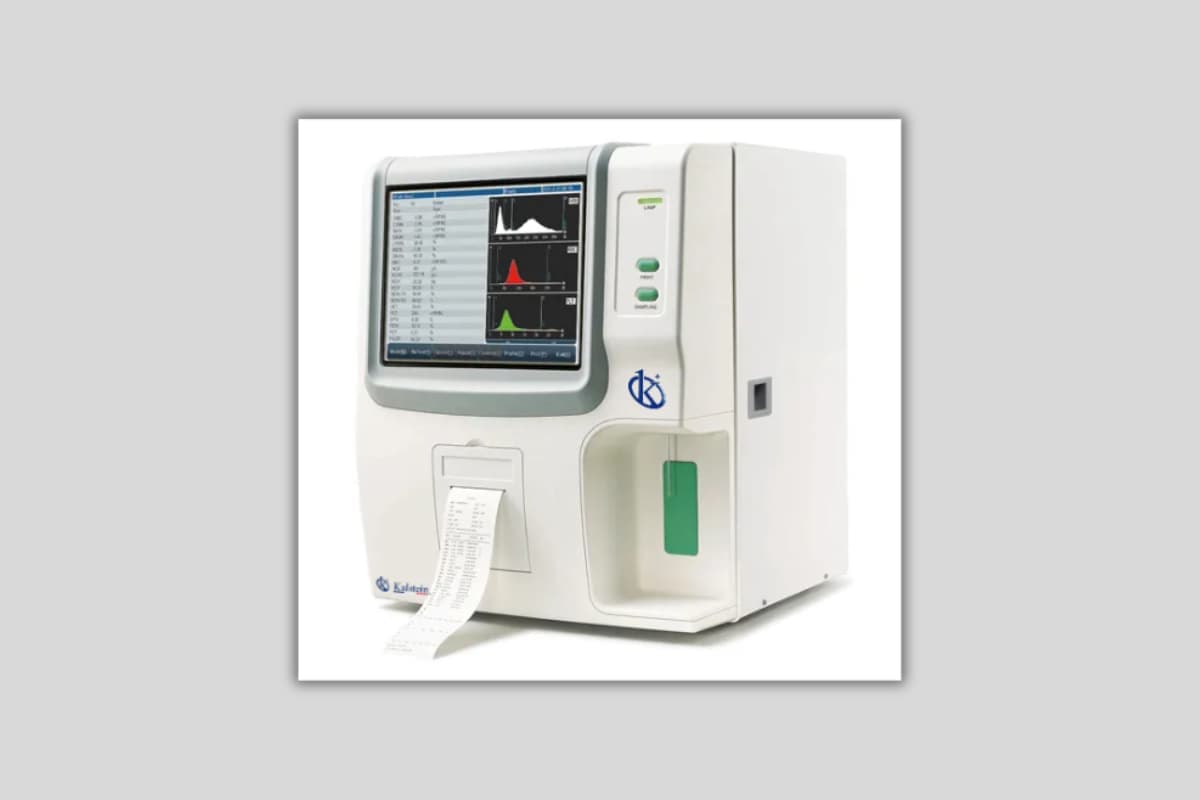
A haematology analyser is a clinical instrument used in pathology labs. It is used to count and characterise blood cells with speed and precision. The device can measure parameters like red and white blood cell counts, haemoglobin concentration, and platelet levels, with reduced turnaround times. Thus, it makes the time-intensive manual process easier.
By delivering consistent and highly detailed blood profiles, these analysers support faster diagnosis and monitoring of conditions like anaemia and blood cancers.
As laboratories face increasing workloads, the haematology analyser stands out as a tool that empowers clinical decision-making in blood analysis.
What is a Haematology Analyser
As the name suggests, a haematology analyser is a type of pathology lab equipment that is used in blood test analysis. The device automates the identification and characterisation of blood cells without manual intervention.
A blood sample is introduced into the analyser, either manually or through a sample handling system. The analyser performs several steps to segregate and analyse different blood components.
Once the data is collected, the haematology analyser interprets the results using advanced software. It then generates a detailed haematology analysis report with key information such as complete blood count (CBC), white blood cell differentiation, red blood cell indices, platelet measurements, etc.
While these devices support every type of clinical diagnosis involving blood sample analysis, their automation levels, underlying technology, and features differ. Accordingly, every lab must procure the most suitable for its needs.
Types of Haematology Analyzers
Blood test analyser systems can be categorised by three distinct criteria: automation level, underlying technology and intended application.
The selection of appropriate automated haematology analyser systems depends on laboratory requirements, testing volume and analytical complexity needs.
| Aspect | Manual | Semi-Automated | Fully Automated |
|---|---|---|---|
| Level of Automation | High manual intervention | Partially automated | Minimal manual intervention |
| Sample Processing | Manual preparation | Some automation | Fully automated |
| Analysis Technology | Visual microscopy | Basic automation | Sophisticated technologies |
| Throughput | Low | Moderate | High |
| Labor Requirements | High | Moderate | Low |
| Accuracy and Precision | Dependent on skill | Improved compared to manual | High |
| Applications | Rarely used clinically | Suitable for smaller labs | Widely used in hospitals |
Technologies in Haematology Analysers
Modern blood test analyser systems utilise three primary technologies, each offering distinct analytical capabilities and cost considerations.
Impedance Technology
Impedance technology measures electrical resistance changes as blood cells pass through small apertures. An electrolyte solution conducts electricity between electrodes, and cell passage creates measurable resistance changes. It enables cell counting and sizing.
It is commonly used for red blood cells, white blood cells, and platelets. Impedence technology can support simple operation, robust performance and cost-effectiveness. However, it provides limited cell morphology information and differentiation capabilities.
Flow Cytometry
Flow cytometry uses lasers and fluorescent markers to analyse individual cells. Cells stained with specific fluorescent dyes emit light signals when excited by lasers. It reveales the size, complexity, and cellular markers in the process.
This technology enables detailed morphological analysis, differentiation of white blood cell subtypes, and detection of abnormal cell populations. However, compared to impedance methods, flow cytometry requires a more complex implementation.
Coulter Principle
The Coulter principle represents a specific impedance technology variation that analyses pulse amplitude generated by individual cells, directly correlating to cell volume. It is primarily used for red blood cell counting and sizing. While the Coulter principle delivers reliable volume determination, it offers limited differentiation capabilities for other cell types.
Application-Based Haematology Analysers
Haematology analysis machines can be basic, advanced, or PoC (Point of Care), depending on the application.
Basic Haematology Analysers
Basic systems focus on routine complete blood counts, including red blood cell count, haemoglobin, hematocrit, white blood cell count, and basic differential (neutrophils, lymphocytes, monocytes). These blood test analyser systems use impedance and light scattering for cost-effective analysis.
Advanced Haematology Analysers
Advanced automated haematology analyser systems provide comprehensive analysis, including reticulocyte counting, immature granulocyte identification, and morphology analysis. These systems deliver integrated reticulocyte analysis with additional data, including reticulocyte haemoglobin content (CHr), % hypochromic cells, and immature reticulocyte fraction. Utilising flow cytometry and image analysis, they suit larger hospitals and research institutions.
Point-of-Care Haematology Analysers
Point-of-care haematology analyser systems are compact, portable units providing rapid blood analysis. They usually enable 5-minute turnaround times for basic complete blood count parameters. Using microfluidics or impedance technology, these systems allow immediate clinical decision-making in emergency departments, intensive care units, and primary care settings.
Differential Analysis Capabilities
Modern haematology analyser systems provide varying levels of white blood cell differentiation capabilities.
Three-Part Haematology Analyser Systems
Three-part differential haematology analyser systems provide basic differentiation of white blood cells into three primary categories: Lymphocytes, Neutrophils, and Monocytes (combined with other cell types).
Three-part systems offer adequate cellular differentiation for standard clinical applications without requiring extensive technical expertise. Healthcare facilities with straightforward diagnostic requirements find these configurations sufficient.
Five-Part Haematology Analyser Systems
Five-part differential systems provide more detailed classification, distinguishing between all major white blood cell types: Lymphocytes, Neutrophils, Monocytes, Eosinophils, and Basophils.
Five-part analysers are more expensive than three-part analysers but provide more in-depth information about the sample. Specific applications like allergy testing require five-part differential analysis capabilities.
Seven-Part Haematology Analyser Systems
Seven-part systems offer the most detailed analysis, including differentiation among Lymphocytes, Neutrophils, Monocytes, Eosinophils, Basophils, Immature granulocytes, and Atypical lymphocytes.
Advanced pathology laboratories utilise seven-part systems. The enhanced analytical depth enables the detection of subtle pathological changes that may not be apparent with other types.
How Can You Implement Them?
Successful implementation of haematology analyser systems depends on laboratory workflow, staffing requirements, and maintenance capabilities. Throughput requirements and anticipated test volumes influence the selection of appropriate analyser configurations. Moreover, staff training requirements also vary between different haematology analyser machine types.
Quality Assurance Protocols
Modern automated haematology analyser systems incorporate robust quality control features. These systems automatically flag potential analytical issues and guide corrective actions as well.
However, regular calibration and maintenance procedures are mandatory for optimal performance. Established quality assurance protocols support regulatory compliance and maintain the high analytical standards in operation.
Haematology Analyser Price in India
Cost evaluation remains a fundamental factor when selecting haematology analyser systems for pathology laboratories. The price ranges of these devices vary based on automation level, analytical capabilities, and brand.
Semi-automated systems represent the most economical option, with prices ranging from ₹5,000 to ₹80,000. They are suitable for smaller laboratories with limited budgets.
Three-part automated haematology analyser systems range from ₹20,000 to ₹3,00,000 in India. Five-part automated systems command higher prices from ₹30,000 to ₹10,00,000, in accordance with their analytical capabilities.
On the other hand, high-end automated systems with advanced features can reach ₹20,00,000. They can handle maximum throughput and analytical depth.
The first step is to decide on the required specifications rather than the brand. Beckman Coulter, Abbott, Mindray, Erba, Agappe, BPL, Medica, Microlab and Neogen are some of the most trusted names in the market when it comes to that.
Conclusion
Haematology analysers have become indispensable equipment in pathology labs. While specialised labs tend to have advanced instruments for microbiology, immunoassay, etc., every lab must have a haematology analyser, whether small or large, because blood analysis lies at the heart of many diagnoses. As the patient numbers and sample volumes increase, labs must procure high-end haematology analyser machines. Moreover, automation is taking precedence. Adequate training is essential for the staff.
Related read - ESR Analyser and Its Clinical Applications
Get Started at ₹1!
Try Flabs for a full month for just ₹1.
Follow us on