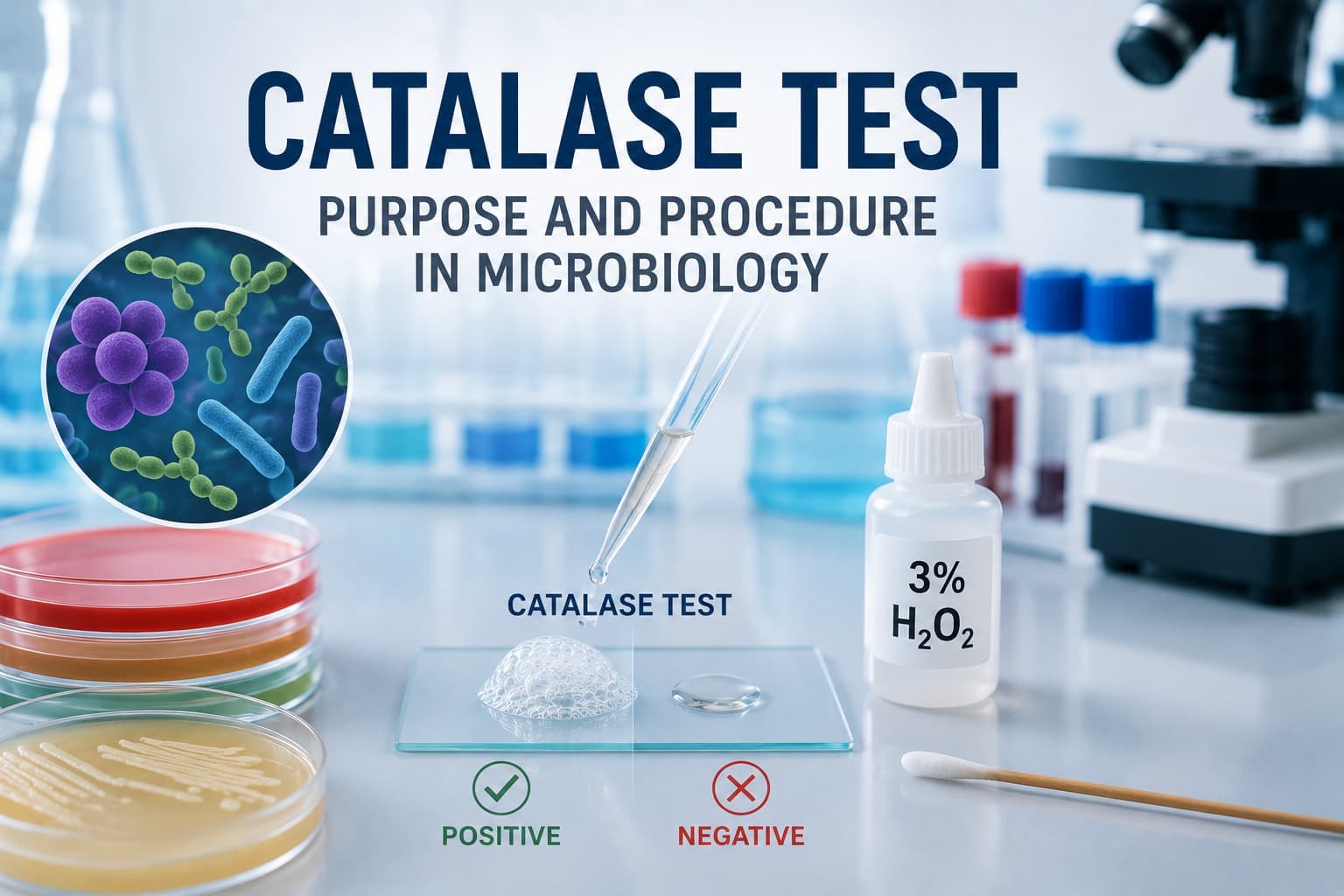
The catalase test is a widely used microbiological assay that distinguishes between catalase-producing and non-catalase-producing organisms. It enables the presumptive identification of bacterial species, especially Gram-positive cocci. The catalase test is frequently used in both clinical microbiology and research settings.
This article provides a review of the catalase test purpose, principle, procedure, reagents, reaction, and interpretation of results, with special emphasis on its application to Staphylococcus aureus and Escherichia coli (E. coli).
What Is the Purpose of the Catalase Test?
The catalase test purpose is to detect the presence of the enzyme catalase in microorganisms. Catalase catalyses the breakdown of hydrogen peroxide (H₂O₂) into water and oxygen.
2H₂O₂ → 2H₂O + O₂ (gas)
This enzymatic activity helps bacteria detoxify hydrogen peroxide, a reactive oxygen species produced during aerobic metabolism. As such, the catalase test is particularly useful for differentiating between aerobic and facultative anaerobic organisms versus strict anaerobes.
Catalase also plays a defensive role in pathogenic bacteria by protecting them against oxidative killing by host immune cells. Higher catalase activity in bacteria has been correlated with increased virulence in certain species.
The test is routinely used to,
- Distinguish catalase-positive organisms (e.g., Staphylococcus, Micrococcus, E. coli) from catalase-negative organisms (e.g., Streptococcus, Enterococcus).
- Assist in identifying aerotolerant versus obligate anaerobic organisms.
- Support the presumptive characterisation of Gram-positive and Gram-negative bacteria.
Catalase Test Principle
The catalase test principle relies on the enzymatic decomposition of hydrogen peroxide by catalase. When a catalase-positive organism is exposed to hydrogen peroxide, visible bubbling occurs due to the rapid release of oxygen gas.
The degree of bubbling can vary depending on the enzyme concentration in the organism and the integrity of the culture sample. Absence of bubbling indicates a negative result, suggesting that the organism lacks catalase activity.
Catalase Test Reagent
The catalase test reagent is Hydrogen Peroxide (H₂O₂). It is used in different proportions.
- 3% solution for most routine bacterial testing.
- 15% for testing anaerobes.
- 30% (superoxol) for Neisseria species differentiation.
Note : 3% H₂O₂ can be prepared by diluting 30% H₂O₂ in a 1:10 ratio using sterile deionised water.
Supplies
- Clean glass microscope slide or test tube.
- Sterile wooden stick, glass rod, or platinum loop (avoid steel or nichrome loops due to potential false positives).
- Dropper or Pasteur pipette.
- Petri dish or dark background for contrast.
Catalase Test Procedure
The catalase test procedure is straightforward and can be performed in two main ways.
1. Slide Method (Preferred for Routine Use)
Place a clean slide in a petri dish to contain any aerosols.
Using a sterile stick or platinum loop, transfer a small amount of a fresh (18-24-hour) bacterial colony to the slide.
Important: Avoid picking up agar. Rspecially from blood agar, which contains catalase and may yield false positives.
Add one drop of 3% hydrogen peroxide directly onto the bacterial smear.
Observe for immediate bubbling (oxygen gas release), preferably against a dark background.
2. Tube Method (Used for Weak or Anaerobic Reactions)
- Add 4-5 drops of 3% H₂O₂ to a clean test tube.
- Using a sterile wooden applicator, transfer the bacterial colony into the tube.
- Observe for bubble formation.
The tube method is recommended when the slide test yields inconclusive or weak results, or when working with strains like S. aureus that may appear catalase-negative using the drop method.
Catalase Test Reaction
The catalase test reaction is visually interpreted based on the presence or absence of bubbling.
Positive Reaction: Immediate and vigorous effervescence (oxygen bubbles) indicates catalase activity.
Negative Reaction: No bubbles form, suggesting absence of catalase.
Note: A weak reaction (only 1-2 bubbles) may indicate low catalase levels or improper technique. Retesting with the tube method is advised.
The reaction is immediate. But delays in observation can lead to missed results, particularly with weakly catalase-positive organisms.
Catalase Test Results Interpretation
The catalase test results can be either positive or negative.
Positive Catalase Test
Presence of rapid bubbling upon exposure to hydrogen peroxide.
Indicates that the organism produces catalase.
Negative Catalase Test
No bubbling or very weak/slow bubbling.
Suggests absence or very low levels of catalase enzyme.
| Organism | Catalase Reaction |
|---|---|
| Staphylococcus aureus | Positive |
| Streptococcus pyogenes | Negative |
| Escherichia coli | Positive |
| Enterococcus spp. | Negative |
| Clostridium spp. | Negative |
| Bacillus spp. | Positive |
| Listeria monocytogenes | Positive |
| Mycobacterium tuberculosis | Positive |
Catalase Test in Staphylococcus aureus
The S. aureus catalase test is a main diagnostic tool in clinical microbiology. S. aureus, a catalase-positive organism, exhibits strong bubbling upon exposure to hydrogen peroxide.
This result helps differentiate S. aureus from Streptococcus pyogenes, which is catalase-negative, despite similar morphology under the microscope (Gram-positive cocci). Following a positive catalase test, additional tests like the coagulase test are used to confirm the presence of S. aureus.
Catalase Test in Escherichia coli
The E. coli catalase test also yields a positive result. E. coli is a facultative anaerobic, Gram-negative rod that expresses catalase to protect itself from oxidative stress during aerobic respiration.
Though not used as a primary identification test for E. coli, the catalase reaction supports its classification and can help rule out catalase-negative enteric pathogens.
Limitations of the Test
While the catalase test is rapid and inexpensive, it has several limitations.
Blood agar interference: Avoid contamination from blood agar as red blood cells contain catalase.
Aged cultures: Use fresh (≤24 hours) colonies; older cultures may yield false negatives.
Loop material: Avoid metal loops unless made of platinum to prevent catalytic artifacts.
Anaerobic organisms: Allow 30 minutes of oxygen exposure before testing.
Handling reagent: 30% H₂O₂ is caustic; if skin contact occurs, rinse with 70% alcohol, not water.
Order of steps: Always apply H₂O₂ to the colony. Not the other way around.
Mixing: Do not mix reagent and colony; gently overlay the drop.
Variability in weak producers: Some S. aureus strains may test negative via the slide method and require tube method confirmation.
Quality Control and Best Practices
Use fresh hydrogen peroxide solution.
Avoid metal loops, which may catalyse the breakdown of peroxide and give false positives.
Always include positive (e.g., S. aureus) and negative (e.g., S. pyogenes) controls.
Conclusion
The catalase test remains a fundamental tool in microbial identification and diagnostic microbiology. By detecting catalase activity through a simple but reliable bubbling reaction, clinicians and microbiologists can distinguish between major bacterial genera such as Staphylococcus and Streptococcus. Proper execution of the catalase test procedure and careful interpretation of catalase test results are at the core of the test.
Whether confirming S. aureus in a wound culture or identifying E. coli in a stool sample, the catalase test continues to offer cost-effective differentiation of bacterial pathogens.
Get Started at ₹1!
Try Flabs for a full month for just ₹1.
Follow us on