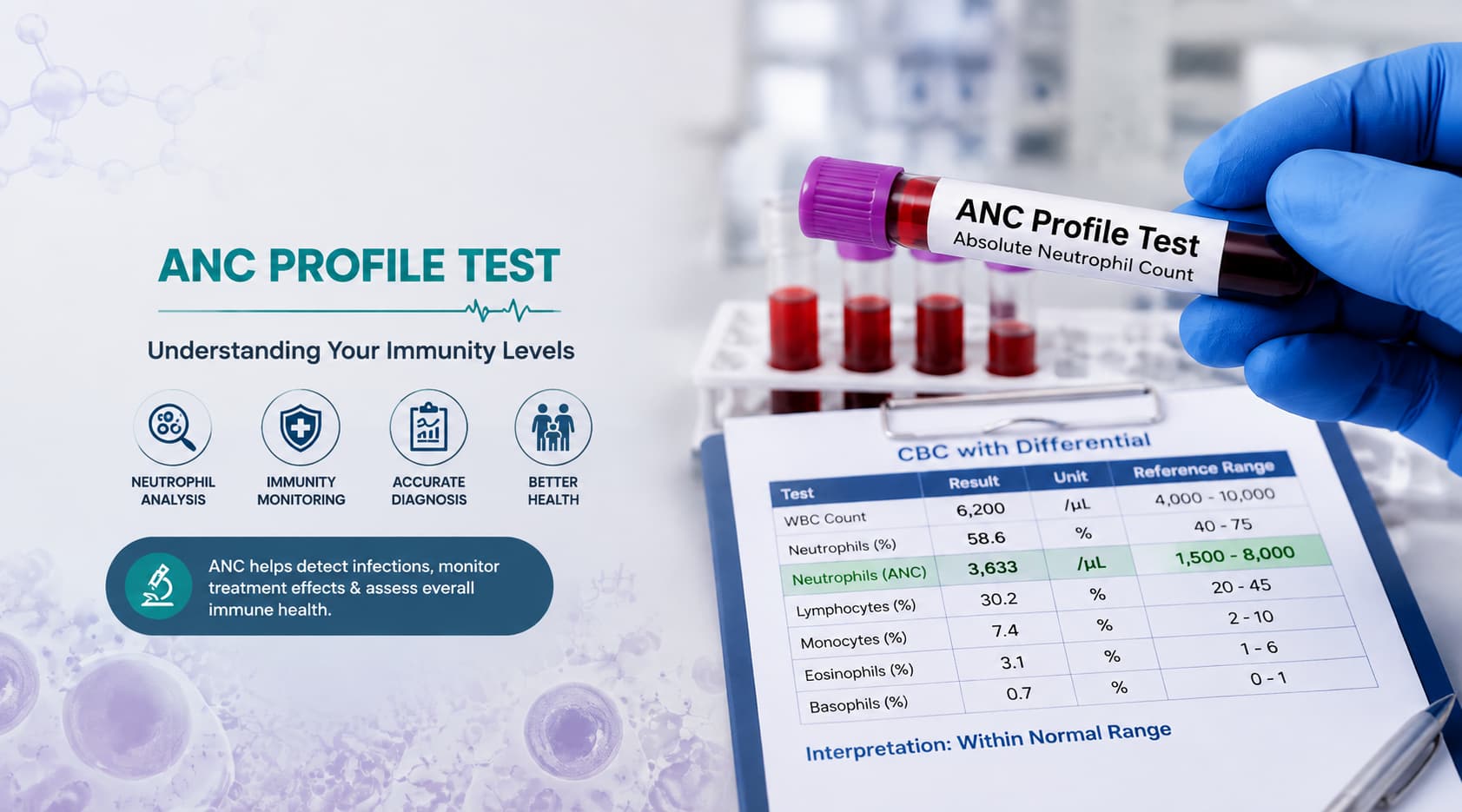
The ANC profile test (Absolute Neutrophil Count) is a dependable marker used in routine diagnosis by pathologists and healthcare teams to evaluate immune system activity.
Neutrophils form the largest proportion of circulating white blood cells and play an important role in protecting the body against infections. Changes in neutrophil levels can provide valuable insights into how the immune system responds to infections, inflammation, chemotherapy, or other treatment-related stressors.
The ANC profile blood test measures the number of neutrophils present in the blood and is commonly calculated as part of a Complete Blood Count (CBC) with differential. It helps doctors assess infection risk, monitor immune response, and evaluate bone marrow function in different clinical situations.
For patients undergoing chemotherapy, managing recurrent infections, or monitoring immune-related conditions, ANC values provide important information about neutrophil status. During pregnancy and other special health conditions, ANC levels may also be reviewed along with other blood parameters to understand overall immune health.
As pathology laboratories in India expand their immuno-haematology workflows, accurate ANC analysis and structured reporting become increasingly important. A connected Laboratory Information System (LIS) helps laboratories manage CBC-based investigations, improve reporting accuracy, and reduce manual workflow challenges.
This guide explains the ANC profile test, including its full form, uses, normal range, pregnancy considerations, and interpretation of results.
What Is ANC Profile Test?
The ANC profile test full form is Absolute Neutrophil Count.
It is a blood test that measures the number of neutrophils present in the bloodstream. Neutrophils are a type of white blood cell that provides the body's first line of defence against many bacterial and fungal infections.
The ANC value is usually calculated from a CBC with differential, where the total white blood cell count and neutrophil percentage are used to determine the absolute neutrophil count.
Healthcare professionals use ANC results to evaluate:
- Risk of infection when neutrophil levels are low
- Immune response during infections
- Bone marrow activity
- Response to chemotherapy or immune-suppressing treatments
According to the National Cancer Institute (NCI), ANC is commonly used to assess infection risk in patients receiving cancer treatments that may reduce neutrophil levels.
External reference: https://www.cancer.gov/publications/dictionaries/cancer-terms/def/absolute-neutrophil-count
The interpretation of ANC results depends on the patient's overall health condition, symptoms, medical history, and other blood parameters. A single ANC value should not be interpreted without clinical context.
For laboratories managing high-volume hematology investigations, integrating analyzers with a laboratory information system can support faster result processing, automated data transfer, and consistent reporting.
What the ANC Profile Test Measures
The ANC profile test full form is Absolute Neutrophil Count.
Neutrophils move swiftly into tissues when pathogens such as bacteria, fungi, protozoa, and viruses threaten the body. Because they pass through vessel walls with ease, a sudden increase or decrease in their numbers reveals how the immune system is reacting behind the scenes.
The ANC profile test is usually part of a complete blood count (CBC) with differential. Some labs create an ANC profile test list that includes absolute neutrophil count, relative percentages, and secondary indices tied to differential distribution.
A few centres also offer an ANC profile panel 3 test, which bundles neutrophil count analysis with markers for inflammation, therapy-related suppression, or bone marrow dynamics.
For laboratories performing CBC-based investigations, automated workflows such as CBC analyzer integration can reduce manual entry errors and improve reporting efficiency.
Why Laboratories Use the ANC Profile Test
Autoimmune disorders, acute infections, chemotherapy regimens, bone marrow dysfunction, and chronic immune deficiency states each alter neutrophil behaviour in distinct ways.
The ANC profile lab test supports decision-making across departments such as:
- Oncology
- Rheumatology
- Internal medicine
- Infectious disease
Patients usually arrive with a pattern of concerns. Night sweats may appear. Weight loss may accompany abdominal discomfort. Recurrent infections might follow months of treatment or chronic illness.
When these signals intersect, the ANC profile test narrows the diagnostic direction with a single venous sample.
A structured pathology reporting software workflow helps laboratories maintain consistent reporting formats for CBC and hematology-related investigations.
Normal Neutrophil Values
Although variations exist across populations, the accepted adult range falls between 1,500 and 8,000 cells/µL. Children may show slightly elevated levels since their immune system is still developing.
To simplify interpretation, the table below outlines commonly referenced categories.
| ANC Range (cells/µL) | Interpretation | Possible Conditions |
|---|---|---|
| Above 8,000 | Neutrophilia | Acute infections, inflammation, stress responses, smoking-related changes, steroid exposure |
| 1,500–8,000 | Within expected range | Normal immune response in stable physiological states |
| Below 1,500 | Neutropenia | Immune suppression, bone marrow disorders, severe infections, autoimmune disease, chronic illness, congenital syndromes |
Neutropenia requires closer surveillance since low neutrophil counts increase the risk of infection.
Persistent neutrophilia may indicate an untreated inflammatory driver or a hematologic concern.
ANC Profile Test in Pregnancy
The ANC profile test in pregnancy holds a special place in obstetric workflows.
Immune modulation during pregnancy may increase neutrophil counts slightly. However, sudden dips or spikes signal conditions that call for medical attention.
Many clinicians ask for a complete ANC profile test during pregnancy when infections or unexplained symptoms appear, since neutrophil numbers adjust earlier than many other biomarkers.
How the ANC Profile Test Is Performed
Preparation stays simple:
- No fasting is usually required.
- Adequate hydration may improve sample collection.
- Patients may be advised to avoid alcohol before testing.
A single venous blood draw is processed through automated analysers that derive absolute and relative neutrophil values.
Laboratories usually provide results within 24 to 48 hours, though turnaround time shifts depending on batching strategy, staffing, and sample load.
High-volume centres with advanced pathology lab equipment report faster timelines.
Factors that alter interpretation include:
- Medication regimens
- Chronic diseases
- Smoking status
- Daily stress peaks
- Recent infections
- Therapy cycles, especially for oncology patients
Management Strategies When Values Shift
Low counts, once confirmed, may require growth factor therapy such as G-CSF. Exposure risks should be minimized since infection thresholds are lower.
Physicians often examine nutritional deficiencies or marrow suppression patterns to understand underlying causes.
High counts steer attention toward infection control, inflammation management, steroid tapering, or reducing stress triggers.
A repeat ANC usually appears in the plan to track movement over time. Many clinicians prefer serial measurements to a single outlier value.
ANC Profile Test Includes More Than a Single Marker
Some labs add segmentation data, band counts, or ratios that enhance interpretation.
The ANC profile test includes parameters that deepen the clinical picture, especially when therapy monitoring or bone-marrow assessment is required.
In certain centres, upward of three markers combine to form an enhanced ANC profile panel 3 test, designed for oncology and rheumatology applications.
This multilayered view gives pathologists a broader perspective while still relying on a moderate volume of blood.
Operational Considerations for Pathology Labs
With test volumes rising, many labs revisit reporting systems, workflow pipelines, and patient communication processes.
The ANC profile test rate or ANC profile test price depends on:
- Infrastructure cost
- Reagent choices
- Regional pricing
- Testing volume
Some labs bundle CBC and ANC reporting, while others list separate ANC profile blood test price tiers.
Managing daily workload remains a major pressure point. This is where technology supports clinical accuracy and operational ease.
FLABS LIS Software for ANC Testing Workflows
FLABS LIS Software aligns naturally with ANC reporting because neutrophil analysis requires fast, structured output with minimal manual handling.
Several features support laboratories performing high-volume CBC and immuno-haematology tests.
FLABS provides:
- Smooth patient registration through a streamlined interface.
- Automated analysis routing for ANC profile panels, reducing manual entries.
- QR-coded report generation for immediate retrieval.
- WhatsApp integration for patient notifications.
- Patient portal access for digital report viewing.
For laboratories working with automated analyzers, FLABS also supports connected workflows through laboratory machine interfacing.
Technicians benefit from a workflow connecting:
- Patient registration
- Sample assignment
- Analyzer processing
- Result verification
- Report release
Data security protocols help protect patient information, while backups support laboratories operating across multiple collection centres.
For pathology labs in India handling large CBC volumes, FLABS provides a scalable structure that supports efficient hematology reporting.
Improve ANC and Hematology Reporting Workflows with FLABS
Reduce manual reporting effort and manage laboratory workflows through a connected LIS platform.
Explore:
Book a FLABS Demo and streamline your laboratory reporting workflow.
Why the ANC Profile Test Matters
A well-interpreted ANC test shapes clinical direction rapidly.
Physicians gain clarity into:
- Immune suppression
- Infection patterns
- Therapy-related adverse effects
- Chronic inflammatory activity
Patients undergoing chemotherapy rely heavily on serial ANC readings to identify safe treatment intervals.
Those with autoimmune conditions experience fluctuating immune activity that becomes easier to monitor with reliable neutrophil tracking.
The ANC profile test price is accessible for most labs and patients, which encourages repeated testing when trends matter more than one isolated number.
A More Connected Way Forward for Pathology Labs
Neutrophil analysis may seem simple on the surface, yet the significance behind each shift in count requires confident data interpretation.
High-quality reporting systems elevate that interpretation.
As labs refine their operations with dependable LIS tools, ANC reporting becomes faster, clearer, and more consistent.
Pathologists seeking smoother ANC workflows, stronger communication channels, and minimal manual rework can adopt FLABS to unify their processes.
Ready to Automate Your Hematology Workflow?
Connect your CBC, ANC and hematology reporting processes with FLABS LIS.
Get Started at ₹1!
Try Flabs for a full month for just ₹1.
Follow us on