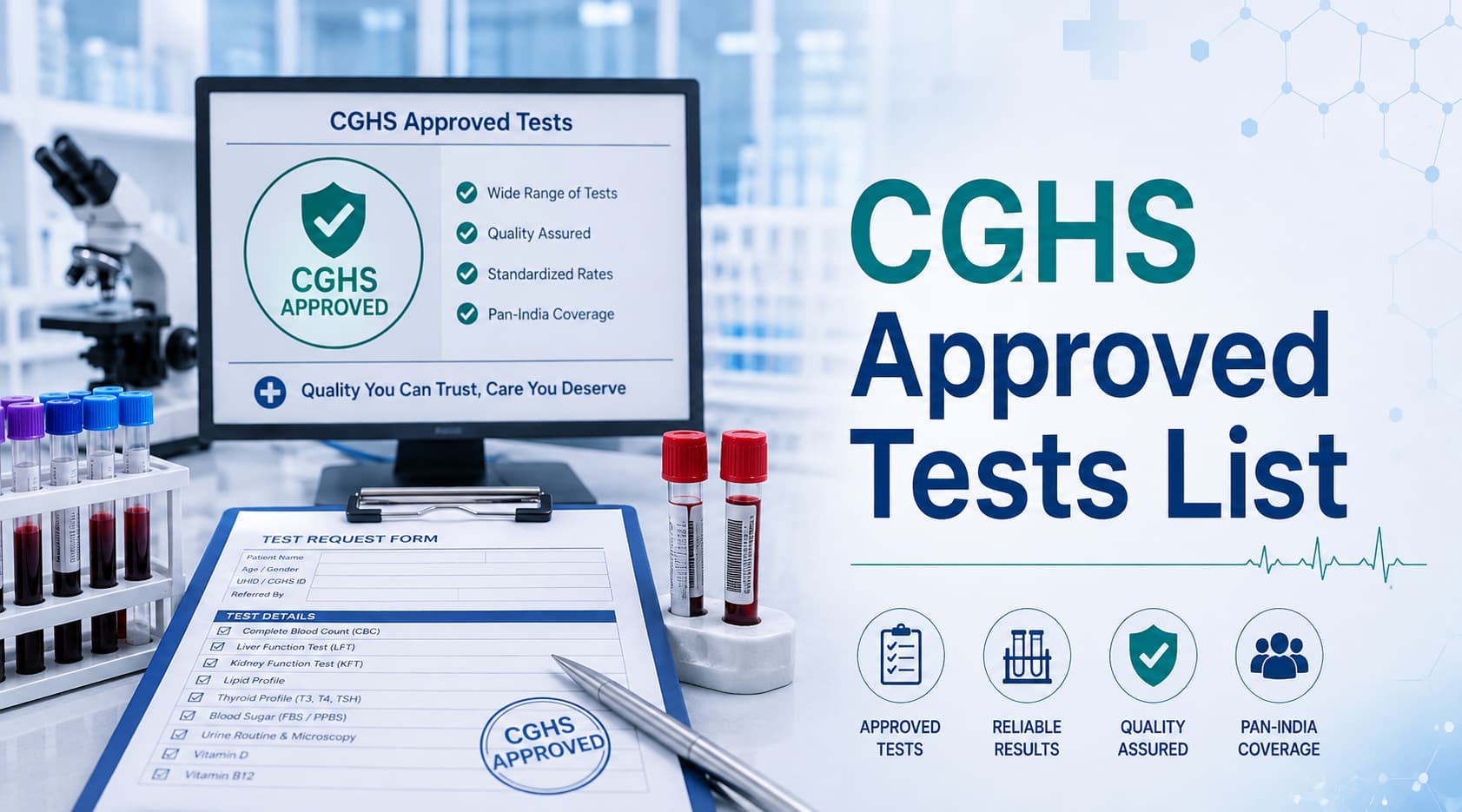
The CGHS approved tests list includes routine and specialised laboratory investigations available under the Central Government Health Scheme’s notified treatment and investigation schedule.
As of August 2026, the latest all-India CGHS rate schedule was notified on 3 October 2025 and became effective on 13 October 2025. Therefore, this 2026 guide uses the revised rates currently applicable unless CGHS issues a later amendment.
The official document refers to these services as the CGHS Treatment Procedure/Investigation List. It assigns a code and reimbursement rate to laboratory tests, imaging procedures, consultations and treatment packages.
However, inclusion in the CGHS rate list does not mean that every test can be performed automatically. Coverage depends on:
- A valid CGHS beneficiary card
- A prescription or referral where required
- The test being included in the notified investigation list
- The diagnostic centre being empanelled under CGHS for the relevant service
- Compliance with referral and permission requirements
- Correct CGHS code and rate selection
- Applicable city and accreditation category
Patients should confirm the prescribed investigation and provider eligibility before testing. Laboratories should verify the current official schedule instead of relying on an old PDF or internally saved rate sheet.
Latest CGHS Rate List Applicable in 2026
The current CGHS rate structure was introduced through the revised CGHS rates notified in October 2025.
The schedule divides locations into:
- Tier X or Tier I cities
- Tier Y or Tier II cities
- Tier Z or Tier III cities
Tier Y rates are generally 10% lower than Tier X rates, while Tier Z rates are generally 20% lower. Non-NABH or non-NABL healthcare organisations receive rates that are 15% lower than the corresponding accredited rate.
For laboratory investigations and other procedures that do not require admission, the rate remains the same regardless of whether the beneficiary has general, semi-private or private ward entitlement.
Which Cities Use Tier X Rates?
The Tier X schedule includes major cities such as:
- Delhi
- Mumbai
- Kolkata
- Chennai
- Bengaluru
- Hyderabad
- Ahmedabad
- Pune
CGHS subsequently clarified that Faridabad, Ghaziabad, Noida and Gurugram are treated at par with Delhi for city-tier rate purposes.
CGHS Lab Test Rate List for Delhi and Tier X Cities
The following table shows selected pathology investigations covered under CGHS.
The rates shown are the Tier X accredited or NABL rate. The official schedule should be checked before billing because test names, rates, codes and provider categories may be amended.
| CGHS Code | Investigation | Tier X NABL Rate |
|---|---|---|
| LB010 | Erythrocyte Sedimentation Rate—ESR | ₹100 |
| LB012 | Complete Haemogram/CBC with indices, TLC, DLC, platelets, ESR and peripheral smear | ₹300 |
| LB017 | Peripheral Smear Examination | ₹100 |
| LB025 | Activated Partial Thromboplastin Time—APTT | ₹290 |
| LB036 | Blood Group and Rh Type | ₹90 |
| LB042 | Hepatitis B Surface Antigen—HBsAg | ₹300 |
| LB043 | Hepatitis C Virus—HCV | ₹500 |
| LB069 | C-Reactive Protein—CRP | ₹250 |
| LB070 | Quantitative C-Reactive Protein | ₹300 |
| LB084 | Antinuclear Antibody—ANA | ₹655 |
| LB105 | Prothrombin Time and INR | ₹250 |
| LB122 | Glycosylated Haemoglobin—HbA1c | ₹300 |
| LB123 | Kidney Function Test—KFT | ₹500 |
| LB124 | Liver Function Test—LFT | ₹500 |
| LB125 | Lipid Profile | ₹490 |
| LB126 | Serum Ferritin | ₹350 |
| LB203 | Bacterial Culture and Sensitivity—Aerobic | ₹460 |
| LB205 | Mycobacterial Culture and Sensitivity | ₹550 |
| LB248 | Procalcitonin | ₹2,070 |
| LB262 | Quantitative HBsAg | ₹650 |
| LB268 | Widal Test | ₹70 |
The official list confirms the haematology, coagulation and hepatitis investigation codes shown above.
The revised schedule also lists HbA1c, KFT, LFT, lipid profile and ferritin as separate investigations with defined rates.
Specialised investigations such as procalcitonin, bacterial cultures, mycobacterial cultures and quantitative HBsAg also have separate codes and rates.
Important Note on CBC
The listed CGHS code LB012 is not limited to a basic three-part CBC. Its official description includes haemoglobin, red-cell count and indices, TLC, DLC, platelets, ESR and peripheral-smear examination.
Laboratories should map the code according to the precise official description rather than using the same code for every internally named “CBC” package.
Important Note on HBsAg and HBV Viral Load
HBsAg, quantitative HBsAg and HBV DNA quantitative are different investigations.
- HBsAg detects hepatitis B surface antigen.
- Quantitative HBsAg measures the concentration of surface antigen.
- HBV DNA quantitative measures viral DNA and is used for viral-load assessment.
Laboratories should not describe quantitative HBsAg as an HBV viral-load test. The CGHS schedule assigns separate codes and rates to these investigations.
Important Note on Culture Tests
The revised schedule lists investigation categories such as:
- Bacterial culture and sensitivity—Aerobic
- Bacterial culture and sensitivity—Anaerobic
- Mycobacterial culture and sensitivity
- Fungal culture
The appropriate code should be selected according to the investigation ordered and the official CGHS nomenclature. A laboratory should not create unsupported CGHS codes merely because its internal LIS calls a test “blood culture” or “urine culture.”
Is Every Test in the CGHS Rate List Automatically Covered?
No.
A listed investigation is potentially admissible under CGHS, but actual access and claim acceptance can depend on:
- Whether the test was medically prescribed
- Whether a valid referral or permission is available
- Whether the test is listed or unlisted
- Whether the diagnostic centre is empanelled for that investigation
- Whether the centre’s accreditation and scope support the claimed rate
- Whether the correct code was submitted
- Whether the service was delivered within the applicable referral period
- Whether mandatory claim records were uploaded
An empanelled provider should verify its current CGHS scope instead of assuming that it can claim every investigation appearing in the national rate schedule.
CGHS Test Referral Validity
Under the revised CGHS diagnostic referral guidelines, a referral issued by a CGHS Wellness Centre Medical Officer for specialist consultation is generally valid for three months.
During this period:
- Routine listed investigations and minor procedures advised by the empanelled specialist may be undertaken without another CGHS endorsement, provided they do not require admission.
- Special investigations such as CT, MRI and PET scans require referral or endorsement from CGHS.
- Any investigation costing more than ₹3,000 also requires CGHS referral or endorsement.
- The applicable referral or endorsement is generally valid for three months.
Unlisted investigations require approval under the applicable delegated-authority rules. The approval authority can differ for pensioners and serving employees.
What Laboratories Should Verify
Before registering a CGHS investigation, the laboratory should check:
- Beneficiary identity and active CGHS card
- Referral or prescription date
- Name of the prescribed investigation
- Whether the investigation is listed or unlisted
- Whether separate permission or endorsement is required
- Correct CGHS code
- Provider empanelment and accreditation category
- City-tier rate
- Claim-system documentation
- Whether the performed test matches the referred investigation
A referral should not be rejected merely because it was created before the October 2025 transition, provided it remains valid. During the TMS 2.0 transition, CGHS instructed healthcare organisations not to send beneficiaries back solely for a fresh referral and provided a manual-upload process for valid earlier referrals.
Are Additional Charges Allowed Beyond CGHS Test Rates?
Empanelled providers are expected to follow the notified CGHS rate and applicable memorandum terms.
Routine items required to perform a laboratory test—such as vacutainers, needles, lancets and syringes—form part of the test cost and should not appear as separate charges. Providing the patient with the laboratory report is also included rather than separately billable.
However, the article should not claim that every possible home-collection, travel or special sample-handling service is automatically included. Any exceptional charge must be supported by current CGHS instructions rather than an internal laboratory policy.
What the CGHS Rate Structure Means for Diagnostic Laboratories
Accurate Code Mapping
The internal LIS test name should map to the correct CGHS investigation code and description.
For example, the following should not be treated as interchangeable:
- HBsAg
- Quantitative HBsAg
- HBV DNA qualitative
- HBV DNA quantitative
Incorrect mapping can cause claim discrepancies even when the laboratory procedure itself was clinically appropriate.
Accreditation-Based Billing
The October 2025 rate notification differentiates accredited and non-accredited providers. A laboratory should claim the accredited rate only where its current NABL accreditation and declared CGHS scope support that classification.
Version Control
Laboratories should retain:
- The current CGHS rate master
- The effective date
- Previous versions
- Mapping-change history
- User responsible for each change
- Evidence of review and approval
- Claim records linked to the rate version used
Referral and Document Audit Trail
The laboratory system should preserve:
- CGHS beneficiary details
- Referral or prescription
- Referring facility
- Investigation code
- Test registration date
- Report date
- Claim-system reference
- Amendments
- Uploaded supporting documents
How LIS Software Can Support CGHS Billing
A laboratory information system can support CGHS workflows by maintaining structured test masters, payer-specific rates and traceable billing records.
Useful capabilities include:
- Separate CGHS and private rate masters
- CGHS code-to-test mapping
- Effective-date control
- City- and accreditation-specific rates
- Referral-document upload
- User-level audit trails
- Analyzer result interfacing
- Result authorization
- Amended-report tracking
- Claim and billing exports
- Alerts for missing documentation
Avoid claiming that LIS software guarantees CGHS compliance or claim approval. Final responsibility remains with the empanelled healthcare organisation, its billing team and applicable CGHS rules.
How Patients Can Check Whether a Test Is CGHS Approved
Patients can:
- Review the investigation written on the referral.
- Ask the CGHS Wellness Centre whether additional approval is required.
- Confirm that the selected laboratory is currently empanelled.
- Check whether the centre offers the prescribed investigation under its scope.
- Ask the centre to confirm the applicable CGHS code and rate.
- Use the official CGHS provider and rate-search facilities.
- Retain the referral, report and any billing documents.
Patients looking for providers can also review the FLABS guide to CGHS-approved diagnostic centres in major Indian cities.
Do not rely only on an old rate-list PDF downloaded from a third-party website.
Conclusion
The CGHS approved tests list for 2026 is based on the latest notified investigation schedule currently in force, rather than a separate rate notification issued every calendar year.
The revised CGHS rates effective from 13 October 2025 include hundreds of laboratory investigations with defined codes and differentiated rates based on city category and provider accreditation.
For patients, the important checks are prescription, referral validity, provider empanelment and test availability. For laboratories, accurate code mapping, current rate masters, accreditation alignment and complete documentation are essential.
Because CGHS rates and administrative instructions may be amended, both beneficiaries and diagnostic providers should verify the latest official notification before testing or claim submission.
Get Started at ₹1!
Try Flabs for a full month for just ₹1.
Follow us on