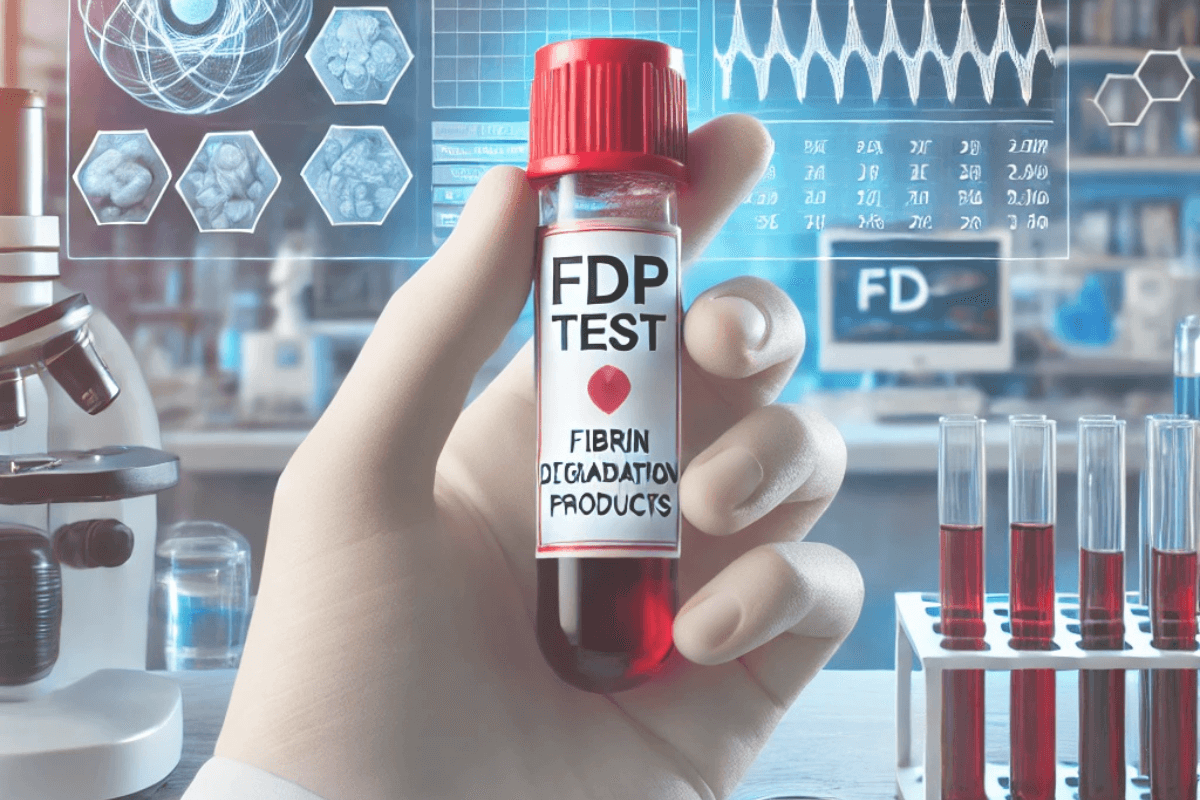
The Fibrin Degradation Products (FDP) test helps pathologists and physician’s about the body’s clot-dissolving system. It measures substances left in the blood after clots dissolve. These substances, called FDPs, result from the breakdown of fibrin, a protein essential for blood clotting. Understanding FDP levels is critical for diagnosing and managing clotting disorders and related conditions.
FDP Full Form
The FDP full form is Fibrin Degradation Products. They are also Fibrin split products (FSPs) and fibrin breakdown products (FBPs). The test is conducted to see that they’re within the FDP normal range values. Any abnormality is interpreted as an underlying health condition, and treatment is initiated.
The Need for the FDP Blood Test
The FDP blood test assesses how effectively the body dissolves clots. It helps identify clotting and bleeding disorders. This test is used to:
- Detect deep vein thrombosis (DVT) and pulmonary embolism (PE).
- Diagnose disseminated intravascular coagulation (DIC).
- Monitor conditions like leukaemia, kidney disease, and stroke.
- Evaluate the effectiveness of treatment for clotting disorders.
FDP levels indicate whether the clotting and fibrinolytic systems are functioning correctly. Elevated levels may signal abnormal clot formation or breakdown.
The Role of Fibrin and FDPs in the Body
Fibrin plays a key role in blood clotting. When a blood vessel is injured, fibrin forms a net-like structure. This net stabilises the clot and prevents further bleeding. As the injury heals, the clot dissolves, releasing fibrin degradation products into the bloodstream. The FDP test measures these fragments to assess clotting activity.
Indications for the FDP
A doctor may order the FDP test in the following scenarios:
- Signs of DIC, such as bleeding gums, severe muscle pain, or reduced urine output.
- Suspected clotting disorders.
- Symptoms of DVT or PE, like leg swelling or sudden shortness of breath.
- Monitoring the progress of treatment for clotting abnormalities.
Additionally, the test is useful in diagnosing conditions such as stroke, preeclampsia, leukaemia, Liver or kidney disease.
FDP test procedure
The FDP test requires a blood sample. The method of blood collection is venipuncture. A nurse or technician draws blood from a vein in the arm. The sample is sent to a laboratory for analysis. Results are shared with the healthcare provider, who interprets them based on the patient’s condition.
Suggested Preparation
Patients do not need to fast before the FDP test. However, certain medications may influence results. Drugs like barbiturates, heparin, streptokinase, and urokinase can elevate FDP levels. Patients should inform their doctor about any medications they are taking. Changes to medication should only be made under medical guidance.
Interpretation of FDP Test Results
FDP test normal range values are usually less than 10 mcg/mL. Elevated levels indicate excessive clot breakdown or fibrinolytic activity. As mentioned, it can be due to one of the following conditions.
- DIC
- Burns
- Kidney or liver disease
- Preeclampsia or placenta abruption
- Leukaemia
- Severe infections
- Hypoxia or congenital heart disease
- Recent surgery or organ transplant rejection
Each laboratory may have slight variations in FDP normal range values. Consult a doctor to interpret the specific results or take a second opinion.
Possible Risks
The FDP test is generally safe as it is simple blood collection. However, it carries minor risks:
- Discomfort or pain at the needle site
- Bruising or hematoma
- Infection at the puncture site
- Fainting or lightheadedness
For healthy individuals, these risks are minimal and resolve quickly.
Diagnosing DIC
Disseminated intravascular coagulation (DIC) is a serious condition where abnormal clotting and bleeding co-occur. If that happens, symptoms like severe pain, nausea, and reduced urine output can occur. Elevated FDP levels are an indicator of the DIC. The condition demands early intervention to prevent complications.
The Semi-Quantitative FDP Test
The semi-quantitative FDP test detects fibrin degradation fragments like X, Y, D, and E. It also measures D-dimer levels. These components provide detailed insights into clot breakdown activity. It is beneficial for diagnosing DIC, DVT, PE, and excessive fibrinolysis.
Why Is the FDP Test Important?
The FDP test helps identify life-threatening conditions early. Healthcare providers rely on this test to:
- Diagnose clotting abnormalities
- Monitor treatment effectiveness
- Guide decisions for additional testing or interventions
Exercise and FDP Levels
Studies show that physical exercise can influence FDP levels. Intense or prolonged exercise causes a modest increase in FDP levels. For example:
- Short maximal treadmill tests in well-trained athletes sometimes increase FDP levels.
- Prolonged activities like a 3-hour race may result in significant fragment D elevation.
- Elderly subjects often show little change in FDP levels during short exercise due to lower exertion levels.
Physical training over time improves post-exercise FDP responses slightly. However, these increases remain modest. Daily exercise-induced fibrinolytic activation in trained individuals may hold greater relevance to reducing risks of thrombotic or atherosclerotic diseases.
Exploring More
Recent research has uncovered fascinating links between FDP levels and pregnancy outcomes. FDP monitoring helps doctors predict and prevent complications in high-risk pregnancies. New rapid testing methods now deliver results in minutes instead of hours.
Some hospitals use AI algorithms to analyse FDP patterns and predict blood clotting issues before they become severe. The future of blood clot prevention keeps getting brighter with each scientific breakthrough.
Suggested read: Folstein Test
Get Started at ₹1!
Try Flabs for a full month for just ₹1.
Follow us on