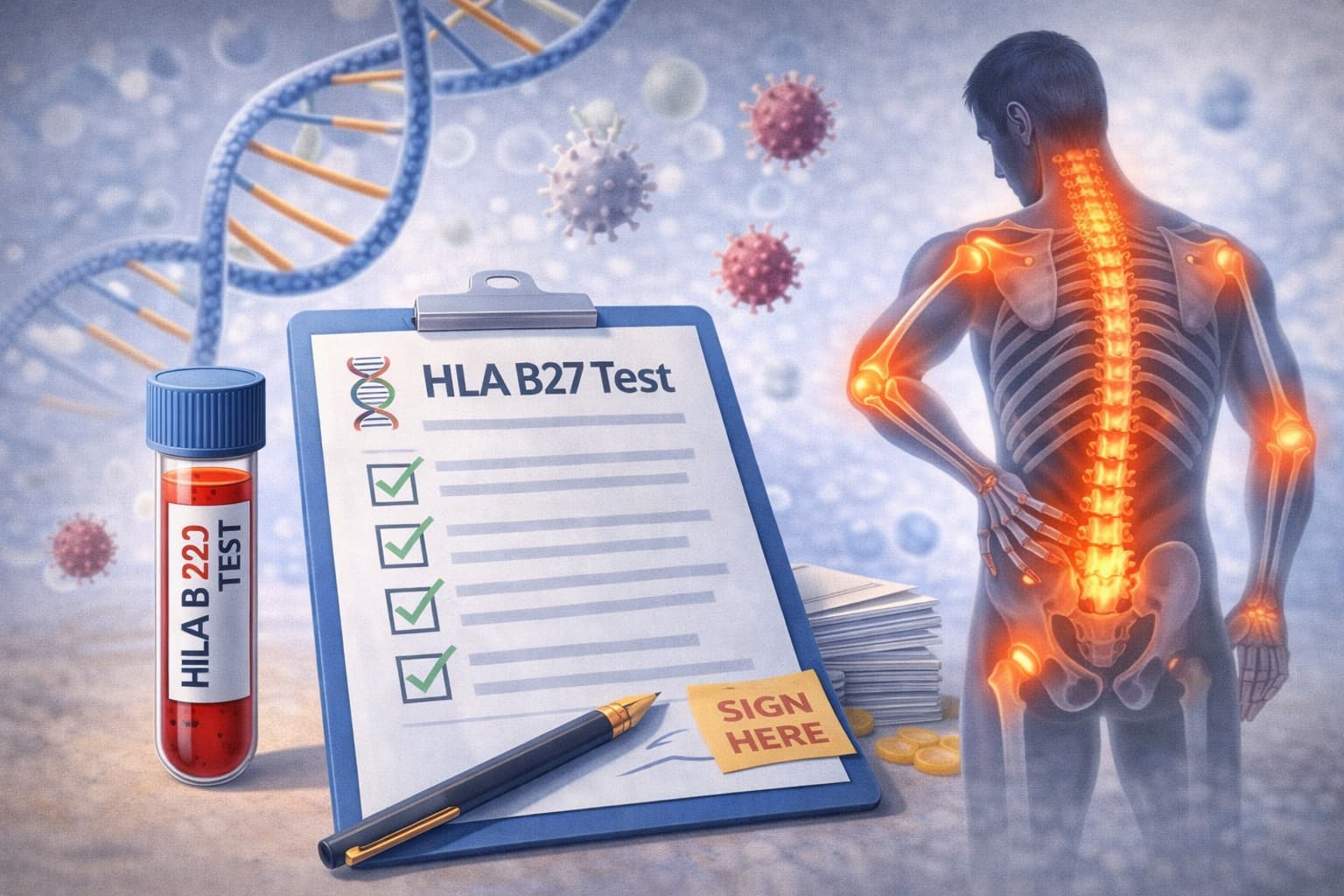
Human Leukocyte Antigen B27 (HLA-B27) is a surface antigen on white blood cells. The protein enables the immune system to identify substances deemed dangerous. Clinical analysis of blood samples determines the presence of HLA-B27 proteins to assess genetic susceptibility.
The presence of this antigen makes a patient vulnerable to distinct systemic disorders. Ankylosing spondylitis often tops the differential and many other conditions.
While the test results are available, for pathologists and laboratory professionals, looking beyond the binary "positive/negative" result is essential. We need to dissect the nuances of this genetic marker. We must examine its role in stratifying risk and how different methodologies impact sensitivity.
The Immunological Basis
We are looking at the Major Histocompatibility Complex (MHC) Class I molecule. Encoded on chromosome 6, this protein sits on the surface of white blood cells. Its primary job is to present antigenic peptides to cytotoxic T cells (CD8+).
In a healthy system, this mechanism identifies viral threats. In patients carrying the HLA-B27 allele, the system misfires.
The exact pathophysiology is still debated. One theory suggests the misfolding of the heavy chain in the endoplasmic reticulum triggers a stress response. Another hypothesis points to molecular mimicry between the antigen and specific bacterial epitopes.
Regardless of the mechanism, the outcome is inflammation.
Ordering a blood test for HLA B27 gene expression is not about diagnosing a single disease. It is about identifying a genetic predisposition that changes the probability of a diagnosis.
Clinical Indications and Utility
Why do clinicians send the sample to your lab? They rarely do so as a screening tool for the general population. The pre-test probability matters.
Rheumatologists utilise the HLA B27 test primarily to confirm a suspicion of Ankylosing Spondylitis (AS). Roughly 90% to 95% of Caucasian patients with AS carry this antigen. The association is strong.
But the utility extends further.
Reactive Arthritis: Formerly Reiter’s syndrome. The correlation here is significant but lower than AS.
Acute Anterior Uveitis: Ophthalmologists rely on this marker when eye inflammation recurs without a clear cause.
Juvenile Idiopathic Arthritis (JIA): Specifically, the enthesitis-related arthritis subtype.
Inflammatory Bowel Disease (IBD): Arthritis associated with Crohn’s or Ulcerative Colitis tends to link back to this marker.
The HLA B27 disease association test acts as a puzzle piece. It fits into a broader picture, including MRI findings of sacroiliitis and elevated CRP levels.
Methodologies: Flow Cytometry vs. Molecular
As laboratory professionals, the method matters. It dictates the workflow, cost, and turnaround time.
Flow Cytometry
The HLA B27 flow cytometry test is the workhorse in many high-volume labs. It uses fluorescently labelled antibodies to detect the antigen on the surface of T lymphocytes.
- Pros: Fast. Cost-effective. Fits into existing haematology workflows.
- Cons: Cross-reactivity with other HLA-B antigens (like HLA-B7) can occur. This leads to false positives.
Molecular Methods (PCR)
Polymerase Chain Reaction (PCR) targets the specific DNA sequences encoding the antigen.
- Pros: Extremely specific. It eliminates the cross-reactivity issues seen in serological methods.
- Cons: Higher cost. Requires specialised equipment.
| Feature | Flow Cytometry | Molecular (PCR) |
|---|---|---|
| Target | Surface Protein Expression | DNA Sequence (Genotype) |
| Specificity | Moderate (Cross-reactivity risk) | High (Allele-specific) |
| Turnaround Time | 4 - 24 Hours | 24 - 72 Hours |
| Cost Profile | Lower | Higher |
| Sample Requirement | Whole blood (EDTA) | Whole blood (EDTA/Citrate) |
Sample Handling and Logistics
The standard HLA B27 test sample type is whole blood collected in an EDTA (lavender top) or sometimes an ACD (yellow top) tube. Sample viability is vital. For flow cytometry, the lymphocytes must be intact. Old or hemolyzed samples will yield unreliable data.
Pathologists should ensure the pre-analytical phase is robust. Transport samples at room temperature. Process them within 24 to 48 hours.
Patients often ask about logistics. "How long does the test take?" is a common query. While the analytical run time for flow cytometry is short, batching samples can extend the reporting time. Most labs release the HLA B27 test report within 2 to 4 days.
Interpreting the Report
| Aspect | Positive HLA-B27 Result | Negative HLA-B27 Result |
|---|---|---|
| What it means | HLA-B27 antigen is detected in the blood | HLA-B27 antigen is not detected in the blood |
| Disease implication | Does not confirm an autoimmune disease | Does not completely rule out autoimmune disease |
| Risk indication | Increased risk for certain conditions, especially spondyloarthropathies | Lower likelihood of HLA-B27–associated conditions |
| Associated conditions | Ankylosing spondylitis, reactive arthritis, psoriatic arthritis, and inflammatory bowel disease–related arthritis | Some individuals may still develop conditions like ankylosing spondylitis despite a negative result |
| Prevalence in healthy people | Many carriers never develop any related disease | Common in the general population |
| Role in diagnosis | Supports diagnosis when combined with symptoms and imaging | Does not exclude disease; clinical evaluation still required |
| Next steps | May prompt further tests (X-ray, MRI, inflammatory markers) | Further evaluation based on symptoms and clinical findings |
| Normal range | Positive or Negative (qualitative test) | Positive or Negative (qualitative test) |
Economic Considerations
The HLA B27 test price fluctuates based on the method used. Flow cytometry generally costs less. The HLA B27 PCR test price is higher due to reagents and tech time.
Clinicians may ask if the HLA B27 flow cytometry test price difference is worth the savings. For screening symptomatic patients, flow is usually sufficient. For ambiguous cases, the molecular route offers better value by reducing diagnostic error.
The Clinical Picture
While we focus on the lab data, we must remember the patient. The physician is looking for a correlation between the lab values and HLA B27 test symptoms.
- Insidious onset of back pain before age 45.
- Pain that improves with exercise but not with rest.
- Morning stiffness lasting more than 30 minutes.
- Awakening in the second half of the night due to back pain.
- Alternating buttock pain.
When the requisition mentions these specifics, the HLA B27 test for genetic susceptibility becomes a high-yield investigation.
Limitations and Pitfalls
Flow cytometry can give false-positive results due to cross-reactivity with HLA-B7 or HLA-B2706, which is not associated with ankylosing spondylitis.
Molecular testing detects the presence of the HLA-B27 gene. But it does not show whether it is expressed on the cell surface; however, gene presence is usually enough for risk assessment.
HLA-B27 prevalence varies by ethnicity. It is high in Pima Indians and low in Japanese populations, and the strength of disease association also differs across ethnic groups.
Final Thoughts
The HLA-B27 assay is a powerful tool in the rheumatological arsenal. It bridges the gap between suspicion and reality. By knowing the methodologies, limitations, and clinical context, laboratory professionals ensure that this test serves its true purpose: reducing the time to diagnosis for patients living with chronic pain.
We move the needle not by just running the sample. We do it by ensuring the right test is used for the right patient at the right time.
Also check - Dual Marker Blood Test: Early Screening During Pregnancy
Get Started at ₹1!
Try Flabs for a full month for just ₹1.
Follow us on