The Liver Function Test (LFT) results are key for checking liver health and its overall effect on the body. A detailed Liver Function Test report gives clear data to help figure out and care for liver conditions. Using the LFT report well is important for spotting liver problems, choosing treatments, and improving how we look after patients; and liver function test report format plays a crucial role in a well-prepared report. This brief article lays out ten basic rules of liver function test report format and reads an LFT report to make sure it's complete, correct, and useful for doctors.
It is important that any liver function test report format follows standards set by the medical regulatory authority of the particular region. In India, ICMR (The Indian Council of Medical Research) issues the guidelines in this regard.
Here are 10 essential guidelines for creating a standardised Liver Function Test (LFT) report format in your pathology lab:
Features of a Proper Liver Function Test Report Format
1. Report Heading and Title
Put the name and emblem of your health centre or lab at the top.
Clearly say it's a Liver Function Test (LFT) Report.
Use a unique ID or number for tracking the report.
2. Patient Details
Show the patient's complete name and birth date.
List the patient’s sex and important health background.
Write the time of sample collection and who ordered the test.
3. Test Elements
Name each liver test, like:
- ALT (SGPT)
- AST (SGOT)
- AST to ALT ratio
- ALP (Alkaline Phosphatase)
- GGT
- Total bilirubin
- Direct bilirubin
- Indirect bilirubin
- Albumin
- Total protein
- A/G Ratio
Make sure to mention units of measurements, like U/L or mg/dL.
4. Reference Ranges
Give the standard ranges for each component.
Note any changes in these ranges based on gender and age.
Mention the units of measurements for the range values also.
5. Results
List the exact numbers for each liver component test.
Use clear groupings (headings and subheadings) to sort the results.
Point out any results that are not normal.
6. Interpretation of Results
Explain the importance of each liver test parameter.
Describe what it might mean if results are not normal.
If it fits, connect the results with the patient's health situation.
7. Test Quality
Talk about the quality checks and the standards followed.
List out all the special certifications of the laboratory.
Share what tools and methods were used for the tests.
8. Extra Notes
Leave space for the doctor's extra thoughts or notes.
Mention any factors that could have influenced the test results.
Indicate if more tests might be needed.
9. Summary
Give a quick review of the main findings of liver function.
Advise if more checks or care are needed.
Remember to say follow-up is important.
10. Lab Contact Info
List how to get in touch with your lab or medical centre.
Include emergency contact details.
Sign off with an official signature and the date of the report.
Liver Function Test Report Sample
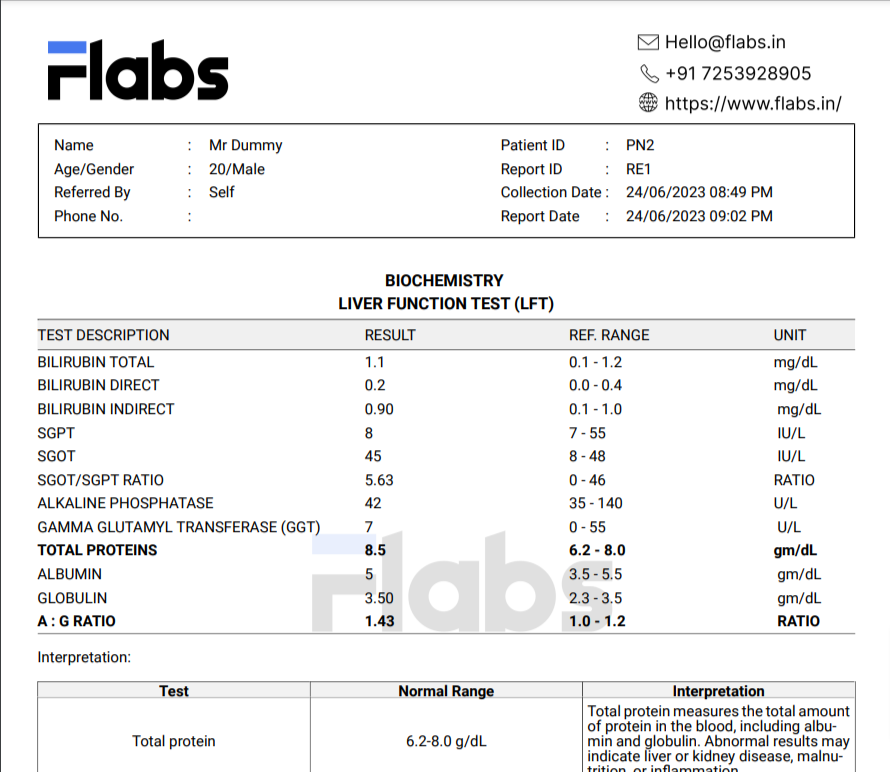
Liver Function Test Report PDF
You can download the Liver Function test sample report in PDF format from the link below. It gives an overview of liver function test report formatting.

Tips for an Effective Liver Function Test Report Format
Use consistent format throughout.
Use simple and clear language.
Add Glossary.
Be detailed in descriptions.
Use Scientific fonts like (Arial, Times New Roman, Calson, Baskerville, Georgia, Garamond,etc)
Label every diagram and visual aid used.
Simplify Your Pathology Reporting
Generate standardized liver function test reports quickly with our Pathology Reporting Software. Designed for diagnostic laboratories, it streamlines report creation, improves accuracy, and enhances workflow efficiency.
Primary Liver Function Tests
There are five primary liver function tests for different purposes. However, the overall liver function test report format will be the same for all the tests.
- Liver Enzymes Test: When your liver is damaged, certain enzymes such as ALP, ALT, AST, and GGT in your blood may rise.
- Total Protein Test: Checks the amount of protein in your blood, which is made by your liver. If protein levels are low, your liver might not be working right
- Bilirubin Levels: Bilirubin is a byproduct that liver puts into bile, and its levels help assess liver health.
- LDH Levels: LDH is an enzyme in your liver and other parts of your body, and its levels can offer clues about liver health.
- PT Blood Clotting Test: The liver helps make blood clotting proteins, so this test can show if your liver is doing the job properly.
How Liver Function Testing is Done
A liver function test is to check for protein and enzyme levels like Bilirubin, ALT and AST . Comparing various enzyme or protein amounts helps with assessing a patient’s liver's health.
Before the Test
You can get the test done at a dedicated pathology lab. A healthcare professional will choose a vein in your arm, clean that spot. A band might be necessary to make the vein more visible. A tiny needle will then be used to take some blood filling a small tube. It takes less than 10 minutes to get it all done.
After the Test
The healthcare professional who took your blood will send it to a lab for analysis in the same location or elsewhere. So the time of results can vary. If you're not dizzy from giving blood you're good to leave. You can eat some food or drink liquids after the sample is taken. Resume regular medications.
Conclusion
Accurate and standardised Liver Function Test (LFT) report formats are the linchpin for ensuring optimal patient care. Adherence to the guidelines set forth by the Indian Council of Medical Research (ICMR) streamlines the process of diagnosing and treating liver-related ailments. A properly structured LFT report not only aids physicians in making informed decisions but also supports the continuous advancement of liver health management.
Medical professionals must embrace these tenets, ensuring every LFT report generated is a tool of precision—clear, comprehensive, and ultimately conducive to the well-being of the patients.
Explore More Pathology Report Formats
Need report formats for additional laboratory tests? Visit our Pathology Report Format resource to find professionally structured templates and reporting formats for various pathology investigations.
Related reading- Liver Cirrhosis Pathology and Serum AFP Test
Get Started at ₹1!
Try Flabs for a full month for just ₹1.
Follow us on