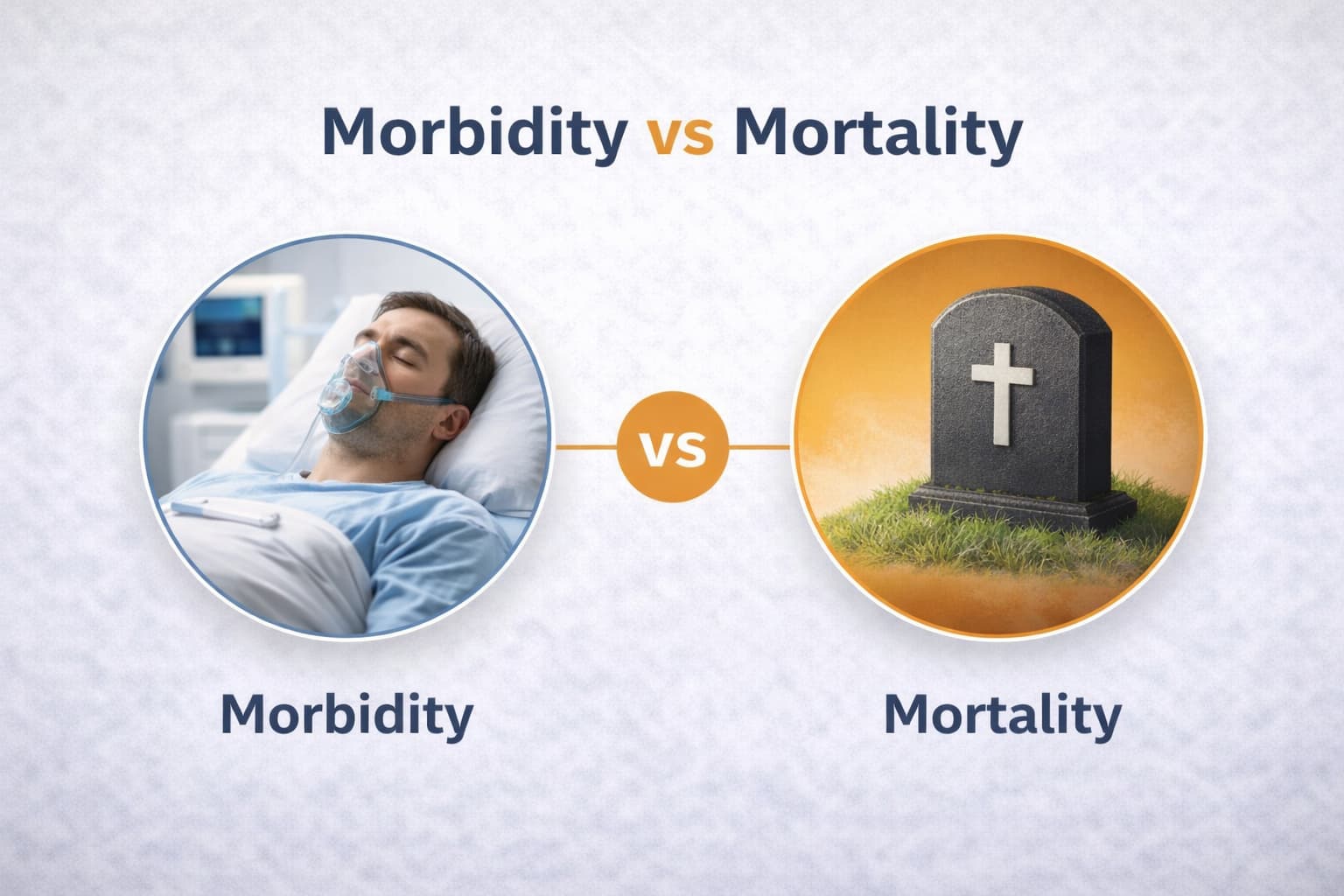
As healthcare professionals, you encounter the terms morbidity vs mortality in reports, dashboards, tumour boards, and research abstracts every day. The two sound similar, yet they capture very different aspects of disease burden. Misinterpreting them can skew study interpretation, quality metrics, and even resource allocation.
For pathologists and other clinicians involved in diagnostics, reporting, and data entry, clarity around morbidity and mortality shapes many aspects.
Below, we’ll walk through the meaning of morbidity and mortality, how each is measured, where confusion creeps in, and how digital platforms can support more accurate, real-time insights.
Morbidity vs Mortality in Practice
| Aspect | Morbidity | Mortality |
|---|---|---|
| Core concept | Presence of disease, impairment, or complication | Death as an endpoint |
| Unit of measure | Cases, episodes, severity scores | Deaths, death rates, case fatality |
| Common metrics | Incidence, prevalence, years lived with disability (YLD) | All-cause and cause-specific rates, years of life lost (YLL) |
| Data sources | Clinic records, pathology reports, imaging, pharmacy data | Death certificates, autopsy reports, registries |
| Time focus | Living with disease (short- or long-term) | Time and cause of death |
| Impact on health systems | Drives demand for services, chronic care, and rehabilitation | Influences survival analyses, resource allocation, and public-health policy |
| Example in oncology | Number of patients living with stage II colon cancer | Colon cancer deaths per 100,000 population per year |
Why the Distinction Matters
Epidemiology, quality improvement, and health systems rely on a shared vocabulary. When teams talk about the difference between morbidity and mortality, they are really talking about two linked but distinct questions:
- Who is living with disease, impairment, or complications?
- Who is dying, and from which causes or conditions?
For pathologists, coding and reporting feed directly into both dimensions. Misclassification in a pathology report, cancer registry, or LIS can affect national estimates of measures of morbidity and mortality, skewing trends for years.
Morbidity: Living with Disease or Impairment
Morbidity refers to the presence of disease, disorder, injury, or any state of ill health in an individual or population. It may be:
Acute– such as a respiratory infection.
Chronic– such as diabetes, COPD, or rheumatoid arthritis.
Complication-driven– such as chemotherapy-induced neuropathy or surgical site infection.
In population health, morbidity is often summarised using:
- Incidence– new cases in a defined period.
- Prevalence– total existing cases at a point in time or over a period.
- Severity metrics– such as disability weights or functional scores.
From a pathology perspective, every coded diagnosis, biomarker, or staging report contributes to the morbidity profile: who is living with cancer, autoimmune disease, chronic infection, or organ damage.
Mortality
Mortality refers to death within a defined population and time period. It deals with:
Death counts– total number of deaths.
Mortality rates– deaths per 1,000 or 100,000 people per year.
Cause-specific mortality– deaths attributed to a particular disease.
Common measures include:
- All-cause mortality rate
- Cause-specific mortality rate
- Case fatality rate– proportion of people with a given disease who die from it within a set timeframe.
For pathologists, cause-of-death certification, autopsy reports, and cancer registry submissions influence how mortality is recorded and analysed.
So, morbidity vs mortality, which is important?
Both dimensions are needed for a realistic view of disease burden.
A condition can have high morbidity with low mortality (for example, osteoarthritis) or high mortality despite relatively lower prevalence (for example, aggressive pancreatic cancer).
Morbidity and Mortality in Epidemiology
In research and public-health reporting, measures of morbidity and mortality frequently appear together.
- Incidence rate: number of new cases of a disease per population at risk over a specified period.
- Prevalence proportion: Proportion of a population living with a disease at a specific time.
- Years Lived with Disability (YLD): It combines prevalence with severity weights to reflect non-fatal health loss.
- Mortality rate: Deaths per population in a defined period, sometimes age-standardised.
- Years of Life Lost (YLL): It captures premature death by weighting deaths at younger ages more heavily.
- Disability-Adjusted Life Years (DALYs): Sum of YLD and YLL, integrating morbidity and mortality into a single indicator.
Maternal, Child, and Perinatal Indicators
Few areas highlight morbidity and mortality more starkly than maternal and paediatric health.
Maternal Morbidity and Mortality Rate
- Maternal morbidity includes complications during pregnancy, delivery, and the postpartum period, such as pre-eclampsia, haemorrhage, sepsis, or cardiomyopathy.
- Maternal mortality rate usually expresses maternal deaths per 100,000 live births.
The phrase maternal morbidity and mortality rate often appears in quality reports or WHO documentation as shorthand for a bundle of indicators assessing the safety of maternity care.
Child Morbidity and Mortality Rate
- Child morbidity covers infectious diseases, malnutrition, congenital anomalies, injuries, and emerging chronic diseases in children.
- Child mortality rate (such as under-five mortality) counts deaths per 1,000 live births.
Together, child morbidity and mortality rates guide vaccination, nutrition programmes, and injury-prevention strategies.
Perinatal Morbidity and Mortality
Perinatal morbidity and mortality focus on the period shortly before and after birth, usually spanning late pregnancy through the first week of life.
- Severe neonatal complications (e.g., hypoxic-ischaemic encephalopathy).
- Stillbirth rate.
- Early neonatal death rate.
Laboratory and pathology data are integral: placental histopathology, autopsy findings, and metabolic screening all contribute to perinatal audits and surveillance.
Cardiovascular Morbidity and Mortality
Cardiovascular disease illustrates how morbidity and mortality interact.
Cardiovascular morbidity includes angina, myocardial infarction survivors, heart failure, stroke survivors, peripheral arterial disease, and procedural complications.
Cardiovascular mortality includes deaths from myocardial infarction, heart failure, arrhythmia, stroke, and sudden cardiac death.
An ageing population may show rising cardiovascular morbidity and mortality driven by risk-factor profiles, treatment patterns, and social determinants. Pathology inputs such as troponin assays, lipid panels, biopsy results, and autopsy reports feed into registries that quantify both disease burden and fatal outcomes.
For clinicians and health systems, the meaning of mortality and morbidity in cardiology translates to very practical questions.
- Are more patients surviving acute events but living with heart failure?
- Are rates of sudden cardiac death changing after the introduction of new therapies?
- How do subgroups differ by sex, age, or comorbidities?
Closing Perspective
Distinguishing between morbidity vs mortality ensures clarity in medical communication and research. While morbidity describes the illness burden within a population, mortality tracks the loss of life. Both metrics provide essential insights into public health.
For professionals in pathology and healthcare administration, correct usage of terms supports better data integrity. In the medical field, the ability to track, analyse, and interpret statistics is a fundamental skill for improving standards in healthcare.
Also check - Types of Autopsy: Clinical, Forensic, and Psychological
Get Started at ₹1!
Try Flabs for a full month for just ₹1.
Follow us on