NABL accreditation rests on one thing above all else and it is not your instruments. It is your paperwork. Assessors watch your lab run, then read what you have written down. When bench reality and documentation drift apart, non-conformities follow.
Most labs underestimate the volume. A mid-sized pathology lab maintains a quality manual, dozens of procedures, and hundreds of records. Knowing the NABL documents required before you apply turns a chaotic scramble into a clean checklist. A single unsigned form can still delay a certificate by weeks.
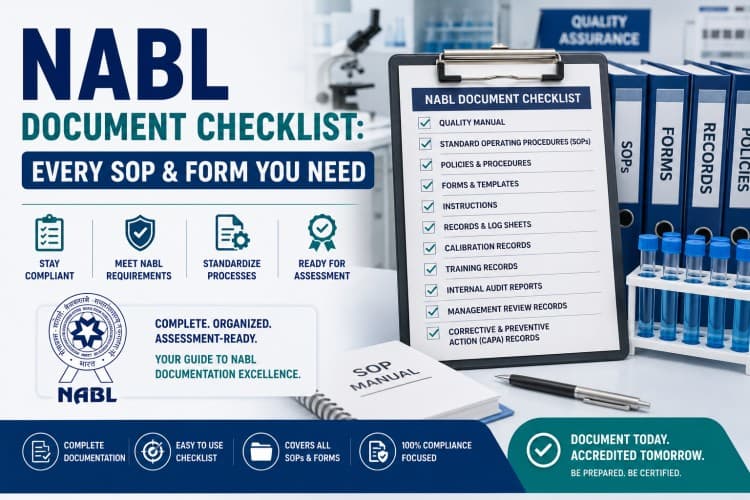
The checklist below maps every document category to ISO 15189:2022 and NABL 112A. Use it to audit your own files before an assessor does.
NABL Documents Required: The Four Levels
The NABL documents required for accreditation fall into four levels. ISO 15189:2022 expects a tiered structure, and assessors read it top to bottom. Level 1 is your quality manual. Level 2 holds your quality system procedures. Level 3 covers SOPs for every test and process. Level 4 contains the forms and records that prove the system runs each day.
| Level | Document Type | Examples | Primary Owner |
|---|---|---|---|
| 1 | Quality Manual | Scope, quality policy, objectives, org chart | Quality Manager |
| 2 | Quality System Procedures | Document control, audits, CAPA, management review | Quality Manager |
| 3 | Standard Operating Procedures | Test methods, equipment use, sample handling | Technical Heads |
| 4 | Forms and Records | QC logs, calibration records, competency files | Bench Staff |
When the four levels right, remaining NABL documents required slot neatly into place.
Your Quality Manual Sets the Direction
The quality manual anchors all other NABL-required documents. It states what your lab does, which disciplines it covers, and how the quality system meets ISO 15189:2022 alongside NABL 112A. Keep it lean. A bloated manual that nobody follows is worse than a concise one that aligns with daily practice.
Your manual should reference lower-level documents rather than repeat them. State a policy, then point to the procedure that delivers it. The quality policy, quality objectives, scope of accreditation, and organisation chart all belong here.
The Procedures and SOPs
Level 2 and Level 3 are subject to the heaviest scrutiny among the required NABL documents. Quality system procedures govern how the lab is managed. SOPs govern how each test is performed. Together, they form the bulk of the essential NABL documents an assessor requests on day one.
Many labs build these from scratch and stumble on consistency. Well-structured NABL SOP templates fix that. They lock formatting, version control, and approval fields, so every procedure looks and behaves the same way.
A solid set of procedures should cover the following at a minimum.
- Document and record control.
- Internal audit and management review.
- Corrective and preventive action (CAPA).
- Risk assessment and opportunity management.
- Equipment calibration and maintenance.
- Reagent and consumable management.
- Sample collection, transport, acceptance, and rejection.
- Internal quality control and external quality assessment.
- Result reporting, alert-value notification, and report release.
- Complaint handling and referral laboratory management.
Every SOP needs a version number, an approval signature, and a revision history. Assessors check those fields before they read a word of content.
Records and Forms
Procedures describe intent. Records prove it happened. The NABL documents required at the record level are where many applications wobble. Because a clean record trail across months is harder than a single well-written SOP.
- Internal quality control charts and Levey-Jennings plots.
- Equipment calibration and preventive maintenance logs.
- Temperature records for fridges, freezers, and rooms.
- Reagent lot verification and stock registers.
- Staff competency assessment and training records.
- Internal audit reports with evidence of CAPA closure.
- Proficiency testing and EQA participation records.
- Biomedical waste handling logs.
These records must be traceable, dated, and signed. A QC log with gaps tells an assessor more than any polished manual.
Who Is Allowed to Sign Your Reports
NABL treats authorised signatories with care. The NABL documents for authorised signatory cover qualifications, the exact scope each person may sign for, and proof of competence. Vague signatory records are a frequent source of findings. The NABL documents required here are small in number but high in weight.
- A current CV with qualifications and experience.
- A signed authorisation letter defining the scope.
- Competency assessment records for the relevant discipline.
- A specimen signature on file.
Match every signatory to the disciplines in your scope. A biochemistry signatory cannot validate a histopathology report, and an assessor will test that line.
Application Forms and the Specific Criteria
Beyond your internal system, NABL needs its own forms. Medical labs apply through NABL 153, the application form for medical testing laboratories. Your scope of accreditation, fee details, and quality manual are included with it.
Read NABL 112A closely. It sets the specific criteria for medical laboratories and works hand in hand with ISO 15189:2022. Treat the NABL 112 checklist as a gap-analysis tool. Walk each clause, then confirm you hold a matching document or record. NABL 112B provides guidance that clarifies grey areas.
The NABL documents required for laboratory registration also include proof of legal identity, biomedical waste authorisation, and calibration certificates from traceable sources. Source them early. External paperwork takes longer to arrive than internal SOPs.
From Paper Chaos to Audit-Ready
Maintaining the full set by hand is where labs lose time. Version control slips. A signature gets missed. A record lingers in a drawer instead of a file, and surfaces only when an assessor asks.
A laboratory information system removes most of that risk. Flabs LIS, trusted by 2000+ NABL labs, centralises pathology operations with intelligent automation and end-to-end management.
Automated QC keeps control data structured and retrievable. AI-powered reporting, including AI interpretation, smart reports, an AI flagger, and voice reporting, reduces manual entry and the errors that accompany it.
When every record carries a timestamp and an audit trail, assessment day stops being a scramble.
Your Pre-Assessment Checklist
- Quality manual aligned to ISO 15189:2022 and NABL 112A.
- A complete set of quality system procedures.
- SOPs for every test in your scope.
- Signed, version-controlled records for QC, calibration, and training.
- Authorised signatory files matched to the scope.
- NABL 153 application with legal and waste documents attached.
Tick every box and your assessment begins from a position of strength. The NABL documents required for accreditation are extensive, yet finite. Map them once, maintain them well, and keep the NABL documents required visible to the whole team. The certificate follows the discipline.
Related read - NABL Accreditation for Pathology Labs
Get Started at ₹1!
Try Flabs for a full month for just ₹1.
Follow us on