If you work in a microbiology lab, you already know that anaerobic infections can turn fatal fast. They have a crude mortality rate of around 30%. Among the culprits, Clostridium perfringens is near the top of the list.
It is responsible for gas gangrene, food poisoning, and necrotising infections. Identifying it quickly matters. That's where Nagler's test earns its place in diagnostics and healthcare.
What Is Nagler's Test?
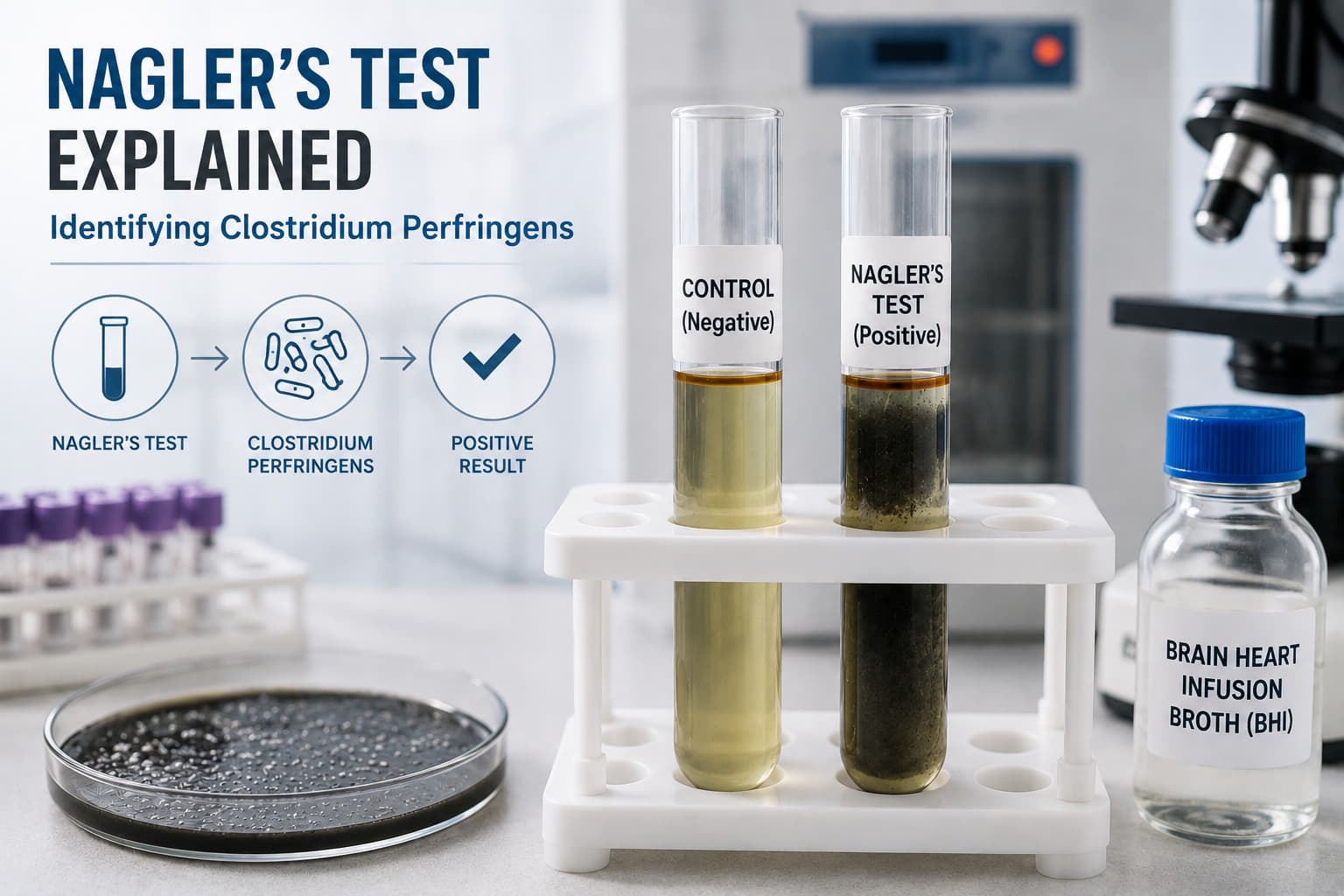
Nagler's test is a biochemical test used to detect Clostridium perfringens based on its ability to produce alpha-toxin, a lecithinase enzyme. When this organism is cultured on egg yolk agar (EYA), the alpha-toxin breaks down lecithin in the medium, producing a white, opaque precipitate around the colonies. This opalescence confirms lecithinase activity.
The test gets its specificity from the use of C. perfringens antitoxin. One-half of the egg yolk agar plate is pre-treated with Nagler test antitoxin, while the other half serves as the control. On the antitoxin side, the reaction is inhibited, with no opalescence. On the untreated side, opalescence appears. This inhibition pattern is the definitive read.
Because the antitoxin neutralises the effect on one side, the Nagler reaction is an example of neutralisation: a principle that differentiates it from generic lecithinase detection and makes it organism-specific.
Nagler's Test Principle
The Nagler's test principle is grounded in enzyme activity and immune inhibition.
C. perfringens secretes alpha-toxin (phospholipase C), which hydrolyses lecithin (a phospholipid) in the egg yolk agar (EYA) into diglycerides and phosphocholine. This hydrolysis produces visible turbidity or a white precipitate. When the specific antitoxin is applied to one side of the plate beforehand, it binds and neutralises the alpha-toxin, blocking lecithin breakdown on that half.
Preparing EYA Base (1000 mL)
Dissolve 75.1 g of Egg Yolk Agar Base in 900 mL of distilled water using a conical flask or glass bottle. Mix thoroughly and heat with stirring until the medium boils and all components, including agar, are completely dissolved. Sterilise the medium by autoclaving at 121°C (15 psi) for 15 minutes, then allow it to cool to 40–45°C.
Once cooled, aseptically add 100 mL of sterile egg yolk emulsion (prepared in a 1:1 ratio with distilled water) to the base. Mix well to ensure uniform distribution, then pour approximately 25 mL into sterile petri plates and allow the medium to solidify at room temperature.
EYA Composition (per 1000 mL)
| Component | Quantity (per 1000 mL) |
|---|---|
| Agar | 25.00 g |
| Proteose peptone | 40.00 g |
| Glucose (Dextrose) | 2.00 g |
| Magnesium sulfate | 0.10 g |
| Disodium hydrogen phosphate | 5.00 g |
| Hemin | 0.005 g |
| Sodium chloride | 2.00 g |
| Potassium dihydrogen phosphate | 1.00 g |
Final pH: 7.6 ± 0.2 at 25°C
So, Nagler reaction test principle = lecithinase production + antitoxin inhibition = organism-specific identification.
Step-by-Step Nagler's Test Procedure
1. Prepare the plate. Use Nagler's medium (egg yolk agar). Apply a few drops of C. perfringens antitoxin to one half of the plate. Spread it evenly. Allow it to absorb for 30 minutes.
2. Inoculate. Using a straight wire, streak the suspected culture across the entire plate from the antitoxin-treated to the untreated side. The streak must cross both halves.
3. Incubate anaerobically. Place the plate in an anaerobic jar or anaerobic chamber. Incubate at 37°C for 24-48 hours.
Consider the following specifics for the best results.
- Incubate Bacillus spp., Gram-positive rods, and anaerobes at 35°C.
- Incubate non-glucose-fermenting Gram-negative rods (except P. aeruginosa) at 25°C.
- Incubate glucose-fermenting Gram-negative rods, including P. aeruginosa, at 30°C.
4. Read the result. Examine for opalescence. It is the pearly, opaque zone around the colonies.
One practical note: Strict anaerobic conditions are imperative here. C. perfringens is an obligate anaerobe, and aerobic or microaerophilic incubation will ruin the result.
How to Read Nagler's Test Results
| Side of Plate | Antitoxin Present | Opalescence | Interpretation |
|---|---|---|---|
| Treated half | Yes | Absent (inhibited) | Alpha-toxin neutralised |
| Untreated half | No | Present | Alpha-toxin active |
| Both halves— opalescence present | No | Present on both | Not C. perfringens (other lecithinase producers) |
| No opalescence on either side | — | Absent | Lecithinase-negative organism |
A positive Nagler's test: Opalescence (or halo) on the untreated side only, with clear inhibition on the antitoxin side. The pattern is specific to C. perfringens.
A negative Nagler's test: No opalescence (or halo) on either side. Other organisms like C. bifermentans and C. sordellii produce lecithinase but are not inhibited by the specific C. perfringens antitoxin, so you'll see opalescence on both sides, not just one.
Is Nagler's Test Direct or Indirect?
This one trips up a lot of candidates and junior technicians. Nagler test, direct or indirect?
It is a direct test. You're inoculating the clinical isolate directly onto the Nagler medium and reading its enzymatic activity. There's no prior extraction, antibody labelling, or secondary reaction involved. The inhibition by antitoxin is a specificity control built into the same plate, not a two-step indirect detection method.
Which Other Organisms Produce Lecithinase?
The Nagler test for Clostridium perfringens identification works because the antitoxin is species-specific. But it's worth knowing what else can produce lecithinase.
- C. bifermentans: Lecithinase positive, not inhibited by C. perfringens antitoxin
- C. sordellii: Lecithinase positive, not inhibited
- C. novyi type A: Produces a different lecithinase (beta-toxin), not inhibited
- Bacillus cereus: Produces lecithinase on egg yolk agar (useful in food microbiology)
This is exactly why the antitoxin control is non-optional. Without it, you're just detecting lecithinase, not C. perfringens.
Turnaround Time for Nagler's Test
Turnaround time (TAT) for Nagler's test is usually 48–72 hours from sample receipt to final report.
- Anaerobic culture setup and incubation (24–48 hours).
- Colony identification and Nagler's test inoculation (additional 24 hours if done after primary culture).
- Reporting.
For pathology labs in India operating under NABL accreditation, TAT documentation is a regulatory requirement. Every step from sample registration to report dispatch needs to be timestamped and auditable. Any delay in anaerobic culture reporting can directly affect patient outcomes in suspected gas gangrene or post-surgical wound infections.
Clinical Significance: Why The Test Still Matters
In the era of MALDI-TOF and next-gen sequencing, Nagler's test is still in use. It's cost-effective. It doesn't need expensive lab equipment and gives you organism-specific identification within the same culture cycle. For labs in tier 2 and tier 3 cities across India, where advanced diagnostics may not always be accessible, it is a practical first-line identification test.
C. perfringens is the organism behind:
- Gas Gangrene (Clostridial Myonecrosis): A surgical emergency.
- Clostridial Food Poisoning: One of the most common foodborne illnesses globally.
- Necrotising Enteritis (Pig-Bel disease): Associated with type C strains
- Clostridial cellulitis and wound infections.
Limitations of the Test
- Not a confirmatory test; requires additional biochemical tests for accurate identification.
- Non-glucose-fermenting rods may produce faint halo zones.
- Lecithinase can diffuse across the plate, complicating result reading; negative results should be compared with an uninoculated control.
- Some organisms may take up to a week to show lecithinase activity.
- Certain strains of P. fluorescens show variable results (both positive and negative).
A Quick Recap
Nagler's test is a specific and accessible method for identifying C. perfringens in microbiology labs. Its principle makes the Nagler reaction test both sensitive and organism-specific. Run it right, read the inhibition pattern correctly, and you have a definitive identification without advanced equipment.
For labs under NABL accreditation, pairing accurate diagnostics with rigorous TAT management and quality documentation is non-negotiable. Your LIS should do the heavy lifting on the operational side so your pathologists can focus on what they do best.
Running the Test in a High-Volume Lab? Your LIS Has to Keep Up.
If your lab is running anaerobic cultures with Nagler's test alongside a full microbiology workload, manual tracking of TAT, report approvals, and quality checks adds up fast.
FLABS LIS for Fast-Moving Labs
FLABS is an AI-powered Lab Information System designed for the operational realities of pathology labs, including microbiology workflows with complex turnaround time requirements. It is trusted by 2000+ NABL-approved labs across India.
It is built specifically for pathology labs. It helps you to automate TAT management, flag abnormal or incomplete results, generate smart reports, and streamline communication through QR-enabled reports and instant sharing via WhatsApp, SMS, and email.
Still Managing TAT, QC, and Reports Manually?
Join 2000+ NABL-approved labs using FLABS to improve efficiency, accuracy, and reporting speed.
Activate your 5-day free trial Today.
Get Started at ₹1!
Try Flabs for a full month for just ₹1.
Follow us on