GESThe Quantiferon TB Gold Test is used in modern TB screening, for its noteworthy advantages over traditional skin tests. It can minimise false positives linked to BCG vaccination. However, Quantiferon TB Gold test result interpretation requires caution, especially in immunocompromised individuals who may not produce a robust immune response.
This test's rapid turnaround and non-invasive nature make it ideal for high-risk groups, ensuring early detection and preventing disease spread through timely intervention. But proper interpretation is not possible without considering patient history, risk factors, and additional diagnostic methods. Let's discuss more in this blog about the test.
Quantiferon TB Gold Test is used in modern TB screening, for its noteworthy advantages over traditional skin tests. It can minimise false positives linked to BCG vaccination. However, Quantiferon TB Gold test result interpretation requires caution, especially in immunocompromised individuals who may not produce a robust immune response.
This test's rapid turnaround and non-invasive nature make it ideal for high-risk groups, ensuring early detection and preventing disease spread through timely intervention. But proper interpretation is not possible without considering patient history, risk factors, and additional diagnostic methods. Let's discuss more in this blog about the test.
Quantiferon TB Gold Test
The Quantiferon TB Gold test is a blood test used to detect Mycobacterium tuberculosis by analysing immune response. It measures the release of interferon-gamma (IFN-γ) from white blood cells when exposed to TB antigens. The test helps well to identify tuberculosis infection. But it doesn't differentiate between latent and active TB.
The Quantiferon TB test is suggested for those with TB symptoms like persistent coughing, chest pain, weight loss, fever, fatigue, night sweats, or loss of appetite. It's also recommended for people exposed to TB, even if latent. You can get test results within 24 hours of sample collection.
Quantiferon TB Gold Test Procedure
The QuantiFERON-TB Gold Test involves collecting blood into three specialised tubes: a nil control, TB antigen, and mitogen control. These are incubated at 37°C for 16-24 hours, then centrifuged to separate plasma. Interferon-gamma levels are measured using ELISA. Then there's comparison of the TB antigen tube to the nil control.
A noticeable increase in the TB antigen tube indicates a positive result. The mitogen control ensures test validity. The advantage is that the Quantiferon TB Gold test result interpretation helps detect latent TB infection surpassing the limitations of traditional skin tests.
No special preparation is needed for taking the test.
Quantiferon TB Gold Test Interpretation
A positive QuantiFERON TB Gold test result indicates exposure to Mycobacterium tuberculosis, but it does not confirm active TB. It simply means the person has been exposed to the bacterium. This test cannot distinguish between active tuberculosis and latent infection. So it’s used alongside other evaluations like risk assessments, radiography, and clinical information.
Quantiferon TB Gold test result interpretation can be:
Negative (Normal): No infection detected
Positive (Abnormal): Exposure to TB detected
Indeterminate: Unclear result, requiring a retest
The test has a detection range from 1 mcg/L to 10 mcg/L with regards to blood samples. The levels between 9 and 10 mcg/L are considered within the TB Gold test normal range.
A positive result requires further evaluation by a medical professional. Additional tests may be recommended such as a chest X-ray to determine the likelihood of progressing to active TB.
The results are reported following a standard pathology report format. Your physician will use it for the Quantiferon TB Gold test result interpretation.
You can also request a TB test report sample from your laboratory or medical facility for future reference. It is imperative to keep it as part of your medical history.
Quantiferon-TB Gold Test Result Graph
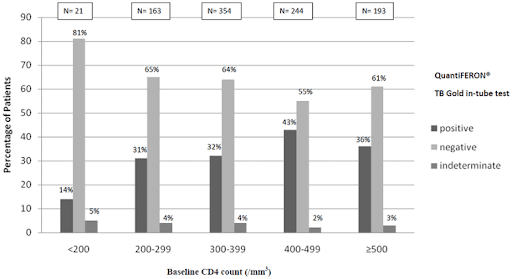
The Quantiferon-TB Gold Test result graph shows the levels of interferon-gamma (IFN-γ) released by a patient's immune cells in response to TB antigens. It is an important part of Quantiferon TB gold test result interpretation.
Quantiferon-TB Gold Test Positive Treatment
Tuberculosis (TB) treatment is often long due to the slow growth of M. tuberculosis and the time needed to kill the bacteria. For latent TB, treatment usually lasts 3-4 months, while active TB can take 4-9 months. Doctors may adjust medications during treatment if drug-resistant strains emerge. Regular checkups are needed to track progress.
Gamma interferon therapy may be used to monitor treatment effectiveness. It’s vital to take all prescribed doses to prevent resistance. Some health departments use directly observed therapy (DOT), while others provide tracking forms.
Common TB drugs include:
Isoniazid
Rifampin
Rifabutin
Pyrazinamide
Rifapentine
Ethambutol
Serious side effects are rare but report issues like stomach problems, vision changes, or fatigue to your doctor. You may need to pause certain supplements during treatment.
Quantiferon TB Gold Test vs Quantiferon TB Gold Test Plus
The Quantiferon TB Gold Test and Quantiferon TB Gold Test Plus are both interferon-gamma release assays (IGRAs) used to detect tuberculosis infection. The main difference is that the Plus version includes an additional antigen tube.
The original test uses two antigen tubes (TB1 and TB2) containing Mycobacterium tuberculosis-specific antigens. The Plus version adds a third tube (TB3) with proprietary antigens designed to elicit immune responses from CD8+ T cells, in addition to CD4+ T cells targeted by the original test.
This modification in the Plus version aims to improve sensitivity, particularly in immunocompromised individuals and young children. It may also help differentiate between latent TB infection and active TB disease.
Points to Remember
- There's a "grey zone" or borderline range (0.20-0.35 IU/mL) where results are less definitive and may require retesting.
- Severely immunocompromised patients, e.g those with AIDS, may produce false-negative results due to an inability to mount an adequate immune response.
- Some individuals may show fluctuating results over time without clear clinical explanation, necessitating cautious interpretation.
- High-altitude environments may influence test results due to potential impacts on immune cell function.
Conclusion
As we discussed, Quantiferon TB Gold test interpretation is an involved task for physicians. When interpreting results, it’s important to consider factors like recent TB exposure, immune status, and environmental conditions, such as high-altitude living, which can impact immune response. Additionally, repeat testing may be necessary for those with indeterminate results or fluctuating immune responses over time. So, knowledge of what the test entails can't be overemphasised.
Get Started at ₹1!
Try Flabs for a full month for just ₹1.
Follow us on