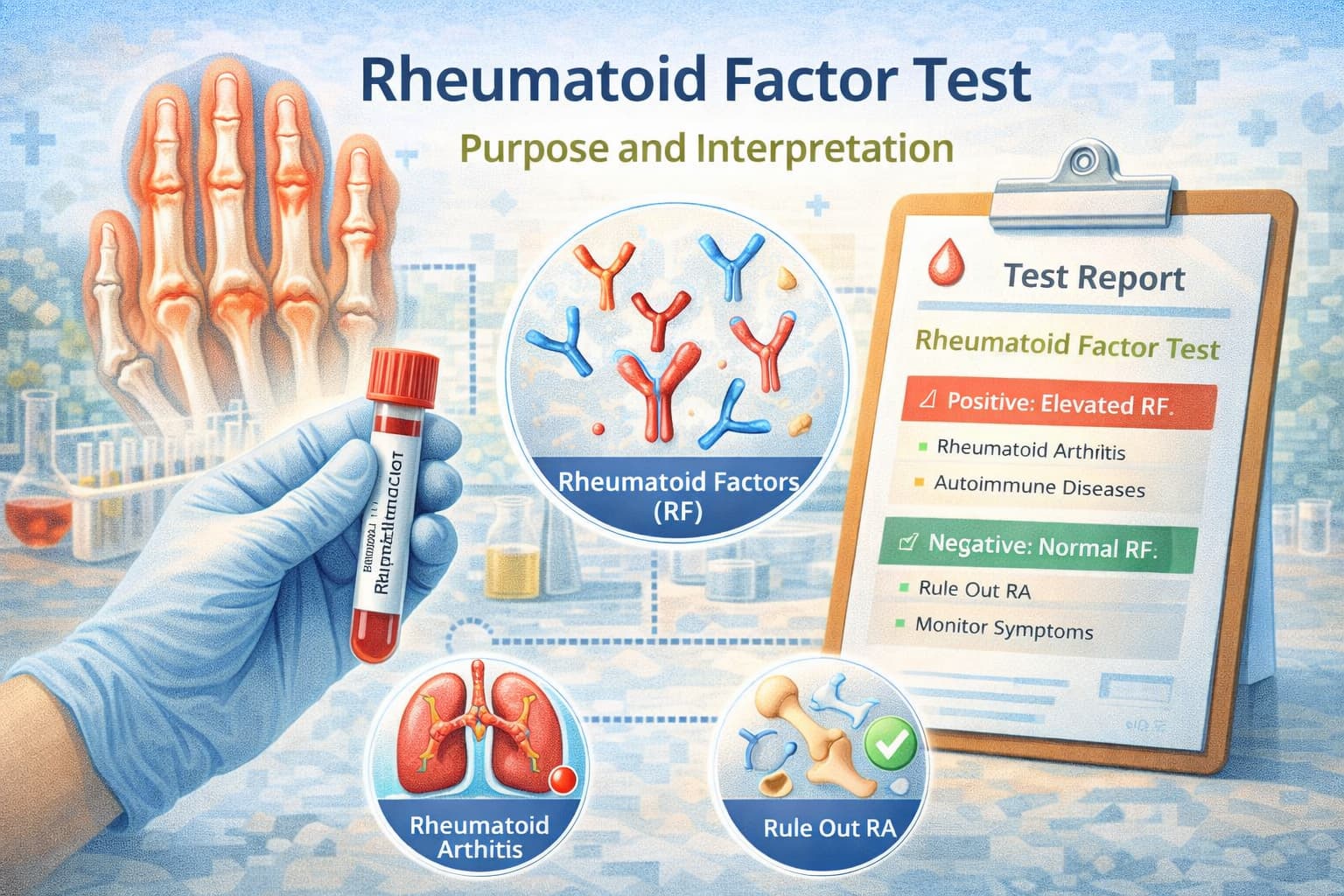
Rheumatoid arthritis (RA) continues to challenge pathology teams with its variable presentation and progressive nature. Around 80% of patients with RA show elevated RF titers. It reinforces the relevance of the rheumatoid factor test in diagnostics across pathology labs in India.
With rising autoimmune cases and increased demand for accurate, timely reporting, a structured approach to RF testing has become essential for laboratories aiming for precision, efficiency, and consistent turnaround time.
The sections below present a clear, professional breakdown aimed at pathologists and healthcare professionals, covering purpose, methodology, interpretation, reporting considerations, laboratory workflow improvements, and how modern AI-powered LIS solutions streamline RF testing and reporting.
The Rheumatoid Factor Test in Clinical Practice
The rheumatoid factor test detects autoantibodies directed against the Fc portion of IgG. These autoantibodies are associated with RA but are also seen in other autoimmune, infectious, and inflammatory conditions. In pathology labs, RF test is recommended as the main part of the diagnostic panel when clinicians suspect autoimmune joint disease.
RF antibodies belong to IgM, IgG, and IgA classes, with IgM RF being the most routinely assessed in standard laboratory workflows. Elevated titers contribute to disease classification, prognosis, and monitoring progression.
Purpose of the RF Test
Diagnostic Value: The test for rheumatoid arthritis factor supports early detection. While RF positivity alone does not confirm RA, in conjunction with symptoms, imaging, and other serological markers (e.g., anti-CCP), it strengthens diagnostic confidence.
Prognostic: High RF titers may align with severe disease, extra-articular involvement, and accelerated joint damage. Clinicians frequently use longitudinal RF values to understand disease trajectory.
Clinical Differentiation: The presence of RF distinguishes RA from other arthropathies. Elevated RF titers may also be observed in chronic infections, liver disease, and certain malignancies.
Principle, Procedure, and Technical Aspects
The rheumatoid factor test principle and procedure vary based on methodology. Most pathology labs in India conduct RF testing using the following.
| Method | Core Principle | Clinical Utility |
|---|---|---|
| Latex Agglutination | Visible clumping indicates RF–IgG interaction. | Quick screening, widely used in mid-volume labs. |
| Nephelometry | Measures light scatter from immune complexes. | Highly scalable, suited for laboratories requiring low TAT. |
| ELISA | Detects specific RF isotypes. | High sensitivity and specificity for IgM RF. |
The rheumatoid factor test procedure usually includes the following steps.
- Sample collection (serum preferred).
- Calibration and reagent validation.
- Running the assay based on the laboratory’s rheumatoid factor test protocol.
- Quality control verification.
- Reporting through the laboratory’s information system.
Interpretation of RF Results
Understanding rheumatoid factor test results requires careful consideration of titer values, assay method, patient symptoms, and comorbidities.
| Parameter | Rheumatoid Factor Test Range | Interpretation |
|---|---|---|
| Normal | As per method-specific rheumatoid factor blood test normal range (commonly <20–30 IU/mL) | Low probability of RA, but seronegative RA still possible. |
| Borderline | Slightly above reference interval | Could indicate early RA or non-RA inflammatory conditions. |
| Elevated | Markedly increased levels | Stronger association with RA, particularly in symptomatic individuals. |
Factors Influencing Interpretation
- Age-related increase in RF
- Chronic infection
- Viral illness
- Other autoimmune disorders
Elevated vs. Normal RF
| Clinical Scenario | RF Levels | Pathology Insight |
|---|---|---|
| Highly symptomatic RA patient | Elevated | Suggests aggressive disease and possible extra-articular involvement. |
| RF-negative but symptomatic | Normal | Consider anti-CCP and ANA panels. Seronegative RA remains a significant subgroup. |
| Elevated RF without arthritic symptoms | Elevated | Evaluate for infections, liver disease, or mixed connective tissue disorders. |
Reporting Test Findings
A structured pathology report format enhances clarity for clinicians. The general report format includes the following.
- Method used (e.g., nephelometry, latex agglutination)
- Rheumatoid factor blood test range
- Flagged abnormal values
- Comments indicating clinical correlation needs
- Reference to additional markers if warranted
The rheumatoid factor test report should highlight Test reliability, QC status, and any limitations.
Challenges in Testing
- High patient load.
- Delays due to manual data entry.
- Variations in sample handling.
- Difficulty tracking rheumatoid factor blood test levels in real time.
- Demand for swift, accurate reports by clinicians and patients.
A modern LIS addresses these pain points through automated workflows, centralised data management, and AI-backed interpretation modules.
How FLABS LIS Strengthens Testing and Reporting
Laboratories adopting Flabs LIS gain an integrated environment for the entire RF testing lifecycle, from registration to final report sharing.
AI-Powered Efficiency
- AI Interpretation for structured reading of rheumatoid arthritis ra factor test results.
- AI Test Suggestion assisting clinicians and technicians with complementary panels.
- AI Smart Report for polished, error-resistant reports.
- AI Assistant supporting every operational step.
- AI Flagger highlighting critical rheumatoid factor test results instantly.
Process Automation
- TAT Management: Track every RF test in real time.
- Bulk Actions: Bulk registration, approval, invoicing, and report downloads.
- Quality Control: Integrated QC ensures assay reliability before report release.
- AI Voice Reporting: For pathologists dictating complex interpretations during RA assessments.
Reporting and Security
- Customisable patient details
- Flexible test parameter formatting
- Dynamic QR codes for secure report access
- Barcode-enabled tracking for every sample
- Interpretation templates that align with lab standards
- Multiple digital signatures for pathologists and specialists
Administration and Growth Tools
- Lab Finance Management for automated billing and audit-friendly data
- Multiple Referral Management enabling transparency across clinician partnerships
Selecting the Right Test Kit and Method
Laboratories consider factors such as volume, desired sensitivity, automation compatibility, and reporting infrastructure. When integrating a rheumatoid factor test kit, labs must evaluate the following.
- Calibration stability
- Analyser compatibility
- QC requirements
- Batch-to-batch consistency
Flabs LIS supports diverse analyser integrations, reducing delays and manual interventions.
Conclusion
The rheumatoid factor test is indispensable for pathologists evaluating RA and related autoimmune conditions. However, clear interpretation, standardised procedures, and reliable reporting are fundamental for delivering actionable insights.
Flabs LIS brings together AI-driven intelligence, robust QC, automated workflows, and advanced report customisation. It equips pathology labs in India to deliver consistent, accurate, and timely RF testing outcomes.
Ready to upgrade your lab operations?
Related - Rheumatoid Arthritis Test: Diagnosis and Types
Get Started at ₹1!
Try Flabs for a full month for just ₹1.
Follow us on